How-To Guides
How to Secure a Detached Garage or ADU in San Diego
Key Takeaways
- Most home alarm systems do not cover detached garages or ADUs - additional sensors or a standalone system are required to close that gap.
- Physical door hardware - reinforced strike plates, slide bolts, and smart locks - is the first and most cost-effective security layer for any detached structure.
- Camera placement should cover approach angles and alley access, not just the door itself, especially for alley-access properties in North Park, South Park, and Mid-City San Diego.
- Wired cameras are more reliable than wireless for detached structures, but stucco construction in older San Diego neighborhoods often requires a hardwired ethernet solution to maintain signal strength.
- A standalone cellular alarm system gives ADU tenants independent coverage that does not depend on the landlord's panel or home internet connection.
- Motion-activated lighting combined with camera motion zones creates a layered deterrent that eliminates dark approach paths around detached garages and ADUs.
- San Diego's coastal marine layer affects infrared night vision cameras - color night vision cameras using ambient light perform better near Ocean Beach, La Jolla, and Point Loma.
- Most wireless and battery-powered security installations on detached garages do not require a permit, but any work involving new electrical circuits or wall penetrations may require approval through the City of San Diego Development Services Department.
In This Article
A homeowner in North Park finished building a new ADU in the back of their lot last spring. They spent months on permits, construction, and getting the unit ready for a tenant. Then, two weeks after move-in, someone broke into the detached garage next to it and walked off with two e-bikes, a set of power tools, and a surfboard. The main house alarm never made a sound. The detached structure had no sensors, no cameras, and a side door with a lock that took about thirty seconds to kick open.
That story is not unusual. San Diego's ADU boom has created thousands of new detached structures across the city, and the majority of them have little to no real security coverage. This article covers the specific risks detached garages and ADUs face in San Diego, the physical and electronic layers that actually work, and how Smart Shield Systems helps local homeowners close those gaps every day - from Chula Vista to Clairemont and everywhere in between.
Whether a homeowner is renting out a backyard unit in City Heights, storing tools in an older garage in Kensington, or just trying to protect a guest house in Mission Hills, the right approach looks different for a detached structure than it does for the main home. Here is what to know.
Why Detached Garages and ADUs in San Diego Are Targeted More Than You Think
A detached garage or ADU sits away from the main living space. That physical distance is exactly what makes it attractive to a burglar. There is no one sleeping twenty feet away, no motion sensor in the hallway that trips when someone forces a door, and often no light at all after dark. The structure is on its own.
San Diego property crime data consistently shows that detached structures - garages, sheds, and accessory units - are burglarized at higher rates than attached garages. The reason is simple: they are easier to approach without being seen or heard. Neighborhoods like City Heights, Mid-City, and Southeast San Diego have seen an uptick in detached garage break-ins that tracks almost directly with the rise in ADU construction in those areas.
The detached structure problem is not just about location. It is about the security gap between what a homeowner thinks is covered and what actually is. Most people assume their alarm system, if they have one, covers the whole property. It almost never does without extra work.
How San Diego's ADU Boom Created New Security Gaps
Since 2020, the City of San Diego Development Services Department has processed more ADU permits than in the previous decade combined. State law changes made it faster and cheaper to build, and homeowners across San Diego moved quickly to add rental income. The construction pace was fast, and security was rarely part of the conversation.
Most of these ADUs were built quickly using prefab or standard construction and were never wired into the existing home alarm. Electricians ran power. Plumbers ran water. Nobody ran alarm wire or camera conduit. The new structure went up as a clean slate with zero security infrastructure - and that is how it stayed.
These are soft targets. A burglar casing a block in City Heights or Logan Heights can spot an unlit, unwired ADU in seconds. No cameras. No sensor contacts on the door frame. No alarm panel visible inside. That structure becomes the easiest option on the street.
Neighborhoods Where Detached Structure Theft Is a Known Problem
Our team gets more calls about detached garage and ADU break-ins from a handful of San Diego neighborhoods than anywhere else. Logan Heights, Normal Heights, and properties along El Cajon Boulevard come up constantly. Alley-access properties in North Park and South Park are especially common because the rear entry points are invisible from the street and rarely have any camera coverage.
The alley grid through North Park - running parallel to 30th Street, Adams Avenue, and Upas Street - gives someone on foot multiple ways to approach a detached garage from behind without ever walking past the front door. That rear access is a real problem for San Diego homeowners who only think about front-door security.
University Heights and Kensington have a slightly different issue: older detached garages with wood doors, outdated hardware, and no power run except a single light circuit. These structures are not just easy to break into - they are hard to secure after the fact because the infrastructure is not there yet.
What Burglars Are Actually After in These Structures
Power tools top the list. A garage in Normal Heights or City Heights can hold thousands of dollars in Dewalt or Milwaukee tools that take five minutes to load into a truck. E-bikes are a close second - they are expensive, portable, and easy to resell. Surfboards, mountain bikes, and camping gear are common in San Diego and show up regularly on stolen property reports.
In ADUs specifically, the targets shift. Electronics, laptops, and tenant belongings are the primary draw. ADU tenant security is a real gap - tenants often assume the landlord's system covers them, and landlords often assume the tenant has their own coverage. Neither is true in most cases.
Package theft is also growing in detached garages. Many San Diego homeowners use their garage as a delivery drop point, which makes it a known target. A burglar who knows packages arrive on weekdays and no one checks until evening has a clear window to act.
The Right Locks and Door Hardware for Detached Garages and ADUs
Before any camera or sensor matters, the physical barrier has to hold. A door that can be kicked open in one hit makes every other security layer irrelevant. The locks and hardware on a detached garage or ADU are the first real line of defense, and most detached structures in San Diego are underbuilt in this department.
Stock hardware on new ADU builds is often builder-grade - functional but not security-grade. Older detached garages are even worse. The combination of cheap locks, hollow-core doors, and shallow strike plates creates a door that is not actually protecting anything. Fixing the hardware is the fastest and most cost-effective security upgrade most homeowners can make.
Upgrading Garage Door Locks and Side Entry Points
Most garage doors - especially older roll-up doors in Kensington and University Heights - have a simple T-handle lock that can be defeated with a wire and thirty seconds of patience. Adding a heavy-duty slide bolt on the inside, or a door defender bar across the bottom track, changes that equation immediately. For side entry doors into the garage, a deadbolt with a reinforced strike plate using three-inch screws is the minimum.
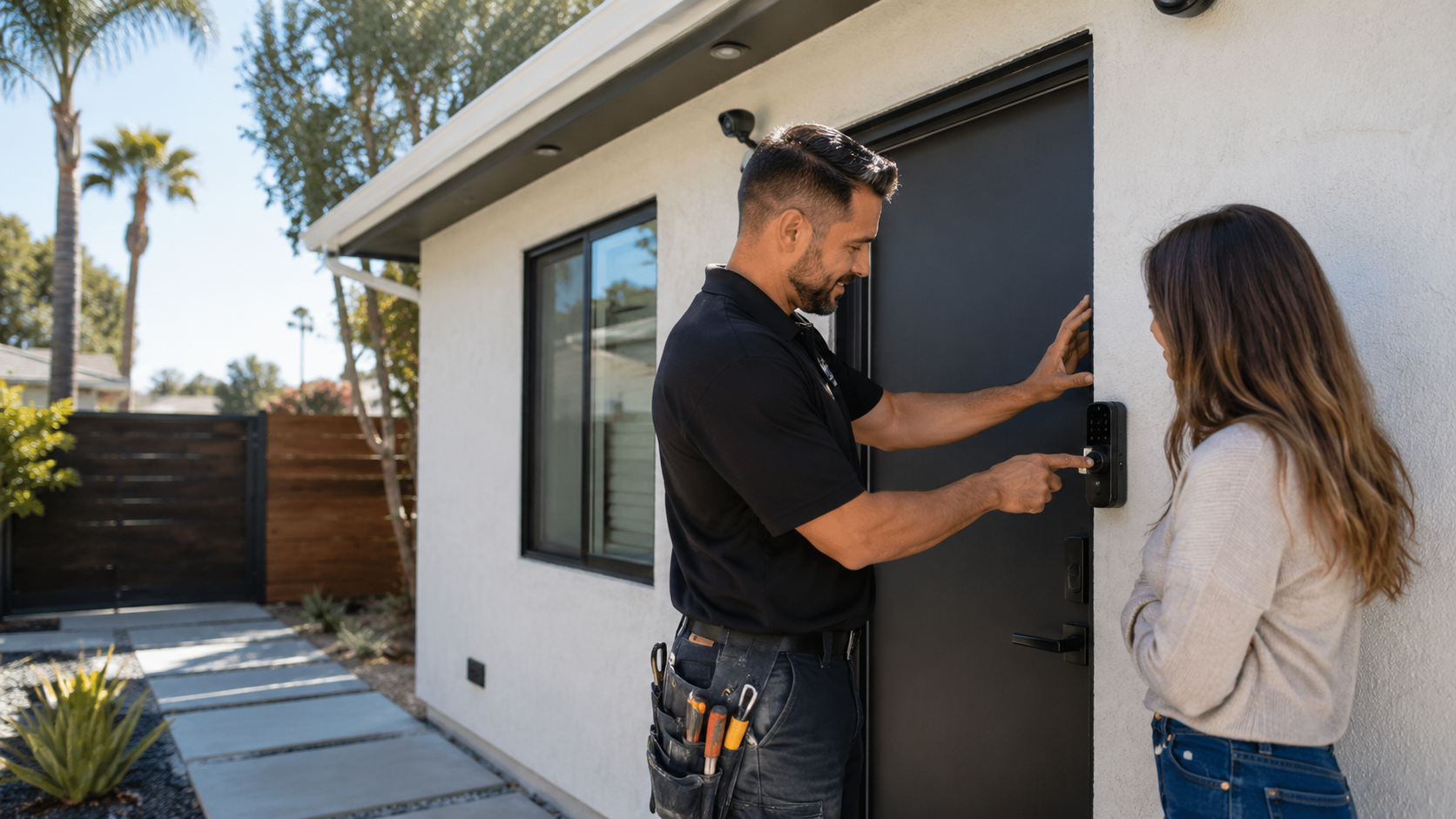
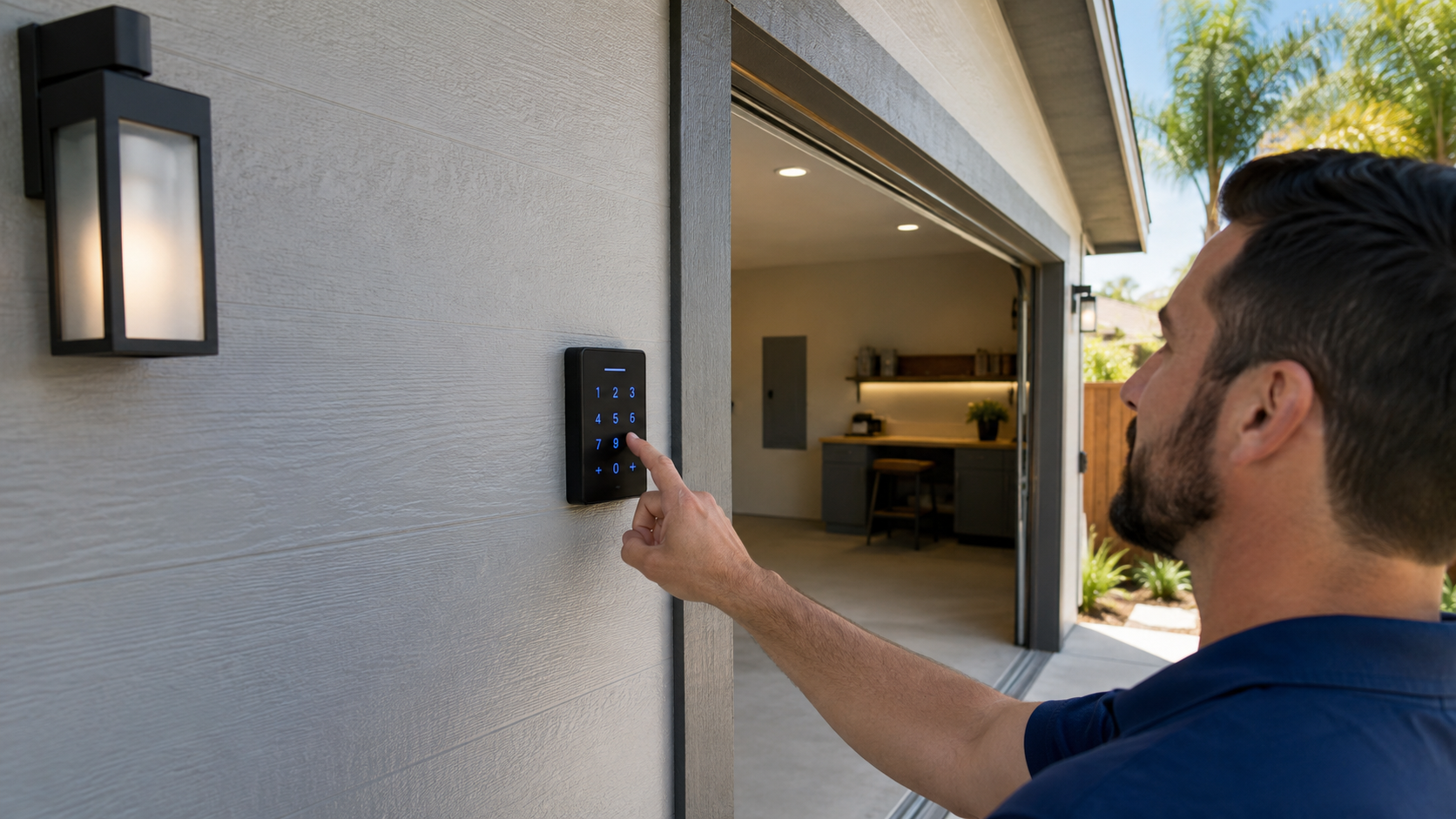
Smart locks on garage side doors are worth considering for homeowners who want to know when that door opens and who opened it. A lock that sends an app alert when the side door is accessed gives a landlord or homeowner real-time awareness without being on the property. Our team at Smart Shield Systems has installed these on dozens of detached garages from Chula Vista to Clairemont.
Older wood garage doors in San Diego's historic neighborhoods should be evaluated honestly. If the door itself is rotting or warped, no lock upgrade fully compensates. Replacement is sometimes the right answer before any electronic security makes sense.
Smart Locks for ADU Entry Doors
A smart lock on an ADU entry door solves multiple problems at once. Keypad entry eliminates the need for physical keys, which means no rekeying between tenants - a real cost and headache for San Diego landlords managing multiple units. App-controlled deadbolts let the property owner grant and revoke access remotely, which is especially useful for short-term rentals or when a tenant loses their phone.
Models that send alerts on door open and close events are particularly useful for ADUs where the landlord lives in the main house. They provide awareness without surveillance - the landlord knows when the door opened, not what the tenant is doing inside. That boundary matters legally and practically.
Temporary access codes are another feature landlords in San Diego use regularly. A maintenance worker gets a code that works from 9 a.m. to 4 p.m. on Tuesday. It expires automatically. No key to copy, no security risk after the job is done.
Reinforcing Frames, Hinges, and Sliding Doors
The lock is only as good as what it is mounted to. A deadbolt installed in a soft wood frame with a two-inch strike plate screws will not stop a hard kick. Door frame reinforcement kits - which replace the standard strike plate with a steel channel that distributes force across multiple studs - are a quick upgrade that dramatically changes how a door performs under impact.
Hinge bolts matter on doors where the hinges are exposed on the exterior. Without them, the hinge side of the door can be forced out even with a good deadbolt engaged. Some newer ADU builds in Mission Hills and Hillcrest include sliding glass doors that look clean but can be lifted off their tracks with a pry bar. A sliding door security bar, or a pin through the top track, stops that attack in about two seconds.
These physical reinforcements are low-cost, do not require permits, and work with or without an electronic system. They are the right starting point for any detached garage or ADU security plan.
Get Your Free Quote
Tell us about your property and we'll get back to you fast.
Security Camera Placement for Detached Garages and ADUs
Pointing a camera at a door is not a camera strategy. A burglar who knows a camera covers only the door will approach from the side, do their work out of frame, and leave before the footage is reviewed. Good camera placement on a detached structure covers the angles of approach - not just the point of entry.
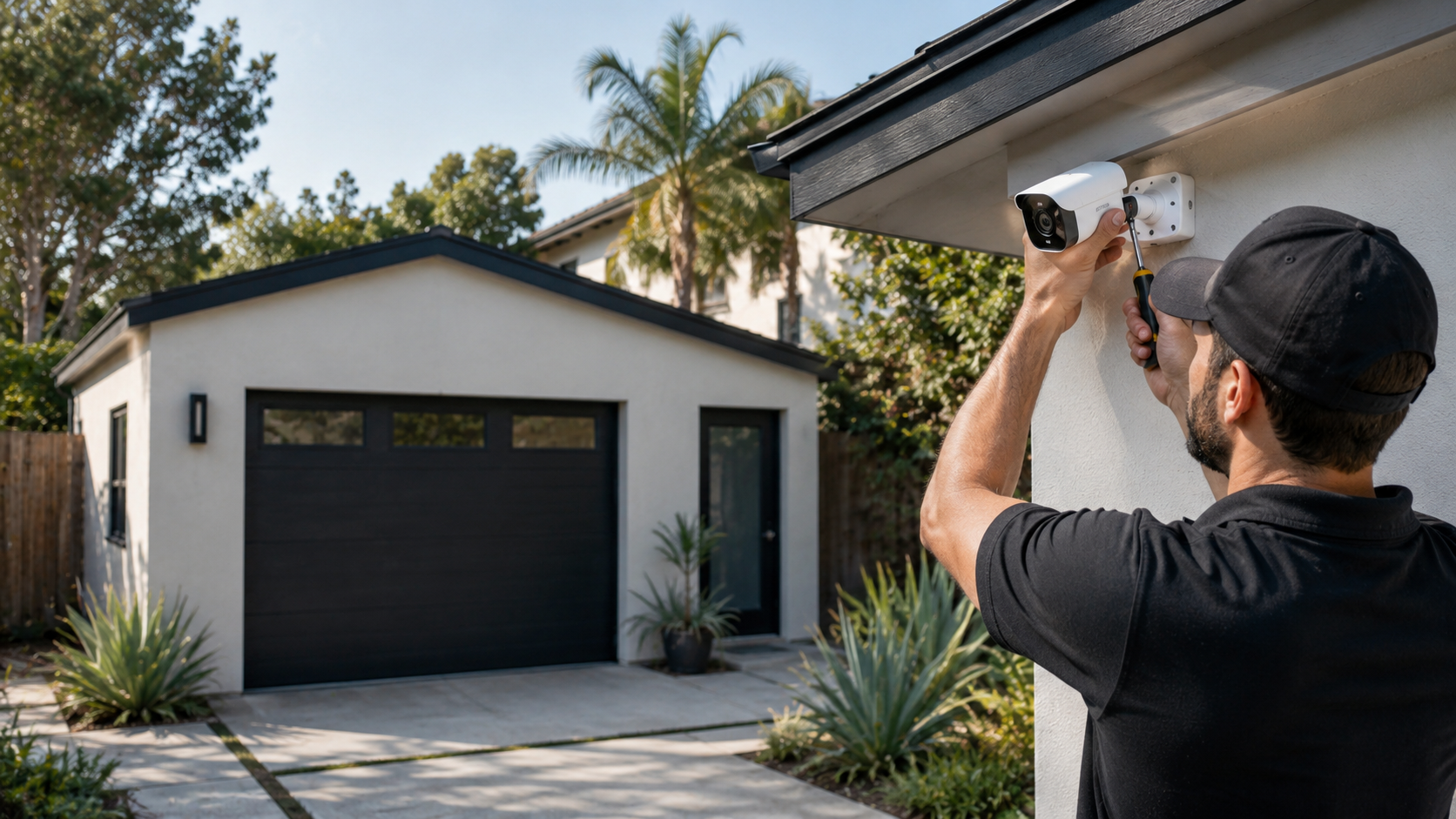
Properties in San Diego with rear alley access need a different camera strategy than corner lots. An alley-access property in North Park or South Park has multiple blind spots if cameras only face the street. The approach, the loitering, the exit - all of that happens at the back, and a camera on the front of the house captures none of it. Our team at Smart Shield Systems assesses sightlines before recommending placement, because wrong placement gives a false sense of coverage.
Covering Alley Access and Rear Entry Points
The alley grid through older San Diego neighborhoods - around 30th Street, Adams Avenue, and throughout the Mid-City alley system - is where a lot of detached garage theft actually starts. Someone walks the alley at dusk, checks for cameras, notes which garages have no coverage, and comes back later. A wide-angle or PTZ camera mounted at the rear roofline of the detached structure, aimed down the alley in both directions, closes that gap.
The goal with alley camera placement is to capture faces and identifying features, not just motion. A camera that shows a hooded figure from fifty feet away is less useful than one that captures a clear face at fifteen feet. Positioning matters as much as hardware. Our team has covered alley-access properties from Normal Heights to Logan Heights and knows where the blind spots typically fall on these lots.
For properties where the detached structure is at the far end of a long lot, a two-camera approach - one covering the alley and one covering the path between the house and the ADU - gives overlapping coverage with no dead zones in between.
Wired vs. Wireless Cameras for Detached Structures
Wireless cameras are faster to install on a detached structure that has no existing conduit. They run on battery or solar and connect to Wi-Fi, which makes them practical for a standalone garage with minimal power. The trade-off is reliability - a wireless camera is only as good as the Wi-Fi signal reaching the back of the lot, and in larger lots in areas like Tierrasanta or Scripps Ranch, that signal can be inconsistent.
Wired cameras require running conduit from the main house or from a subpanel in the detached structure. That is more work upfront, but the result is a camera that does not drop offline during a storm, does not need battery changes, and records continuously rather than only on motion events. For homeowners who want reliable, uninterrupted footage, wired is the right answer.
Many installs end up as a hybrid - wired cameras on the detached structure itself, powered from a small subpanel, with a wireless connection back to the main recorder in the house. Our home security camera installation team works through these options with each homeowner based on the actual lot layout.
Night Vision, Motion Zones, and Local Storage Options
Color night vision cameras - which use ambient light from streetlights and porch lights to produce color images instead of black-and-white infrared footage - are worth the extra cost for detached structures. They make it possible to identify clothing color, hair color, and face details that standard infrared cameras wash out. In neighborhoods with any street lighting, color night vision consistently outperforms infrared-only cameras.
Motion zone settings let a homeowner draw a virtual boundary on the camera feed so that only motion inside that zone triggers an alert. Without this, a camera pointed toward a street in North Park sends alerts every time a car passes. With a properly set zone, only someone who steps onto the property gets flagged. That reduces alert fatigue significantly.
Local storage - either on an SD card in the camera or on a network video recorder in the detached structure - means footage is not lost if the internet goes down. San Diego's coastal fog near Ocean Beach and Point Loma can affect infrared cameras specifically because moisture scatters the IR beam and washes out the image. Color night vision cameras handle marine layer conditions noticeably better, which comes up often in calls from homeowners near the coast.
Need Help in San Diego?
Smart Shield Systems serves San Diego and all of San Diego County.
Alarm Systems That Actually Cover a Detached Garage or ADU
Most San Diego homeowners with a monitored alarm in the main house do not realize their detached structure is completely unprotected. The alarm panel in the living room has no idea what happens in the garage fifty feet away. This is the gap that gets people every time - and it is one of the most common things our team finds during a site assessment.
Closing that gap requires either expanding the existing system with additional sensors, or adding a second standalone system to the detached structure. Both approaches work. The right choice depends on what panel is already in the main house, how far the detached structure is from it, and whether a tenant needs independent coverage. Our residential alarm system installation team handles both scenarios regularly.
Adding Wireless Sensors to an Existing Home Alarm Panel
Many monitored alarm panels in San Diego homes can accept additional wireless sensors - door contacts, window sensors, and motion detectors - as long as they operate on the same frequency band as the existing panel. Honeywell, DSC, and Qolsys panels all have wireless expansion capability, and many installs in San Diego were put in with panels that still have unused zones available.
The catch is range. A wireless sensor on a door of a detached garage at the back of a long lot may be fifty to eighty feet from the panel in the main house. Walls, stucco, and distance all reduce signal strength. When range is a problem, a wireless repeater added between the two structures can bridge the gap without running new wire. Our team tests signal strength at the actual door location before recommending any sensor placement.
When the existing panel is too old to accept new wireless sensors - which is common in older San Diego homes in Normal Heights and University Heights - the cleaner solution is a standalone system for the detached structure rather than trying to retrofit a panel that was not designed for expansion.
Standalone Alarm Systems for ADUs and Guest Houses
A standalone cellular alarm system in an ADU operates completely independently from the main house. It has its own panel, its own sensors, and its own cellular communicator that reports to a monitoring center over the cell network - not over the property owner's internet connection. If the main house internet goes down, the ADU alarm still works.
A basic standalone setup for an ADU includes door sensors on all entry points, a motion detector covering the main interior space, a siren, and cellular monitoring. That is a full alarm system for a structure that previously had nothing. For ADU tenants in San Diego who want their own coverage without depending on the landlord, this is the most practical path.
Landlords benefit too. A separate alarm on the ADU means the tenant's security does not run through the landlord's panel, which eliminates situations where the landlord can inadvertently arm or disarm coverage on the tenant's living space. That separation is cleaner legally and practically.
Professional Monitoring vs. Self-Monitoring for Detached Structures
Professional monitoring means a staffed monitoring center receives an alarm signal, contacts the homeowner or tenant, and dispatches police or fire if there is no response or if the situation calls for it. For a detached structure that the homeowner cannot see from inside the main house, professional monitoring is the difference between getting a call while the break-in is happening versus discovering it the next morning.
Self-monitoring through app alerts works for some people in some situations. A homeowner who keeps their phone nearby and responds quickly to alerts can handle a lot of events themselves. But someone working in Sorrento Valley, or at a job site in Otay, who misses a notification for forty minutes has effectively left the structure unmonitored during the exact window when it needed attention.
The 24/7 alarm monitoring option from Smart Shield Systems gives detached structure alarms the same response layer as a full home system - without requiring the homeowner to be available every moment of the day.
Lighting as a Security Layer Around Detached Structures
A well-placed motion light is one of the cheapest deterrents available for a detached garage or ADU. It does not record anything or call the police, but it does something a burglar actively dislikes: it removes the cover of darkness. Most people looking to break into a detached structure prefer to work in the dark. A light that snaps on when they step into the yard removes that preference immediately.
San Diego's mild year-round climate is an advantage here. There is no ice, no deep freeze, no concern about thermal shock on outdoor fixtures. Lights installed on a detached garage in San Diego will perform consistently through the year, and solar-powered options work reliably in this climate in a way that would not be practical in Seattle or Chicago.
Motion-Activated Floodlights and Where to Mount Them
Mounting height matters more than most homeowners realize. A floodlight mounted at twelve feet or higher loses sensitivity because the passive infrared sensor is reading motion from too far above ground level. Eight to ten feet is the right range for most detached garage applications - high enough to cover a wide area, low enough to reliably detect a person approaching.
The sensor angle should cover the approach path, not just the door. If someone typically approaches a detached garage from the alley, the floodlight sensor should face the alley. A light that only activates when someone is already at the door gives no deterrent warning during the approach. Solar-powered floodlights work well on detached structures in San Diego because the panels can be positioned to catch the strong Southern California sun throughout the year, even on overcast days near the coast.
Our team at Smart Shield Systems often pairs motion floodlights with smart lighting systems that allow homeowners to adjust sensitivity, duration, and behavior through an app - useful when a neighbor's cat or a passing car keeps triggering the light at 2 a.m.
Combining Smart Lights With Camera Alerts
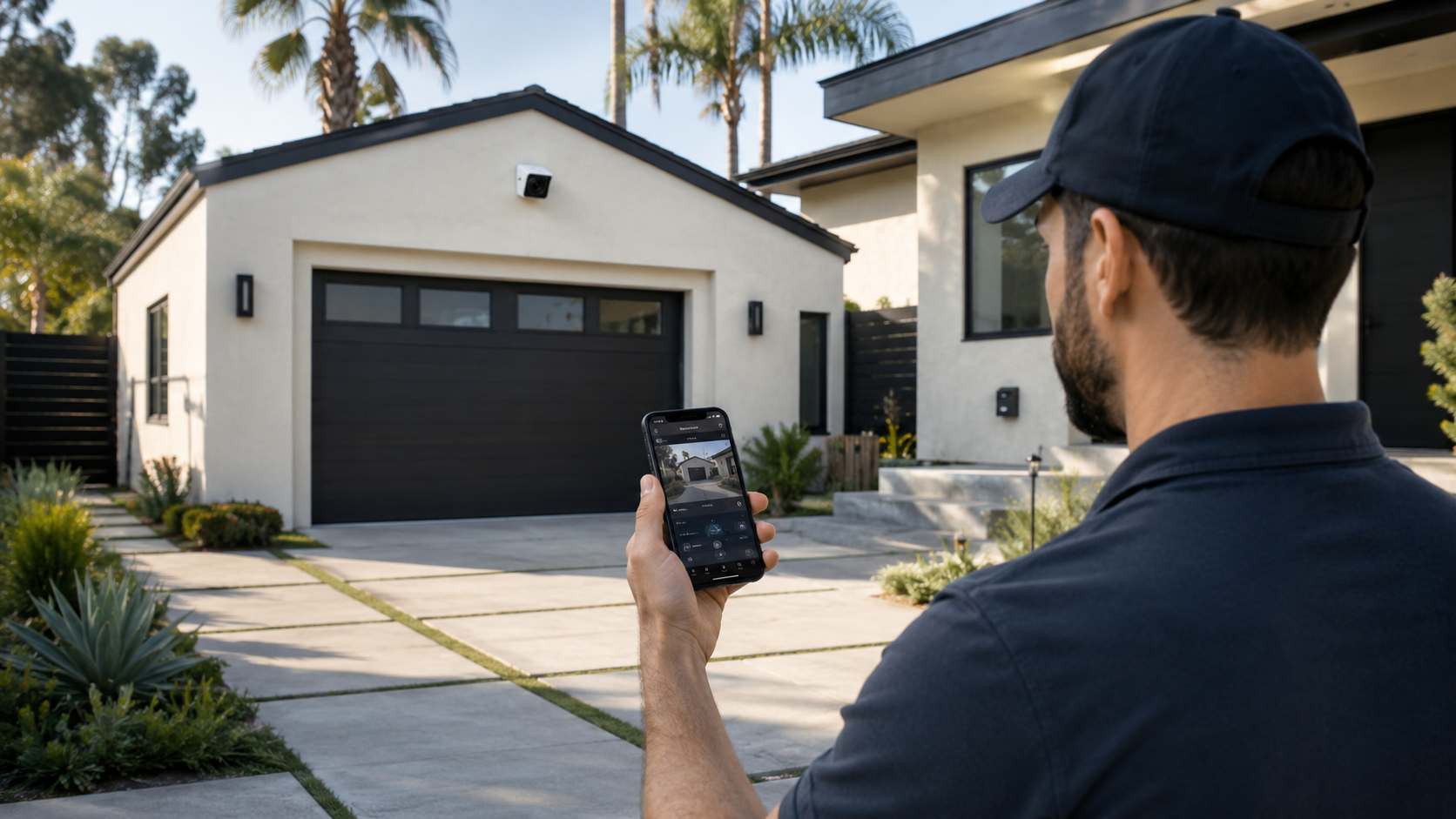
Linking smart lights to camera motion zones creates a layered deterrent that works better than either one alone. When the camera's motion zone detects a person, it triggers the light automatically. The person is suddenly illuminated. The camera captures their reaction - which is almost always to leave. That footage is useful if the same person returns, and the light alone usually ends the event right there.
This combination is especially useful for dark side yards and rear approaches in older San Diego neighborhoods. Sherman Heights, Barrio Logan, and properties backing up to alleys in South Park all have areas where a first-time visitor to the property could walk within ten feet of a garage door before being seen from inside the main house. A camera-triggered light changes that dynamic entirely.
The setup does not require a complex smart home system. A camera with built-in smart light integration and a compatible outdoor fixture can be configured in an afternoon. Smart Shield Systems installs these combinations regularly as part of full detached structure security plans.
Networking and Power Considerations for Detached Structures
A security camera that cannot hold a Wi-Fi connection is not actually securing anything. A sensor that loses power during the exact window when someone is testing doors is worse than no sensor at all. The infrastructure behind a security system - Wi-Fi signal, power supply, and backup power - determines whether the system works when it matters.
Detached structures create infrastructure challenges that attached garages do not. The physical separation from the main house means Wi-Fi signal, power, and network connectivity all have to cover extra distance and often pass through walls or air gaps that reduce reliability. Getting the infrastructure right before mounting cameras and sensors saves significant headache later.
Extending Wi-Fi to a Detached Garage or ADU
The three practical options for getting Wi-Fi to a detached structure are: a plug-in Wi-Fi extender in the main house pointed toward the garage, a mesh network node placed at an intermediate point between the two structures, or an ethernet cable run from the main house router to a dedicated access point in the detached structure. Each has trade-offs.
A Wi-Fi extender is the cheapest option and works for structures close to the main house. Mesh nodes - from systems like Eero, Google Nest, or Ubiquiti - are more reliable and cover more distance. The hardwired ethernet approach is the most reliable of all and is often the right choice when stucco construction is involved. Stucco is common throughout San Diego's older neighborhoods in Mission Hills, Bankers Hill, and Kensington, and it blocks Wi-Fi signal significantly more than wood frame construction. Homes in these areas often need the hardwired option to get a stable connection to a detached structure.
Our team tests actual signal strength at the detached structure location before recommending any approach. What looks like a twenty-foot gap on a site plan can have two stucco walls and a concrete foundation in between, which changes the calculation completely.
Power Options When the Detached Structure Is Not Wired
Some older detached garages in San Diego - especially standalone structures built before 1970 in neighborhoods like North Park, Logan Heights, and City Heights - have minimal electrical: a single circuit for one overhead light and maybe an outlet. That is not enough to run a hardwired camera system or a panel with a backup battery.
Battery-operated sensors and solar-powered cameras are the practical answer in these situations. They do not require an electrician and can be installed same-day. For homeowners who want wired cameras and a full alarm panel, running a new circuit from the main house to the detached structure is the right investment - and Smart Shield Systems coordinates with licensed local electricians when that work is needed. The cost is usually less than homeowners expect when it is done alongside the security installation.
When it does make sense to run new power to a detached structure, it also opens the door to garage door automation and other conveniences that a single-circuit garage cannot support. The infrastructure investment pays off across multiple upgrades.
Keeping Security Devices Online During Power Outages
San Diego's fire season creates real grid stress. East County neighborhoods - Santee, El Cajon, and areas along the I-8 corridor - have experienced rolling outages during high-wind events in recent years. When power goes out, a camera system running on standard wall power goes offline completely. A UPS - an uninterruptible power supply - keeps the router, the camera recorder, and the alarm panel running on battery for several hours through most outage events.
A UPS on the router alone is often the most impactful single addition, because cellular backup on the alarm panel cannot communicate status to the homeowner if the router is down. Keeping the router online means app notifications, remote viewing, and alarm communication all stay active even when the grid is not. Our team at El Cajon area installs regularly factors in power backup specifically because of the fire season outage history in that corridor.
Cellular alarm panels with built-in battery backup handle outages independently of the home network, which is the most reliable configuration for a detached structure alarm during a San Diego fire weather event.
Need Help in San Diego?
Smart Shield Systems serves San Diego and all of San Diego County.
San Diego Permit and HOA Considerations for ADU Security Installations
Most homeowners skip the permit and HOA research when adding security to a detached structure. In most cases, a wireless sensor and camera installation does not require a permit and does not violate HOA rules. But there are specific situations where both matter, and getting it wrong can create problems with an open ADU permit file or a neighbor dispute over a camera pointed at a shared fence.
San Diego has specific rules about what kinds of work require permits, and ADUs in particular often have active permit files that should not be complicated by any unpermitted structural or electrical work. Taking five minutes to check before the installation saves a lot of trouble later.
When You Need a Permit for Security Work in San Diego
Battery-operated sensors, wireless cameras mounted on exterior walls, and smart locks replacing existing lock hardware generally do not require a permit in San Diego. The line gets crossed when work involves opening walls, running new electrical circuits, or making structural modifications. Any of those require a permit through the City of San Diego Development Services Department.
ADU additions are especially worth checking on this. Many ADUs built since 2020 are still under inspection or have open permit files. Adding unpermitted electrical work to a structure with an open permit can complicate final inspections or future property transactions. When Smart Shield Systems installs wired systems on ADUs with open permits, we flag this for the homeowner and work with their contractor or pull the appropriate permits through proper channels.
The practical rule: if an installer is drilling through walls or connecting to the electrical panel, verify permit requirements with Development Services first. For surface-mounted, wireless, and battery-powered equipment, a permit is typically not needed.
HOA Rules Affecting Camera and Alarm Installations
Planned communities throughout San Diego - including Mira Mesa, Scripps Ranch, Del Sur, and parts of Carmel Valley - have HOA guidelines that govern visible equipment on exterior walls, fences, and shared structures. The rules vary widely. Some HOAs require equipment to match the building color. Others prohibit cameras aimed at common areas or neighboring properties. A few have no restrictions at all.
The right approach is to pull the CC&Rs - the community's governing documents - and check before purchasing equipment. If the HOA requires approval, submit a simple request with photos of the planned equipment placement. Most HOAs approve standard residential cameras without issue. Smart Shield Systems has navigated HOA requirements in Mira Mesa and Del Sur communities many times and can advise homeowners on equipment and placement that works within typical guidelines while still providing real coverage.
How Smart Shield Systems Approaches Detached Garage and ADU Security in San Diego
Our team at Smart Shield Systems has done this work across San Diego long enough to know that every property is different. A detached garage in South Park on an alley lot needs a completely different plan than a new ADU in Tierrasanta behind a ranch-style home on a flat lot. The site visit is where the real work starts, not at a product catalog.
We are a local San Diego business, not a national company routing calls through a regional office. When a homeowner in Pacific Beach calls about a camera that lost its angle after a new fence went up, they get a local team member who knows the neighborhood and can be there the same week. That local presence changes how we work and how quickly we can respond.
What a Site Assessment Looks Like for a Detached Structure
When our team visits a property for a detached garage or ADU assessment, the first thing that happens is a walk of the exterior - not a conversation about equipment. We check sightlines from the alley or street, test Wi-Fi signal strength at the detached structure's wall, and look at existing door hardware and frame condition. We identify blind spots that a homeowner walking the property every day might have stopped noticing years ago.
We have done this across San Diego from Chula Vista to Clairemont, from La Mesa to Ocean Beach. Each neighborhood has patterns - the alley-access issues in Mid-City, the stucco signal problems in Kensington, the minimal-power garages in Logan Heights. The assessment draws on that accumulated experience, not just what is visible on the day of the visit.
After the walk, we give the homeowner a plain-language summary of what we found, what the priority fixes are, and what a full plan would look like. There is no pressure to do everything at once. Most people start with the physical door upgrades and cameras, then add alarm coverage in a second phase when budget allows.
Installation Process and What Homeowners Should Expect
A basic installation on a detached garage or ADU - two to three cameras, door sensors, and a smart lock - takes two to three hours for our team. A full system with wired cameras, motion lighting, smart locks, a standalone alarm panel, and alarm monitoring integration typically takes four to six hours on a larger ADU. We give a time estimate before the job starts, and we do not leave until the homeowner has walked through every component and confirmed it works.
During installation, disruption to the main house is minimal. Most of the work happens at the detached structure. If conduit needs to be run between the main house and the garage, we plan the path in advance to minimize visible surface conduit where the homeowner cares about appearance. The goal is a clean install that works, not a tangle of cables that becomes its own problem.
After everything is running, we walk through the app, test the alarm, and show the homeowner how to adjust motion zones, add access codes, and reach our team if something stops working. The handoff is part of the job, not an afterthought.
Ongoing Support and Monitoring After Installation
Day one is the easy part. The real value of working with a local company shows up six months later when a camera stops recording, or a homeowner in Pacific Beach adds a wood fence that blocks the angle a rear camera was covering. Our team is reachable by phone, and because we are based in San Diego, a technician can usually be on-site within a day or two for any issue that cannot be resolved remotely.
Monitoring plans through Smart Shield Systems route through a San Diego-area monitoring center, not a national call center in another time zone. When an alarm triggers on an ADU in Logan Heights at 2 a.m., the response comes from people who know San Diego's geography and can coordinate with SDPD effectively. For homeowners who want ongoing system maintenance, we offer check-in service plans that include periodic testing of sensors, camera cleaning, and firmware updates. The system that works on day one should still work in year three.
Final Thoughts
A detached garage or ADU in San Diego is a real asset - whether it is generating rental income, storing thousands of dollars in tools and gear, or housing a family member. Leaving it unprotected because it is not the main house is a gap that catches too many San Diego homeowners off guard.
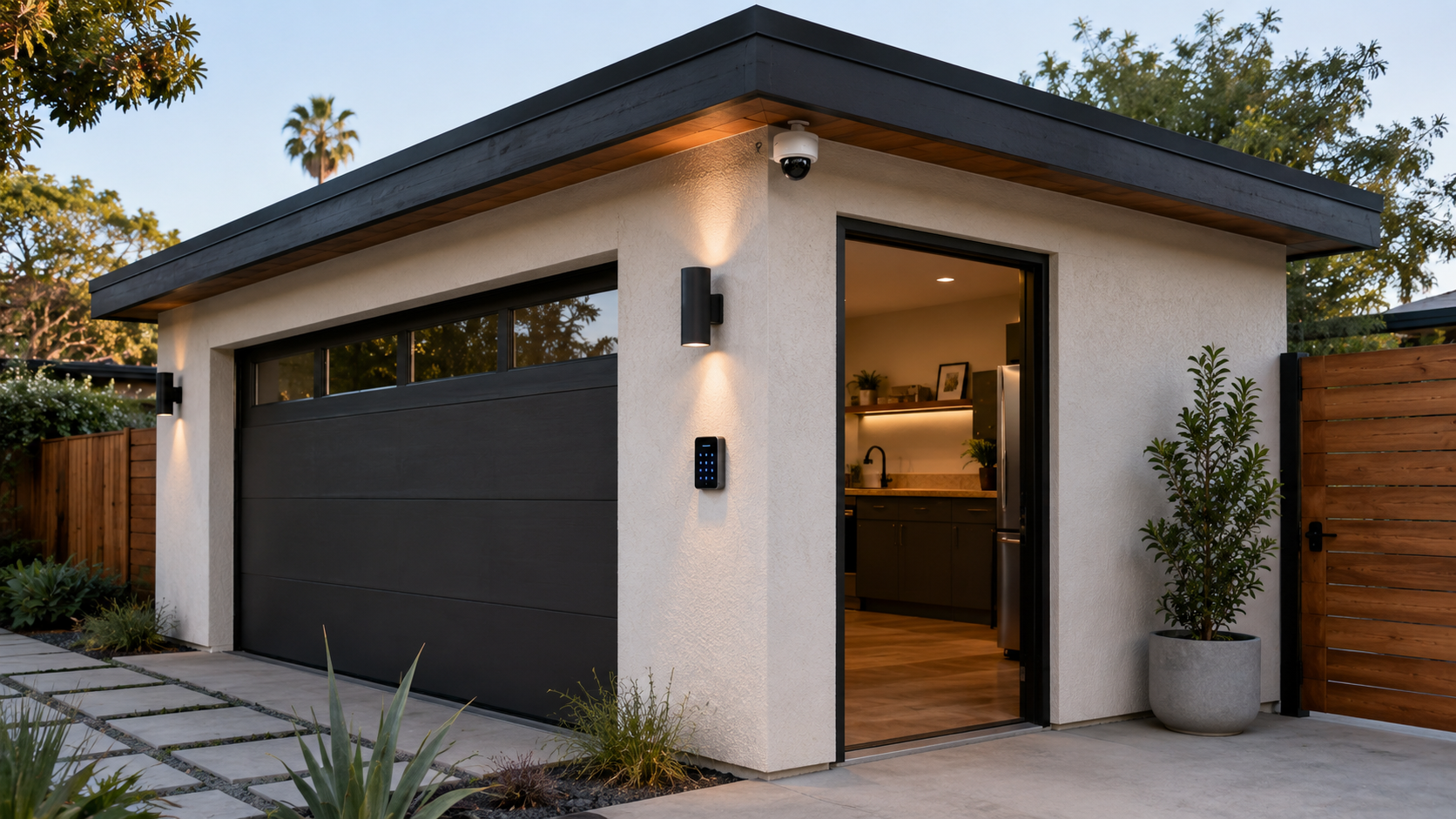
The good news is that fixing it does not require a massive budget or a full rewire. Start with door hardware and physical reinforcement, add cameras covering approach angles and alley access, extend alarm coverage to the detached structure, and put motion lighting in the dark spots. Each layer adds real friction for anyone trying to break in, and together they create a detached structure that is no longer the easiest target on the block.
Smart Shield Systems is ready to help. Contact our San Diego team to schedule a site assessment for your detached garage or ADU - and get a straight answer about what your property actually needs.
Need Help in San Diego?
Smart Shield Systems serves San Diego and all of San Diego County.
Frequently Asked Questions
Does my home alarm system already cover my detached garage or ADU?
In most cases, no. Standard alarm systems are wired and configured to cover the main structure only. Without additional sensors specifically installed and paired to the panel, a detached garage or ADU has zero alarm coverage. To check your own setup, pull up your alarm panel's zone list - if no zone is labeled for the garage or ADU, it is not covered. Our team can assess this during a site visit and recommend the fastest path to coverage.
How much does it cost to add security to a detached garage or ADU in San Diego?
A basic setup - two cameras and a door sensor - runs roughly $400 to $800 installed. A mid-range package with cameras, door and motion sensors, smart lock, and professional monitoring typically falls between $1,200 and $2,500. A full system with wired cameras, motion lighting, a standalone alarm panel, and cellular monitoring on a larger ADU can reach $3,000 to $5,000 or more, especially if any electrical work is required. Costs vary based on lot size, existing infrastructure, and equipment choices.
Can my ADU tenant get their own alarm system without affecting mine?
Yes. A standalone cellular alarm in an ADU operates completely independently from any system in the main house. The tenant has their own panel, sensors, and monitoring - the landlord's system is unaffected. This separation actually protects both parties. Landlords in San Diego should consider including a clause in the lease about security systems, specifying whether the landlord provides coverage or the tenant is responsible, and what types of installations are permitted without causing damage to the structure.
Do I need a permit to install security cameras on my detached garage in San Diego?
Camera installation on the exterior of a detached garage generally does not require a permit in San Diego when no structural or electrical modifications are involved. Surface-mounting a camera to an existing wall and connecting it to power via an outdoor outlet or battery does not trigger permit requirements. However, if installation involves running new conduit inside walls or connecting to the main electrical panel, a permit through the City of San Diego Development Services Department may be required. When in doubt, a quick check with Development Services takes about ten minutes.
What is the best type of lock for a detached garage in San Diego?
For side entry doors on a detached garage, a Grade 1 deadbolt with a reinforced steel strike plate and three-inch screws is the right baseline. For ADU entry doors, a smart lock with app alerts and keypad entry adds management capability that a standard deadbolt cannot match. For roll-up garage doors, a heavy-duty slide bolt on the interior track adds a second barrier that is difficult to defeat from outside. In coastal areas like La Jolla and Ocean Beach, choose hardware rated for salt air exposure - coastal humidity corrodes cheap zinc hardware faster than most homeowners expect.
How do I get Wi-Fi to my detached garage for security cameras?
The three practical options are a Wi-Fi range extender plugged into an outlet near the main house facing the garage, a mesh network node placed in an intermediate location, or an ethernet cable run from the main router to a dedicated wireless access point in the detached structure. Stucco walls - common throughout older San Diego neighborhoods - block Wi-Fi significantly more than wood frame construction. Homes in areas like Kensington, Mission Hills, or Bankers Hill often need the ethernet option to get a reliable signal to a detached structure at the back of the lot.
Will my security cameras work during San Diego's marine layer and foggy mornings?
Traditional infrared-only night vision cameras can produce washed-out or blurred images in marine layer conditions because moisture scatters the infrared beam. This is a real and common complaint from homeowners in Carlsbad, La Jolla, Point Loma, and Ocean Beach. Color night vision cameras - which use amplified ambient light rather than infrared - perform significantly better in these conditions. They produce clear, color-detailed images even in heavy coastal fog, making them the better choice for any San Diego property within a few miles of the coast.
Can I monitor my detached garage security remotely when I am not home?
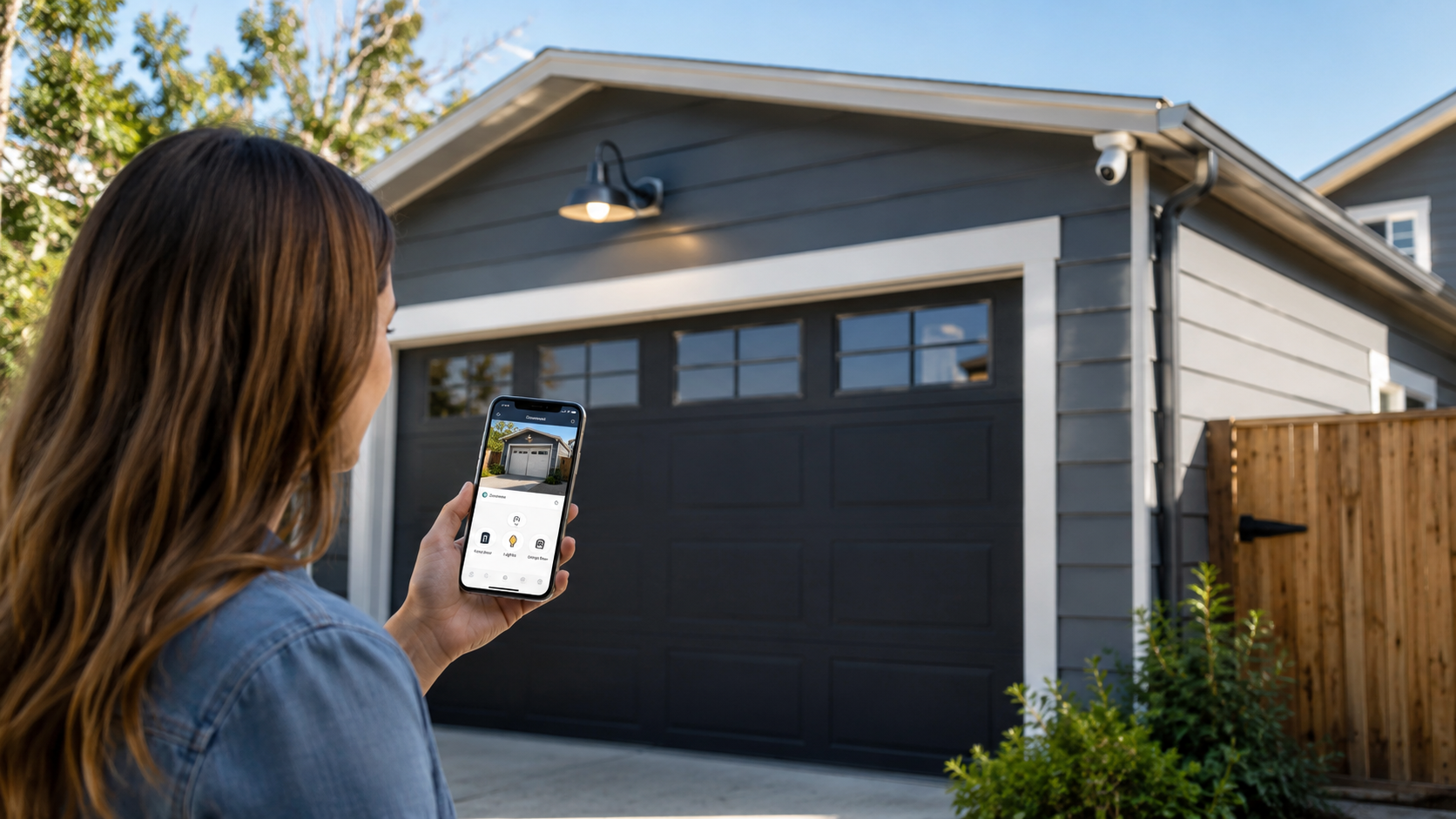
Remote monitoring through a smartphone app is standard with virtually all modern camera and alarm systems. Through the app, a homeowner can view live video, receive motion alerts with snapshot previews, use two-way audio on cameras equipped with speakers, and arm or disarm the alarm from anywhere with cell service. Cellular alarm panels work for remote arming and disarming even when the home internet is down. For homeowners who travel frequently or manage rental properties across San Diego, remote video monitoring is a standard part of the setup.
How do I secure a detached garage that shares a wall with an alley in San Diego?
Alley-access garages in North Park, South Park, Normal Heights, and throughout Mid-City San Diego are among the most frequently burglarized detached structures our team sees. The approach is three layers: a rear-facing wide-angle camera covering the alley in both directions, a motion-activated floodlight positioned to illuminate the alley approach to the garage door, and a reinforced rear door or roll-up door with a heavy-duty interior bolt. These three elements together address the most common attack pattern on alley-access properties. Alley-access situations make up a large share of the calls we receive from Mid-City San Diego homeowners each year.
How long does it take to install a security system on a detached garage or ADU?
A basic wireless camera and sensor setup on a small detached garage typically takes under two hours. A mid-range installation with two to three cameras, a smart lock, door sensors, and motion lighting runs two to four hours. A full system on a larger ADU - wired cameras, standalone alarm panel, smart locks on multiple doors, motion lighting, and alarm monitoring integration - can take a full day. Smart Shield Systems gives homeowners a specific time estimate before the job starts, based on the site assessment, so there are no surprises on installation day.
Sources and Further Reading
Frequently Asked Questions
- Does my home alarm system already cover my detached garage or ADU?
- In most cases, no. Standard alarm systems are wired and configured to cover the main structure only. Without additional sensors specifically installed and paired to the panel, a detached garage or ADU has zero alarm coverage. To check your own setup, pull up your alarm panel's zone list - if no zone is labeled for the garage or ADU, it is not covered. Our team can assess this during a site visit and recommend the fastest path to coverage.
- How much does it cost to add security to a detached garage or ADU in San Diego?
- A basic setup - two cameras and a door sensor - runs roughly $400 to $800 installed. A mid-range package with cameras, door and motion sensors, smart lock, and professional monitoring typically falls between $1,200 and $2,500. A full system with wired cameras, motion lighting, a standalone alarm panel, and cellular monitoring on a larger ADU can reach $3,000 to $5,000 or more, especially if any electrical work is required. Costs vary based on lot size, existing infrastructure, and equipment choices.
- Can my ADU tenant get their own alarm system without affecting mine?
- Yes. A standalone cellular alarm in an ADU operates completely independently from any system in the main house. The tenant has their own panel, sensors, and monitoring - the landlord's system is unaffected. This separation actually protects both parties. Landlords in San Diego should consider including a clause in the lease about security systems, specifying whether the landlord provides coverage or the tenant is responsible, and what types of installations are permitted without causing damage to the structure.
- Do I need a permit to install security cameras on my detached garage in San Diego?
- Camera installation on the exterior of a detached garage generally does not require a permit in San Diego when no structural or electrical modifications are involved. Surface-mounting a camera to an existing wall and connecting it to power via an outdoor outlet or battery does not trigger permit requirements. However, if installation involves running new conduit inside walls or connecting to the main electrical panel, a permit through the City of San Diego Development Services Department may be required. When in doubt, a quick check with Development Services takes about ten minutes.
- What is the best type of lock for a detached garage in San Diego?
- For side entry doors on a detached garage, a Grade 1 deadbolt with a reinforced steel strike plate and three-inch screws is the right baseline. For ADU entry doors, a smart lock with app alerts and keypad entry adds management capability that a standard deadbolt cannot match. For roll-up garage doors, a heavy-duty slide bolt on the interior track adds a second barrier that is difficult to defeat from outside. In coastal areas like La Jolla and Ocean Beach, choose hardware rated for salt air exposure - coastal humidity corrodes cheap zinc hardware faster than most homeowners expect.
- How do I get Wi-Fi to my detached garage for security cameras?
- The three practical options are a Wi-Fi range extender plugged into an outlet near the main house facing the garage, a mesh network node placed in an intermediate location, or an ethernet cable run from the main router to a dedicated wireless access point in the detached structure. Stucco walls - common throughout older San Diego neighborhoods - block Wi-Fi significantly more than wood frame construction. Homes in areas like Kensington, Mission Hills, or Bankers Hill often need the ethernet option to get a reliable signal to a detached structure at the back of the lot.
- Will my security cameras work during San Diego's marine layer and foggy mornings?
- Traditional infrared-only night vision cameras can produce washed-out or blurred images in marine layer conditions because moisture scatters the infrared beam. This is a real and common complaint from homeowners in Carlsbad, La Jolla, Point Loma, and Ocean Beach. Color night vision cameras - which use amplified ambient light rather than infrared - perform significantly better in these conditions. They produce clear, color-detailed images even in heavy coastal fog, making them the better choice for any San Diego property within a few miles of the coast.
- Can I monitor my detached garage security remotely when I am not home?
- Remote monitoring through a smartphone app is standard with virtually all modern camera and alarm systems. Through the app, a homeowner can view live video, receive motion alerts with snapshot previews, use two-way audio on cameras equipped with speakers, and arm or disarm the alarm from anywhere with cell service. Cellular alarm panels work for remote arming and disarming even when the home internet is down. For homeowners who travel frequently or manage rental properties across San Diego, remote video monitoring is a standard part of the setup.
- How do I secure a detached garage that shares a wall with an alley in San Diego?
- Alley-access garages in North Park, South Park, Normal Heights, and throughout Mid-City San Diego are among the most frequently burglarized detached structures our team sees. The approach is three layers: a rear-facing wide-angle camera covering the alley in both directions, a motion-activated floodlight positioned to illuminate the alley approach to the garage door, and a reinforced rear door or roll-up door with a heavy-duty interior bolt. These three elements together address the most common attack pattern on alley-access properties. Alley-access situations make up a large share of the
- How long does it take to install a security system on a detached garage or ADU?
- A basic wireless camera and sensor setup on a small detached garage typically takes under two hours. A mid-range installation with two to three cameras, a smart lock, door sensors, and motion lighting runs two to four hours. A full system on a larger ADU - wired cameras, standalone alarm panel, smart locks on multiple doors, motion lighting, and alarm monitoring integration - can take a full day. Smart Shield Systems gives homeowners a specific time estimate before the job starts, based on the site assessment, so there are no surprises on installation day.
S
Smart Shield Systems Team Team
Licensed security systems professionals serving San Diego and San Diego County.
Licensed in California · License #7623
Why trust Smart Shield Systems?
Founded in 2016, Smart Shield Systems is a licensed and insured security systems serving San Diego and San Diego County. All content is reviewed by our licensed technicians.

Need Help in San Diego?
Smart Shield Systems serves San Diego and all of San Diego County.
Related Articles

How-To Guides
Smart Locks for San Diego Homes - What to Choose and What to Avoid
Learn which smart locks perform best in San Diego's coastal climate and which models to avoid. Expert guide covers salt air resistance, neighborhood compatibility, and installation considerations for local homes.
Tips & Advice
Why San Diego Vacation Rental Owners Need Smart Locks and Cameras
Vacation rental owners in San Diego County benefit from smart locks and cameras: contactless check-in, evidence of damage or parties, and remote management. Here is why and what to consider.
Tips & Advice
How Access Control Systems Protect San Diego Office Buildings
Access control systems keep San Diego office buildings secure by controlling who enters where and when. This guide covers how they work and why offices in Kensington, Clairemont, and across the county use them.