Tips & Advice
La Jolla Home Security: Estate-Grade Systems for Muirlands and La Jolla Farms
Key Takeaways
- Large La Jolla estates need systems built for long perimeters, multiple structures, and high property values, not packaged big-box kits.
- Coastal salt air and June Gloom fog demand marine-grade, weather-rated cameras and low-light sensors that cheap hardware cannot match.
- Hillside lots near Mount Soledad and the Muirlands require layered camera placement that follows elevation changes and removes blind spots.
- Gated entry, video intercoms, driveway sensors, and scheduled staff codes give owners full control over who reaches the home.
- Professional 24/7 monitoring dispatches San Diego Police automatically, while the mobile app adds remote viewing and control for any owner.
- Smart home integration ties lighting, locks, and leak, fire, and environmental sensors into one system that protects vacant seasonal homes.
- Battery backup and cellular communication keep security live during SDG&E power shutoffs and wildfire events in the hills.
- Smart Shield Systems designs, installs, and services estate systems across Muirlands, La Jolla Farms, La Jolla Shores, Bird Rock, and the Village.
In This Article
A Muirlands homeowner came back from three weeks in Europe last summer and called us before she even unpacked. She had been watching her phone the entire trip, worried about her two-acre property sitting empty behind the gate off Muirlands Drive. Every time the wind moved a palm frond across her old motion light, she got a false alert. By the time she landed at Lindbergh Field, she trusted the system less than when she left.
Her story is common up in the hills above the Village. Large estates in La Jolla carry security challenges that a box from a big-box store was never built to handle. Long perimeters, ocean air, detached guest houses, and high property values all change the math.
Why Estate Homes in La Jolla Need a Different Kind of Security?
Most packaged security kits are built for a 1,800-square-foot tract home with a front door, a back door, and a couple of windows. That model falls apart fast on a La Jolla estate. When a property spans an acre or more with multiple structures, the standard playbook leaves big holes.
Estate security has to account for distance, value, and discretion all at once. High-value property attracts a different kind of attention, and the design has to match. Below is a quick look at how estate needs differ from a typary home setup.
| Factor | Standard Home | La Jolla Estate |
|---|---|---|
| Perimeter length | Under 200 feet | 500 to 1,500+ feet |
| Entry points | 2 to 4 doors | Gates, guest house, pool house, garages |
| Camera count | 2 to 4 | 8 to 30+ |
| Network needs | Single router | Multiple access points, wired backbone |
| Coastal exposure | Varies | Salt air and marine layer year-round |
The Challenge of Large Lots in Muirlands and La Jolla Farms
Properties along Muirlands Drive and through La Jolla Farms often sit on multi-acre lots with winding private drives. A single camera at the front door does almost nothing when the actual risk is someone walking up a 600-foot perimeter fence line at night. Large lot coverage means thinking about the whole property edge, not just the house.
These estates usually have more than one way in. There is the main gate, a service entrance, a path down to a canyon, and sometimes beach access on the Farms side. Each of those is a separate point that needs eyes on it.
Outbuildings add another layer. A detached garage, a casita, a pool house, and a garden shed all hold value and all sit far from the main alarm panel. Perimeter security on these lots has to tie every structure back into one system so nothing gets left as an island.
We map these long perimeters during the walkthrough and plan camera and sensor coverage in overlapping zones. That way a gap in one area gets picked up by the next, and there is no blind stretch of fence where someone can move unseen.
Coastal Conditions That Affect Equipment
Homes near the water in La Jolla deal with salt air every single day. Salt air corrosion eats cheap camera housings, connectors, and gate hardware far faster than anything inland. We have pulled five-year-old budget cameras off oceanfront homes that were already rusted through and fogged over.
The marine layer is its own problem. June Gloom mornings blanket the coast in thick fog that can sit until noon, and salt moisture works into any seam or gasket that was not rated for it. Coastal equipment has to carry proper weather ratings or it simply will not last.
We spec marine-grade housings, sealed connectors, and corrosion-resistant mounts for any home within reach of the ocean spray. The upfront cost is a little higher, but it saves owners from replacing failed gear every couple of years.
Humidity also affects the electronics inside. Condensation inside a poorly sealed dome camera will ruin the sensor over time. Choosing hardware built for coastal exposure is the difference between a system that lasts a decade and one that fails before its first warranty ends.
Privacy and Discretion for High-Profile Owners
Many estate owners in La Jolla do not want their home to look like a fortress. A wall of obvious cameras and bright signage signals to everyone driving by that there is something worth protecting inside. That can do more harm than good.
Discreet security means protection that blends into the architecture. We use low-profile cameras tucked under eaves, color-matched housings, and mounting that respects the lines of the home. The goal is full coverage without drawing the eye.
Privacy also extends to the data side. Owners want to know who can see their footage and where it is stored. We set up systems with private storage and tight access so the only people viewing the cameras are the ones the owner approves.
For high-profile residents, this quiet approach matters as much as the technology itself. A well-designed system protects the property while keeping a low profile that does not advertise wealth to the street.
What Standard Systems Miss
DIY kits from the big-box stores are fine for an apartment or a small condo. On a sprawling estate they leave real coverage gaps. The wireless range will not reach a detached garage 300 feet away, and the included cameras cannot read a license plate down a long drive.
Guest house security is a common blind spot. A casita or pool house often has its own doors, its own valuables, and its own people coming and going. A two-camera kit was never meant to handle a second living structure.
Pool areas, garden gates, and side service paths also fall outside what these kits cover. Each is a place someone could enter unnoticed if the system was not planned around the full footprint of the property.
Our video surveillance camera designs treat the whole estate as one connected site. Every structure, gate, and path ties into a single platform so there are no orphaned zones left unwatched.
Camera Systems Built for Hillside and Oceanfront Properties
Cameras are the backbone of any estate system, but the right camera in the wrong spot is useless. La Jolla's terrain makes placement harder than most. Sloped lots, ocean glare, and long approaches all change what works.
Good surveillance on these homes is about matching the gear to the conditions. Estate cameras need the right lens, the right mount angle, and the right network to do their job on oceanfront homes and hillside parcels alike.
Camera Placement on Sloped and Terraced Lots
Hillside homes near Mount Soledad and in the upper Muirlands sit on terraced lots where the ground drops away fast. A camera mounted flat will either stare at a retaining wall or shoot over the heads of anyone walking the lower terrace. Camera placement on these lots takes careful angling for the elevation change.
Blind spots multiply on a slope. A planter, a stairway, or a level change can hide a person completely from a poorly aimed camera. We walk the property at different times of day to find where shadows and grade create gaps.
On terraced lots we often stage cameras at multiple heights so each level of the yard has its own coverage. A camera on the upper deck watches the approach, while a lower unit covers the path to the pool or canyon edge.
The result is layered coverage that follows the shape of the land. On a Mount Soledad property, that might mean six or eight cameras stepped down the hillside instead of two at the front door doing nothing useful.
Low-Light and Night Vision for Coastal Fog
June Gloom is real, and it wrecks cheap cameras. When the marine fog rolls in thick before sunrise, basic night vision washes out into a gray blur. Owners check the app and see nothing usable.
Low-light cameras built for these conditions use larger sensors and better infrared to cut through haze. Some models pair color night vision with smart light so a fogged morning still produces a clear, identifiable image instead of a smear.
Placement matters here too. Pointing a camera straight into a coastal sunrise or a wet, reflective driveway creates glare that blinds it. We angle cameras to avoid direct light and to keep the most important zones sharp during the worst conditions.
For oceanfront homes we test the cameras through an actual foggy morning before signing off. If a unit cannot read the gate or the driveway during heavy June Gloom, it gets repositioned or replaced.
License Plate and Driveway Cameras
On a long private drive off La Jolla Farms Road, an owner wants to know who is coming well before they reach the house. A standard camera will show a car but not the plate. A dedicated license plate recognition camera reads tags even on a moving vehicle.
Driveway monitoring gives owners a head start. Capturing an approaching vehicle at the gate or the start of the drive means there is a record of every car that enters, day or night.
Plate cameras need specific settings to work. They run at faster shutter speeds and tighter focus zones than general cameras, so they are usually a separate unit aimed at a single lane. Mounting them at the right distance and angle is what makes the plate readable instead of a blur.
For estates where service trucks, guests, and deliveries all share one drive, this footage is valuable. It builds a log of vehicles that pairs with the access control at the gate.
Wired vs Wireless for Big Properties
On a small home, wireless cameras are easy. On a two-acre estate, distance becomes the enemy. Wireless cameras lose signal across long spans, thick walls, and detached buildings, which leads to dropped footage and dead zones.
Wired cameras carry power and data over one cable and stay rock solid no matter the distance. For the core of an estate system, we run wired connections to a central recorder so the most important cameras never drop. The trade-off is more cabling work during install.
Wireless still has a place. A remote shed or a temporary view can run on a well-placed access point, and modern mesh systems extend signal range across a property when wiring is not practical.
Most estate systems we build use a wired backbone with wireless added where it makes sense. That blend gives reliable coverage on the main structures plus flexibility for the far corners of the lot.
Need Help in San Diego?
Smart Shield Systems serves San Diego and all of San Diego County.
Get Your Free Quote
Tell us about your property and we'll get back to you fast.
Gated Entry and Perimeter Access Control
The gate is the first line of defense on most La Jolla estates. Controlling who comes through it, and knowing when they do, is where good access control starts. A camera records what happened; access control decides what is allowed to happen.
From automated gates to driveway sensors, perimeter security on these properties is about layering detection so an owner is never surprised. Here is how the pieces fit together.
Automated Gates and Keypad Entry
Most Farms estates and Muirlands homes with private drives already have or want a motorized gate. Automated gates swing or slide open on a motor controlled by a keypad, a remote fob, or a phone app. The right setup matches the gate style and the daily traffic.
Keypad entry lets the household and trusted visitors enter with a code instead of a physical key. Fob systems work well for family members who pass through daily. We often combine both so there is a backup if one method fails.
Gate automation also ties into the rest of the system. An access control setup for gates can log every entry, trigger a camera to record, and send the owner a notification all at once.
Reliability is the main concern on coastal gates. Salt air corrodes motors and circuit boards, so we spec hardware rated for the environment and schedule service to keep the gate moving smoothly for years.
Video Intercoms for Guests and Deliveries
A video intercom at the gate lets the owner see and speak to whoever is standing there. Whether the household is inside the home or across the country, they can screen the visitor before the gate ever opens. That is visitor screening done right.
Delivery management is a daily reality on these estates. Drivers from couriers and food services arrive constantly, and a video intercom lets someone confirm the delivery and grant or deny entry from a phone.
The intercom feed pairs with the camera system so every interaction at the gate is recorded. If a package goes missing or a stranger lingers, there is a clear video record tied to the timestamp.
For owners who travel often, this remote screening is one of the most-used features we install. They handle a gate visitor from a hotel room the same way they would from the living room.
Driveway Sensors and Early Warning
On a long approach off La Jolla Farms Road, an owner wants warning before a vehicle reaches the house. Driveway sensors using infrared beams or buried detection trigger an alert the moment a car crosses a set point on the drive.
Early warning changes how an owner responds. Instead of a car suddenly appearing at the door, they get a notification at the start of the drive and can check the camera to see who it is.
Vehicle detection can also automate other actions. A car crossing the beam can switch on driveway lighting, start a recording, or chime an indoor alert so the household knows someone is on the way up.
These sensors are tuned to ignore small animals and wind-blown debris so they do not cry wolf. Proper calibration keeps the alerts meaningful, which matters on rural-feeling lots where wildlife crosses the drive at night.
Managing Service and Staff Access
Estate life means a steady stream of help: gardeners, housekeepers, pool techs, and contractors. Each needs to get in, but not all at the same time or with the same access. Managing staff access cleanly avoids handing out keys that get copied or lost.
Scheduled codes solve this. A gardener gets a code that only works Thursday mornings, and a contractor gets one that expires when the project ends. Our temporary access code system makes this simple to manage.
Access logs record who entered and when. If something goes missing or a question comes up about a service visit, the owner can pull a clear record tied to each individual code.
This level of control gives owners confidence without micromanaging. The staff get reliable entry on their schedule, and the household keeps a tidy log of every person who came through the gate.
Professional Monitoring vs Self-Monitoring
Once the cameras and sensors are in, the next choice is who watches them. Some owners want a monitoring center handling alarms around the clock. Others prefer to manage alerts themselves through an app. Both have a place, and the right answer depends on the household.
Here is a side-by-side look at how professional monitoring and self-monitoring compare for a La Jolla estate.
| Feature | Professional Monitoring | Self-Monitoring |
|---|---|---|
| Who responds | Monitoring center 24/7 | The owner |
| Police dispatch | Automatic | Owner must call |
| If owner is asleep or away | Still covered | May be missed |
| Monthly cost | Recurring fee | Lower or none |
| Best for | Large or vacant estates | Hands-on owners |
How 24/7 Monitoring Works
With 24/7 alarm monitoring, a triggered sensor sends a signal to a monitoring center staffed at all hours. An operator sees the alarm, confirms whether it is real, and follows a set response plan for the property.
If the alarm is verified, the operator contacts the owner and dispatches San Diego Police to the address. This happens in minutes, even at 3 a.m. when no one in the house is awake to notice.
The center also keeps the owner's contact list and any special instructions, such as a code word or a neighbor to call. That alarm response is far faster than an owner fumbling for a phone after waking to a siren.
For large estates where an alarm in the pool house might not be heard from the master bedroom, this constant watch matters. The monitoring center never sleeps and never misses the signal.
Response Times and Local Patrol Coordination
Police response time in La Jolla varies with the time of day and how busy the area is. Realistic windows run several minutes for a verified alarm, sometimes longer during peak hours when units are spread across the city.
Many estate owners add a private patrol service to close that gap. These patrols are often closer and can roll a car to the property quickly while police are en route.
Our systems coordinate with private patrol by sending alerts directly to the patrol dispatch as well as the monitoring center. That coordination means two sets of eyes responding instead of one.
We help owners set up these arrangements during design. Knowing which patrol covers their stretch of Muirlands or the Farms lets us wire the response plan to match what is actually available in the neighborhood.
Mobile Alerts and Remote Control
Whether an owner chooses professional monitoring or not, the app puts the system in their pocket. Mobile alerts ping the phone the moment a sensor trips, a gate opens, or a camera spots motion in a watched zone.
Remote access means the owner can pull up live camera views from anywhere. A homeowner in Europe can check the gate off Muirlands Drive on the same screen they use to read email.
Arming and disarming from the app is part of the package. Forgot to set the alarm before leaving for the airport? It takes one tap from the smartphone app, no trip back to the house required.
This remote control pairs well with both monitoring styles. Self-monitors run their whole system from the app, while professionally monitored owners still get the same visibility on top of the center's coverage.
False Alarm Reduction and City Permits
The City of San Diego requires an alarm permit for monitored systems, and repeated false alarms bring fines. Good system design cuts those false alarms before they ever reach the dispatch line. The San Diego Police alarm permit program spells out the rules.
Most false alarms come from poor placement and bad calibration. A motion sensor aimed at a curtain that moves with the AC, or a door contact set too sensitive, trips for no reason. We tune every sensor to the real environment of the home.
Verification features help too. Cameras tied to alarm zones let the monitoring center confirm a real event before calling police, which keeps the false alarm count down.
We handle the permit registration as part of our setup so owners are not left sorting out city paperwork on their own. Fewer false alarms mean lower fines and a system the household actually trusts.
Need Help in San Diego?
Smart Shield Systems serves San Diego and all of San Diego County.
Smart Home Integration for Estate Living
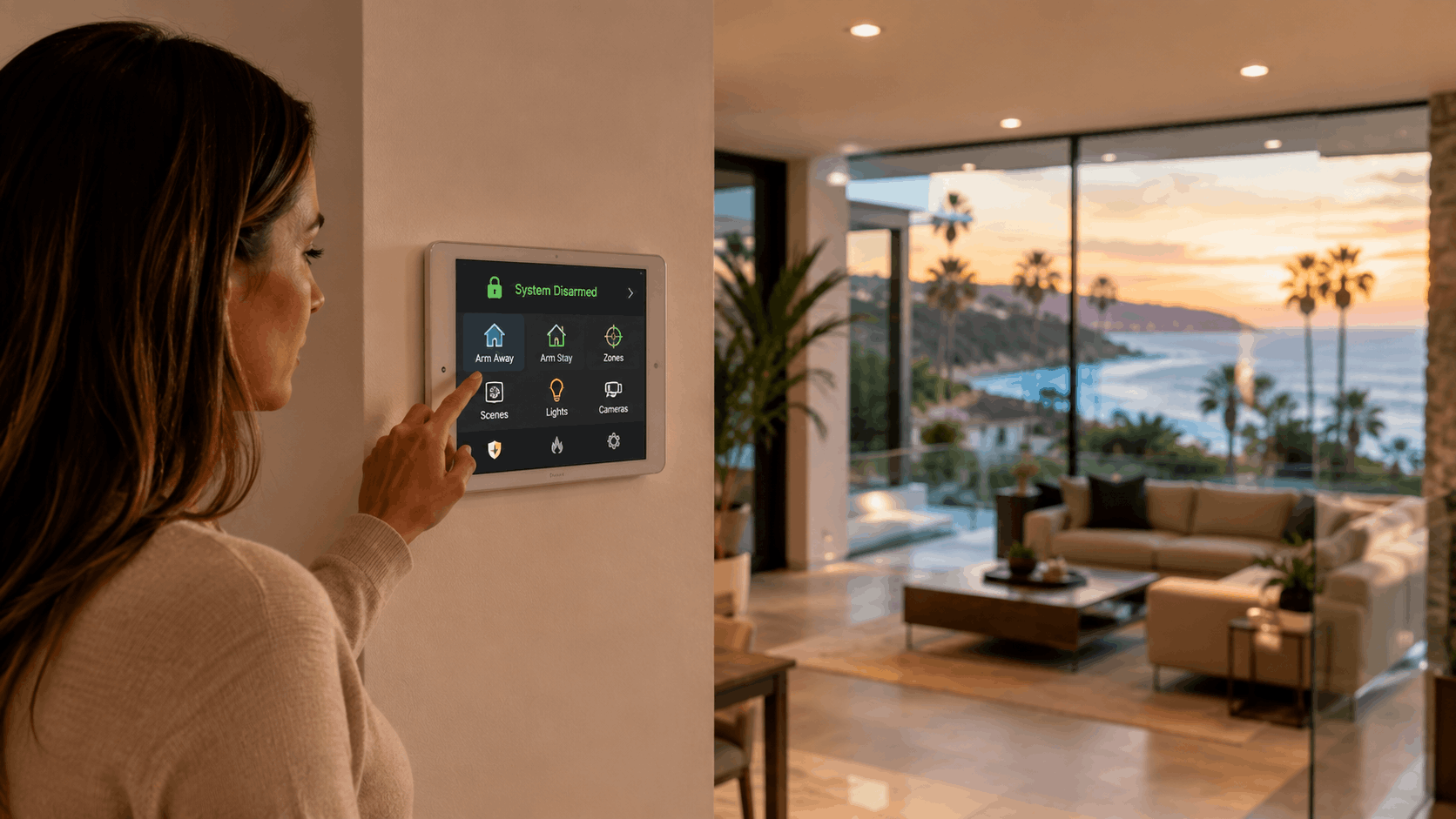
Security on a large home works best when it connects to the rest of the house. Smart home integration ties cameras, locks, lighting, and sensors into one platform an owner controls from a single app. On an estate, that unified control turns a scattered set of devices into one system.
Home automation also adds layers of protection that a basic alarm cannot. Here is how the pieces work together across estate technology.
Lighting Automation for Deterrence
An empty estate is a target, and darkness makes it worse. Lighting automation makes a home look lived-in even when the owners are away for weeks. Interior lamps and landscape lights switch on and off in patterns that mimic real activity.
A vacation mode setting varies the timing so the lights do not flip on at the exact same minute every night. That randomness is what sells the illusion that someone is home.
Landscape lighting along a long Muirlands driveway also serves as deterrence. A dark approach invites someone to test the property, while a well-lit drive that responds to motion sends them elsewhere.
We connect lighting to the security system so a triggered sensor can flood an area with light. Our smart home automation services handle this integration across the whole property.
Smart Locks and Multi-Door Management
A La Jolla estate can have a dozen exterior doors across the main house, the guest house, and the pool house. Tracking which ones are locked is a chore with physical keys. Smart locks put every door on one dashboard.
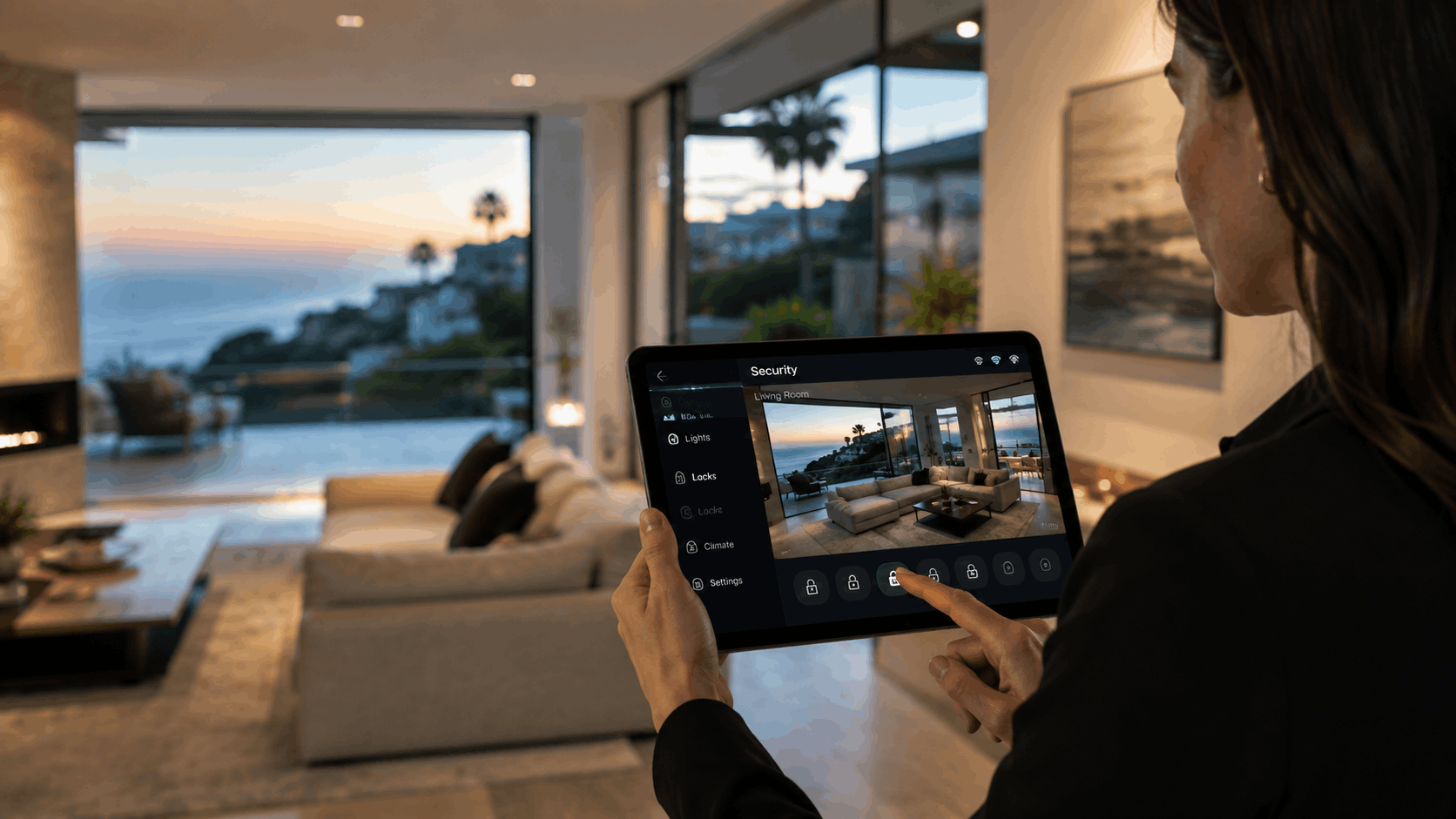
Multi-door management means an owner can check and lock every entry from a single screen. Heading to bed? One tap confirms the casita, the pool house, and the side garage are all secured.
Smart locks also work with the access codes used at the gate. A housekeeper's code can open both the gate and the service door, all logged and scheduled to her working hours.
A central dashboard removes the guesswork. Instead of walking the property to check doors, the owner sees the full status at a glance and gets an alert if any door is left open.
Water, Fire, and Environmental Sensors
The biggest threat to many empty estates is not a burglar but a burst pipe. A leak in a vacant home can run for days and cause enormous damage before anyone notices. Leak detection sensors catch the first drops and alert the owner immediately.
Fire sensors and smoke alerts tie into the same system, sending a signal to both the owner and the monitoring center. Our fire and smoke detection systems add a layer the standard smoke alarm cannot match.
Environmental monitoring also covers temperature and humidity. On a coastal property, a failed HVAC system that lets humidity spike can damage finishes and electronics, and a sensor flags the problem early.
For a part-time resident, these sensors are protection that runs whether anyone is home or not. Catching a leak or a temperature swing remotely can save tens of thousands in repairs.
Connecting Existing Systems
Many older homes near Muirlands already have a security system, a gate motor, or an intercom from years past. Tearing all of that out is wasteful when much of it can be updated and folded into a new platform.
System integration lets us keep working components and connect them to a modern controller. An older gate operator often pairs fine with new access control, saving the cost of a full replacement.
Legacy systems sometimes need a bridge device or a panel swap to talk to current technology. We assess what is worth keeping and what has reached the end of its life during the walkthrough.
Upgrades done this way respect the owner's prior investment. The household ends up with one unified system instead of a patchwork of old and new devices that do not communicate.
Wildfire and Disaster Preparedness in the Hills
Security in La Jolla's hills is not only about intruders. The dry hillsides around Mount Soledad and the upper Muirlands carry real wildfire risk during the dry season. A good system helps owners respond to fire and emergencies, not just break-ins.
For hillside homes, disaster readiness and security work hand in hand. Here is how the system supports owners when conditions turn dangerous.
Fire Detection and Early Notification
During dry season, minutes matter. Heat and smoke detection placed through the home and outbuildings catches a fire early and sends an early notification to the owner and the monitoring center at the same time.
Smoke alerts that connect to monitoring mean help is called even if no one is home. A fire in an empty guest house gets a response instead of burning undetected.
Some detectors also sense rapid temperature rise, which can flag a fire before heavy smoke builds. On a large property, distributed sensors cover the spread-out structures a single hallway alarm would miss.
We place fire detection with the layout of the estate in mind. Keeping current with regional fire guidance from CAL FIRE's Ready for Wildfire program helps owners pair detection with a broader plan.
Power Outages and Backup Systems
SDG&E public safety power shutoffs hit the hills during high-wind, high-fire-risk days. If the security system dies with the power, the home is exposed exactly when risk is highest. Battery backup keeps the system live through an outage.
Cellular communication is the other piece. When the internet drops along with the power, a cellular connection lets the system keep sending alerts and reaching the monitoring center.
We size the battery backup to the system so cameras, sensors, and the gate keep working for hours. For longer outages, owners can add a generator tie-in that carries the load.
This redundancy is what separates an estate system from a basic kit. During a power outage, the household stays connected to their property instead of going dark.
Remote Monitoring During Evacuations
If a fire forces an evacuation, owners do not have to wonder what is happening at home. Remote monitoring lets them watch live cameras from wherever they have fled to. They can see if the property is still standing and whether crews are on site.
During an evacuation, this property watch brings real information instead of rumor. Owners following news of a fire near Mount Soledad can check their own cameras directly.
The system also keeps recording while the owner is away, building a record of conditions through the event. That footage can matter for insurance after a disaster.
Mobile access means none of this requires being near the house. From a hotel or a relative's home, the owner keeps eyes on the estate through the whole emergency.
Protecting Vacant Seasonal Homes
Many La Jolla estates belong to part-time residents who leave for months at a time. A vacant property faces every risk at once: break-ins, leaks, fire, and storm damage, all with no one there to notice.
For seasonal homes, the system becomes the caretaker. Sensors watch for water and fire, cameras watch the grounds, and the monitoring center responds to anything that trips while the owners are gone.
Scheduled access lets a property manager or cleaning crew check in on a set code, with every visit logged. The owner sees the activity from across the country.
Lighting and automation keep the home looking occupied through the off-season. A well-designed system gives part-time residents the same protection year-round, whether they are in town or not.
Need Help in San Diego?
Smart Shield Systems serves San Diego and all of San Diego County.
Working With Smart Shield Systems in La Jolla
Designing security for a La Jolla estate is not a catalog order. It starts with knowing the property, the neighborhood, and the way the household actually lives. Smart Shield Systems works as a local installer that builds custom design for each home rather than dropping in a one-size package.
Here is how our team approaches an estate from the first visit through years of service.
On-Site Assessment and Custom Design
Every project starts with a walkthrough. We map every entry point, gate, and blind spot on the property, noting where the terrain creates gaps and where the coastal exposure demands tougher gear.
This site assessment is where the custom design takes shape. We look at the perimeter length, the outbuildings, the sight lines on a terraced lot, and the way the family uses the space day to day.
From the walkthrough we build a plan that covers the whole footprint with no orphaned zones. The owner sees exactly where each camera, sensor, and gate control goes and why.
Because we work La Jolla regularly, we bring knowledge of what the neighborhood faces. A property in the Farms gets a different plan than one near the Village, because the conditions and risks differ.
Clean Installation on Finished Homes
Estate owners do not want cables stapled across their finished walls. Our installs respect the architecture, with wiring routed through walls and attics and mounts color-matched to the home. Clean installation is part of the job, not an afterthought.
On finished homes we plan cable runs to stay hidden and minimize any patching. Low-impact wiring means the high-end finishes in a Muirlands estate stay intact.
We coordinate with the household and any property staff to work around schedules and protect the home during the install. Drop cloths, careful access, and tidy work areas are standard.
The finished system should look like it belongs to the home. Cameras tucked under eaves and keypads set flush at the gate keep the security low-profile and the architecture untouched.
Ongoing Service and Maintenance
Coastal equipment needs care to keep performing. Salt air fogs lenses and corrodes connections over time, so we offer maintenance and service plans that keep the system sharp.
Regular checkups catch problems before they become failures. We clean lenses, check seals, test backup batteries, and confirm every camera and sensor still reports correctly.
Firmware updates matter too. Cameras and controllers need current software to stay secure and run their latest features, and we handle those updates as part of service.
Equipment care on the coast is ongoing, not one-and-done. A serviced system lasts far longer than one left to weather the salt air alone, and our team keeps it running through the years.
Serving Muirlands, La Jolla Farms, and Beyond
We serve estates across La Jolla, from Muirlands and La Jolla Farms to La Jolla Shores, Bird Rock, and down into the Village. Our local response means a technician who knows the area, not a dispatcher hours away.
Beyond La Jolla, our local service area covers the wider region from our base in San Diego. We work coastal homes and inland properties alike.
Knowing each neighborhood lets us tailor the response. A call from the Farms gets handled with knowledge of those long private drives, while a Bird Rock home gets a plan suited to a tighter coastal lot.
This local footprint is what lets us back up the systems we install. When an owner needs service or has a question, our team is right here in the area, ready to respond.
Final Thoughts
Estate security in La Jolla is a different job than securing a standard home. Long perimeters, coastal conditions, multiple structures, and high property values all demand a system built for the property, not pulled off a shelf.
The right setup ties cameras, gated access, monitoring, and smart home features into one platform an owner controls from anywhere. It protects against intruders, leaks, fire, and the realities of leaving a large home empty for stretches at a time.
Our team designs, installs, and services these systems across Muirlands, La Jolla Farms, and every La Jolla neighborhood. To plan a system for your estate, reach out for a consultation and let us walk the property with you.
Frequently Asked Questions
- What does an estate-grade security system cost in La Jolla?
- Cost depends on the size of the property, the number of cameras, and whether gate integration and monitoring are included. A large La Jolla estate with full perimeter coverage, multiple structures, and gated access runs well above a standard home system because of the scope involved. After the on-site walkthrough we provide a clear quote based on the actual property rather than a generic package price.
- How many cameras does a large La Jolla property need?
- Camera count depends on lot size, the number of entry points, and how many outbuildings need coverage. A multi-acre estate often needs anywhere from eight to thirty or more cameras to cover the perimeter, gate, driveway, and structures like guest houses and pool areas. We determine the right number during the assessment by mapping every approach and blind spot on the property.
- Do I need a permit for an alarm system in San Diego?
- Yes. The City of San Diego requires an alarm permit for monitored systems, and unregistered alarms or repeated false alarms can lead to fines. We handle the permit registration as part of our setup so owners are not left sorting out the paperwork. Good system design also keeps false alarms low, which avoids the fines that come with too many false dispatches.
- Can security cameras handle the marine fog and salt air?
- They can when the equipment is rated for it. Standard cameras corrode fast near the ocean and wash out in heavy June Gloom fog. We spec weather-rated, marine-grade cameras with sealed housings and low-light sensors built for coastal conditions. We also test cameras through real foggy mornings to confirm they still read the gate and driveway clearly before signing off.
- How long does installation take on an estate?
- Timeframe depends on system size and property complexity. A larger estate with extensive wiring, gate integration, and many cameras can take several days to a couple of weeks. We plan the work to respect the home's schedule and finishes, and we give a clear timeline after the walkthrough so owners know what to expect from start to finish.
- Will a new system work with my existing gate or intercom?
- In most cases, yes. We assess existing gates, locks, and intercoms during the walkthrough and integrate working components into the new system rather than replacing everything. An older gate motor often pairs fine with modern access control. Where a device has reached the end of its life, we recommend an upgrade, but the goal is to keep what still works and unify it.
- What happens if the power or internet goes out?
- Battery backup keeps the system running through a power outage, including SDG&E public safety shutoffs. Cellular communication takes over if the internet drops, so the system keeps sending alerts and reaching the monitoring center. We size the backup to the system during design, and owners can add a generator tie-in for longer outages on hillside properties prone to extended shutoffs.
- Can I monitor my home while traveling?
- Yes. The mobile app gives remote monitoring from anywhere with a connection. Owners can view live cameras, check door and gate status, arm or disarm the system, and screen visitors at the gate from a hotel or another country. This remote access is one of the most-used features by estate owners who travel often and want eyes on their property while away.
- Do you serve all of La Jolla or just Muirlands and the Farms?
- We serve all of La Jolla, including Muirlands, La Jolla Farms, La Jolla Shores, Bird Rock, and the Village, plus the wider San Diego area. Our local team responds across these neighborhoods with knowledge of the specific conditions each one faces, from long private drives in the Farms to tighter coastal lots in Bird Rock.
- How discreet can the cameras and equipment be?
- Very discreet. For privacy-focused owners we use low-profile cameras tucked under eaves, color-matched housings, and mounting that blends into the architecture. The goal is full coverage without an obvious cluster of cameras advertising the home. We also set up private footage storage with tight access so only approved people can view the system.
S
Smart Shield Systems Team Team
Licensed security systems professionals serving San Diego and San Diego County.
Licensed in California · License #7623
Why trust Smart Shield Systems?
Founded in 2016, Smart Shield Systems is a licensed and insured security systems serving San Diego and San Diego County. All content is reviewed by our licensed technicians.

Need Help in San Diego?
Smart Shield Systems serves San Diego and all of San Diego County.
Related Articles
How-To Guides
How to Choose the Right Home Security System for Your San Diego Home
Picking the right home security system in San Diego means weighing your layout, budget, and goals. This guide walks you through assessing your needs, comparing equipment types, and choosing monitoring so your home in San Diego County is protected.
Tips & Advice
Best Security System for Chula Vista Homes: Wired vs Wireless
Wired or wireless? Chula Vista homeowners in Otay Ranch, Eastlake, and older neighborhoods near Hilltop need different answers. Here is what actually matters locally.
Tips & Advice
Voice Control and Home Security: Setting Up Alexa and Google Home
Control your alarm, locks, and cameras with Alexa or Google Home. This guide walks through setup and routines for San Diego County homeowners.