Tips & Advice
Point Loma Home Security: Hilltop View Property and Coastal Specialist
Key Takeaways
- Salt air corrodes standard security gear within 12 to 18 months, so coastal homes need marine-grade housings and at least an IP66 rating.
- Steep Point Loma lots off streets like Chatsworth and Catalina create blind spots that require cameras placed at multiple elevations.
- View-property cameras should be low-profile and aimed across approaches to protect the home while keeping ocean and bay sightlines clear.
- Marine layer fog washes out cheap night vision, so choose cameras with low-light color sensors and smart infrared.
- Monitored alarms shorten emergency response on the peninsula's quiet, winding streets where a siren may reach no one.
- Part-time and rental owners should combine remote monitoring, leak and humidity sensors, and temporary access codes for empty homes.
- Some HOAs restrict exterior camera placement, so check your CC and Rs before installing.
- A local San Diego specialist knows coastal conditions firsthand, responds faster, and builds a plan around your specific lot.
In This Article
Every few weeks, a homeowner near the top of Chatsworth Boulevard calls our team with the same story. Their old cameras started fogging over, the door sensors quit working, and the whole system looked corroded after just a couple of years near the water. On the hilltop, the salt air does not care how much you paid for your gear.
Point Loma is a different animal than most of San Diego. The steep lots, ocean-facing windows, terraced yards, and marine layer fog create security problems a flat-lot system in the suburbs never has to deal with. Standard gear rusts faster, cameras miss blind spots on sloped driveways, and night vision struggles when the fog rolls in off Sunset Cliffs.
Why Point Loma Homes Need a Coastal Security Approach?
The peninsula sits right where salt air, ocean humidity, and steep terrain meet. That combination breaks down security gear faster and creates blind spots most installers never plan for. Point Loma home security has to account for all three or it fails early.
A coastal security setup is built around the reality of living a few blocks from the water. The equipment, the mounting, and the camera angles all have to survive conditions that a home in East County never sees. Local knowledge matters here because you cannot fix salt air corrosion after the fact - you plan for it upfront.
How Salt Air Wears Down Cameras and Sensors
Salt in the ocean air is one of the harshest things you can expose electronics to. It settles on camera housings, works into seams, and starts eating the metal underneath. Cheap gear rated for inland use often shows rust spots within 12 to 18 months of coastal exposure.
We see it most on the little things. Door contacts corrode, screw terminals get powdery, and wiring connections lose their grip long before the camera itself dies. On homes closer to the water, we have replaced door sensors that failed in under two years because the internal contacts pitted from humidity.
The fix is choosing an outdoor camera housing built for marine conditions, not just weather. Sealed gaskets, marine-grade coatings, and corrosion-resistant fasteners buy you years instead of months. Our home security camera installation team specs gear for salt exposure from the start on peninsula homes.
Hilltop Lots and Uneven Sight Lines
The lots near the crest of Point Loma are rarely flat. Steep driveways, terraced yards, and homes built into the slope create angles a standard camera plan misses completely. What covers a flat suburban lot leaves gaps here.
Take a property off Catalina Boulevard with a driveway that drops fifteen feet from street to garage. A single camera at the front door sees the porch but nothing of the lower approach. Someone could walk right up the slope out of frame the whole way.
These camera blind spots are why a hilltop view property needs cameras at more than one elevation. We map the actual walkable paths on a lot before placing anything, so the coverage matches how a person would move up or down the slope, not just the flat theory of it.
Ocean Fog and Night Camera Performance
The marine layer is part of life on the peninsula. Most mornings and many evenings, fog rolls over the ridge and settles thick enough to cut visibility to a few hundred feet. Standard cameras turn that fog into a wall of gray at night.
Cheap night vision relies on infrared that bounces off the water droplets in fog. The result is a bright, washed-out image where you cannot make out a face or a plate. It looks like the camera is working until you actually need the footage.
A good night vision camera for the coast uses low-light color sensors and smart infrared that adjusts to conditions. Some models add warm white spotlights that cut through light fog better than raw IR. On foggy blocks near Sunset Cliffs, that difference decides whether your footage is useful or useless.
Neighborhood Layout and Response Times
The roads near La Playa and Sunset Cliffs wind, narrow, and dead-end in ways that slow emergency response. A first responder unfamiliar with the peninsula can lose minutes finding an address tucked off a curving side street. Those minutes matter during a break-in.
Point Loma falls under the San Diego Police Department's Western Division, and coverage across the peninsula is generally good. Still, a monitored alarm shortens the gap between an alarm tripping and someone actually being dispatched to your door.
With a monitored system, a real person verifies the alarm and calls it in immediately, day or night. Our 24/7 alarm monitoring means you are not relying on a neighbor to hear a siren on a quiet street. That head start on emergency response is the whole point of monitoring.
Security Cameras for Hilltop View Properties
People buy on the Point Loma hilltop for the view. Nobody wants a camera arm blocking the bay or a bulky housing in the corner of every window shot. The trick is protecting the property while keeping those sightlines wide open.
Good camera placement on a view property is about angles, not just count. Placed right, security cameras cover every approach and stay out of your line of sight to the water. Here is how we handle elevated lots.
Placing Cameras Without Ruining the View
The mistake we see most is mounting a camera dead center on a view-facing wall, right where you look out at the bay. There is almost always a better spot. Cameras belong at the edges of the view, aimed across approaches rather than out at the horizon.
A low-profile camera tucked under an eave or in a corner covers a deck or walkway without ever entering your window frame. Small dome and bullet models in a color matched to the trim disappear into the architecture. You forget they are there until you need the footage.
On a view property, we aim cameras to cross the approach lines - the path to the front door, the deck stairs, the side gate. That keeps the ocean and bay sightlines clean while still catching anyone coming toward the house. It takes planning, but it is very doable.
Covering Long Driveways and Terraced Yards
Multi-level lots near the crest need eyes at several heights. A single driveway camera at the top misses the lower section, and one at the bottom misses the street. We stage cameras down the slope so the coverage overlaps with no dead zones.
Wide-angle lenses help on terraced yards where one camera can watch a whole level. For long driveways that curve, a PTZ camera that pans, tilts, and zooms can follow movement across a span a fixed camera cannot cover. It is a smart pick for a big front approach.
We usually mix fixed wide-angle cameras for reliable coverage with one PTZ where the property really needs range. Our video surveillance camera plans are built around each lot's actual shape rather than a fixed template that ignores the slope.
Weatherproof Gear That Survives the Coast
Closer to the water at La Playa and Shelter Island, the humidity and salt spray are relentless. A weatherproof camera here needs at least an IP66 rating, which seals against dust and heavy water jets. That rating is the floor, not a luxury, near the coast.
Beyond the rating, materials matter. We look for polycarbonate or marine-grade aluminum housings with stainless fasteners and sealed cable entries. Bargain plastic housings crack and let moisture in within a couple of seasons of salt exposure.
We also seal every cable penetration and mounting point during install. Water finds the smallest gap, and once it is inside a housing, the camera is on borrowed time. Doing it right the first time is far cheaper than replacing corroded gear every year.
Wired vs Wireless on a Steep Property
Steep lots make both wiring and signal tricky. A wired camera gives you the most reliable feed and constant power, but running cable up a terraced hillside or through thick older walls takes real work. When we can run it cleanly, wired is the stronger choice for permanent cameras.
Wireless security shines where a wired run is impractical - a detached structure, a far corner of a lower terrace, or a spot power cannot reach easily. The tradeoff is signal range. Thick walls, distance, and elevation changes all weaken a wireless connection on a big hilltop lot.
Often the best answer is a hybrid. We wire the main coverage points for reliability and use wireless for the outliers, adding mesh points or a repeater where the signal needs help. On a steep property, that mix usually beats going all one way.
Need Help in San Diego?
Smart Shield Systems serves San Diego and all of San Diego County.
Get Your Free Quote
Tell us about your property and we'll get back to you fast.
Alarm Systems and Entry Protection
Cameras record what happened. A home alarm system helps stop it before it happens. On the peninsula, the mix of older Craftsman homes and newer builds means entry protection has to flex to the house.
Good entry sensors and a smart burglar alarm layout cover the ways people actually break in - doors, ground-floor windows, and glass. Here is how we approach it on Point Loma homes.
Door and Window Sensors for Older Homes
The older Craftsman and Spanish-style homes near Rosecrans are beautiful, but their windows make sensors tricky. Odd sizes, thick stucco frames, and original wood sashes do not fit a standard contact sensor cleanly. A one-size approach leaves gaps.
We carry recessed sensors, surface-mount contacts, and wireless options so we can match the window instead of forcing it. On a thick Spanish-style frame, a slim recessed sensor keeps the look clean while still working reliably. Older home security is about adapting to the house, not the other way around.
Casement windows that crank open need a different sensor placement than a double-hung sash. We test each opening during the walkthrough so nothing gets missed. Our intrusion sensor installation covers the odd openings that trip up generic kits.
Motion Detection for Multi-Level Layouts
Split-level and multi-story hilltop homes need motion sensors placed around how people move, not just where the walls are. A sensor aimed at a hallway upstairs does nothing for a break-in through a lower-level slider. Coverage has to follow the real traffic paths.
We place a motion detector at chokepoints - stair landings, main hallways, and the room a burglar would cross to reach the rest of the house. On a multi-level home, one well-placed sensor at a landing can cover both the up and down routes.
Pet-immune sensors matter for families with dogs and cats that roam at night. They ignore movement below a weight threshold so your pet does not set off the alarm. We set the sensitivity to the household so the system stays armed without false trips.
24/7 Monitoring and Local Dispatch
A siren is fine, but on a quiet peninsula street it may not reach anyone who will act. That is where 24/7 monitoring changes things. When a sensor trips, a monitoring center sees it and moves on it immediately.
The monitoring team verifies the event and handles alarm dispatch to the right responders. Self-monitored systems send you a phone alert and stop there - if you are asleep, on a plane, or at your second home, nobody responds. Monitoring covers the hours you cannot.
On the peninsula's less-traveled streets, that verification and dispatch step saves real time. We set up residential alarm systems with monitoring so a real person always has eyes on your home, not just an app that pings your pocket.
Glass Break and Perimeter Alerts
View-facing walls on hilltop homes tend to be mostly glass. Big sliders and picture windows look great but give a burglar a wide, quiet entry if all you have is a contact sensor. Glass break sensors close that gap.
A glass break sensor listens for the specific frequency of shattering glass and trips instantly, before a hand ever reaches inside. One sensor can cover a whole room of windows, which suits open, view-oriented layouts well. It catches the break itself, not just the opening.
Perimeter alarm coverage adds a layer by watching the outer edge of the property - gates, fences, and yard approaches. Combined with glass break sensors on the view side, you get warning at the boundary and at the wall. That layered setup fits big-window hilltop homes.
Smart Home and Remote Access Features
Plenty of Point Loma owners travel, split time between homes, or rent out a place part of the year. Smart home security lets them watch and run the property from anywhere. Done right, it is practical, not gimmicky.
Remote access through a mobile app puts live view, locks, lights, and alerts in one place. Here is what actually earns its spot for peninsula homeowners.
Watching Your Home From the App
The core feature owners use most is live view from a security app. Open the phone, see any camera in real time, whether you are downtown or across the country. For anyone who travels, that instant look settles a lot of worry fast.
Clip playback lets you scroll back to what a camera caught while you were gone. Instead of hours of footage, smart alerts flag only the events that matter - a person at the door, a car in the driveway. You check the clip and move on.
Alerts can be tuned so you are not buzzed every time a shadow moves. We set them to notify on real activity, like motion in a specific zone at a specific time. That keeps the live camera view useful instead of noisy.
Smart Locks and Keyless Entry
A smart lock ends the hidden-key-under-the-mat habit that gets homes broken into. With keyless entry, you give each person a code and lock or unlock the door from your phone. For coastal doors, corrosion resistance is the thing to watch.
Salt air attacks lock hardware just like it attacks cameras. We steer coastal clients toward finishes and internals built to resist it, so the lock still turns smoothly after a few years near the water. A cheap smart lock can seize up fast in this air.
Access codes make life easier for cleaners, dog walkers, or guests. You issue a code, set when it works, and delete it when you are done. Our keyless entry systems let you manage all of that from the app without ever cutting a key.
Lighting and Automation for Deterrence
An empty-looking house invites trouble. Smart lighting on a schedule makes a vacant view property look lived in, which is one of the simplest deterrents there is. Lights turn on and off in a natural pattern while you are away.
You can go beyond a fixed timer with home automation that varies the pattern so it does not look robotic. Interior lamps, porch lights, and even a TV simulator can play out a normal evening. From the outside, someone is clearly home.
Tie the lighting to your cameras and you get more - lights that snap on when a camera detects motion at night. That sudden light often sends a would-be intruder walking. Our smart home automation setups make lighting part of the security, not just convenience.
Integrating Cameras, Alarms, and Sensors
Separate gadgets from different brands rarely talk to each other. You end up with one app for cameras, another for locks, and a third for the alarm. An integrated system pulls it all into a single place.
When cameras, alarms, and sensors run on one connected security platform, they work together. A door sensor tripping can pull up the nearest camera, flip on lights, and send one clear alert. You see the whole picture instead of scattered pings.
One system also means one point of support and one login to learn. Our smart home security integration ties the pieces together so every alert flows to one dashboard. That is far simpler to live with than a drawer full of apps.
Need Help in San Diego?
Smart Shield Systems serves San Diego and all of San Diego County.
Protecting Second Homes and Vacation Rentals
Point Loma has a lot of part-time owners and rental hosts. A home that sits empty for weeks or months faces different risks than one lived in daily. Vacation rental security and second home protection center on knowing what is happening while you are away.
For a vacant property, the goal is early warning - catching a problem before it becomes a disaster. Here is what matters most for homes that sit empty.
Securing a Home That Sits Empty
The scary thing about a vacant home is not just break-ins. A slow leak or a door left ajar can do quiet damage for weeks before anyone notices. Near Shelter Island, we set up systems that watch for both.
A leak sensor under a sink or water heater catches a drip early and alerts you before it soaks the floor. Entry alerts tell you the moment a door or window opens when nobody should be there. Together they give real vacant home security, not just a camera nobody is watching.
Check-in features let you open the app and confirm all is well in seconds. A quick live look and a glance at the sensor status, and you know your part-time home is fine. That routine saves a lot of long-distance stress.
Access Control for Rental Guests
Short-term rental hosts hand out access constantly, and physical keys are a nightmare to manage. Rental access control with temporary codes solves it. Each guest gets a code that works only for their stay and expires on checkout.
You never have to meet a guest to hand off a key or worry about copies floating around. Guest codes can be created and revoked from your phone in seconds. Our guest temporary access codes make turnover between bookings simple and secure.
Cameras at the entry points add accountability without invading guest privacy inside. You can confirm check-in and check-out times and keep an eye on the exterior. That protects both your property and honest guests from disputes.
Alerts for Damage and Environmental Issues
Coastal homes take weather abuse even when nobody is inside. An environmental sensor watches for the conditions that quietly ruin a house - high humidity, water intrusion, and temperature swings. For a vacant coastal property, that early warning is worth a lot.
A flood alert from a low-lying sensor can save a floor or a whole level from water damage. Humidity sensors flag conditions that grow mold, which is a real risk in a closed-up home near the ocean. You get the alert while it is still a small fix.
Door-left-open alerts catch the simple mistakes too - a cleaner or guest who did not fully shut a slider. Add smoke and carbon monoxide detection and the system watches for the serious stuff around the clock. That coverage matters most when nobody is home to notice.
HOA and Community Rules to Know
Some Point Loma communities and condo associations have rules about exterior cameras and equipment. Before you mount anything on a shared wall or a view-facing facade, it pays to check. Camera regulations vary from one association to the next.
Rules often cover where cameras can point, whether they can capture common areas, and how equipment is mounted on the building. A camera aimed at a neighbor's unit or a shared walkway can create a real dispute. Knowing the HOA rules upfront avoids a costly redo.
We work with clients to place gear that satisfies both security needs and association guidelines. Careful angling covers your property without pointing where the rules forbid. A quick read of your CC and Rs before install saves headaches later.
What Installation Looks Like in Point Loma
A good security installation on the peninsula starts long before anyone drills a hole. Hilltop and coastal properties need a plan built around the specific lot. Here is what a Point Loma install actually involves and how to prepare.
We keep the process clear so you know what is coming. From the first walkthrough to the final system setup, here is what to expect.
The On-Site Walkthrough and Assessment
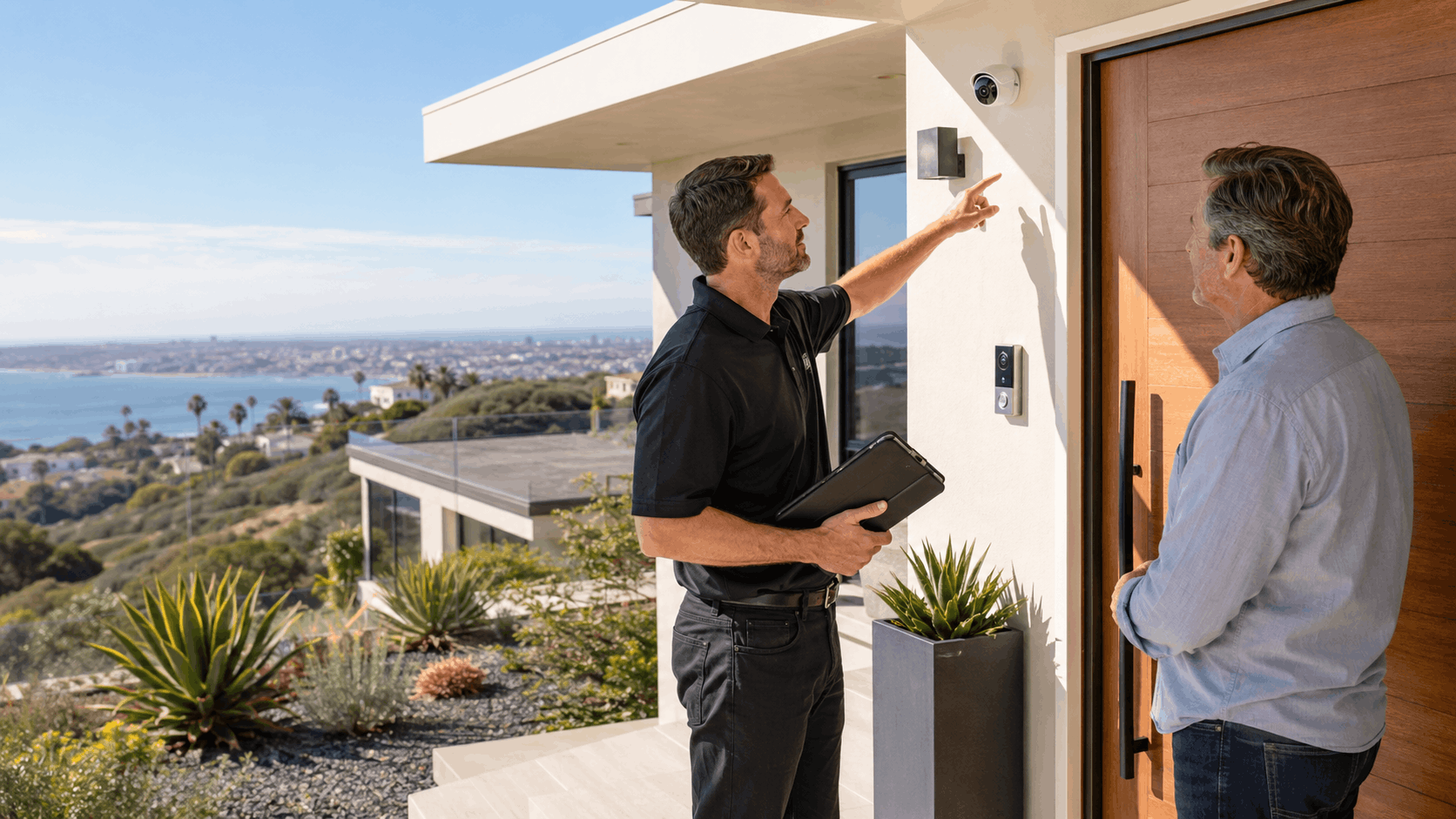
Every job starts with a security assessment in person. We walk the property, note every door and window, trace the driveway and yard paths, and check how the sun and fog hit the lot. You cannot plan a hilltop system from a satellite photo.
During the site survey we flag salt exposure zones, sightline gaps, and the best mounting points that keep your view clear. We look at power and network access too, since those shape whether a spot goes wired or wireless. Every lot has quirks, and this is where we find them.
By the end of the walkthrough, we have a real map of the property and a plan that fits it. You get to weigh in on camera placement and priorities before anything is ordered. That upfront work is why the install goes smoothly.
Working With Steep and Difficult Lots
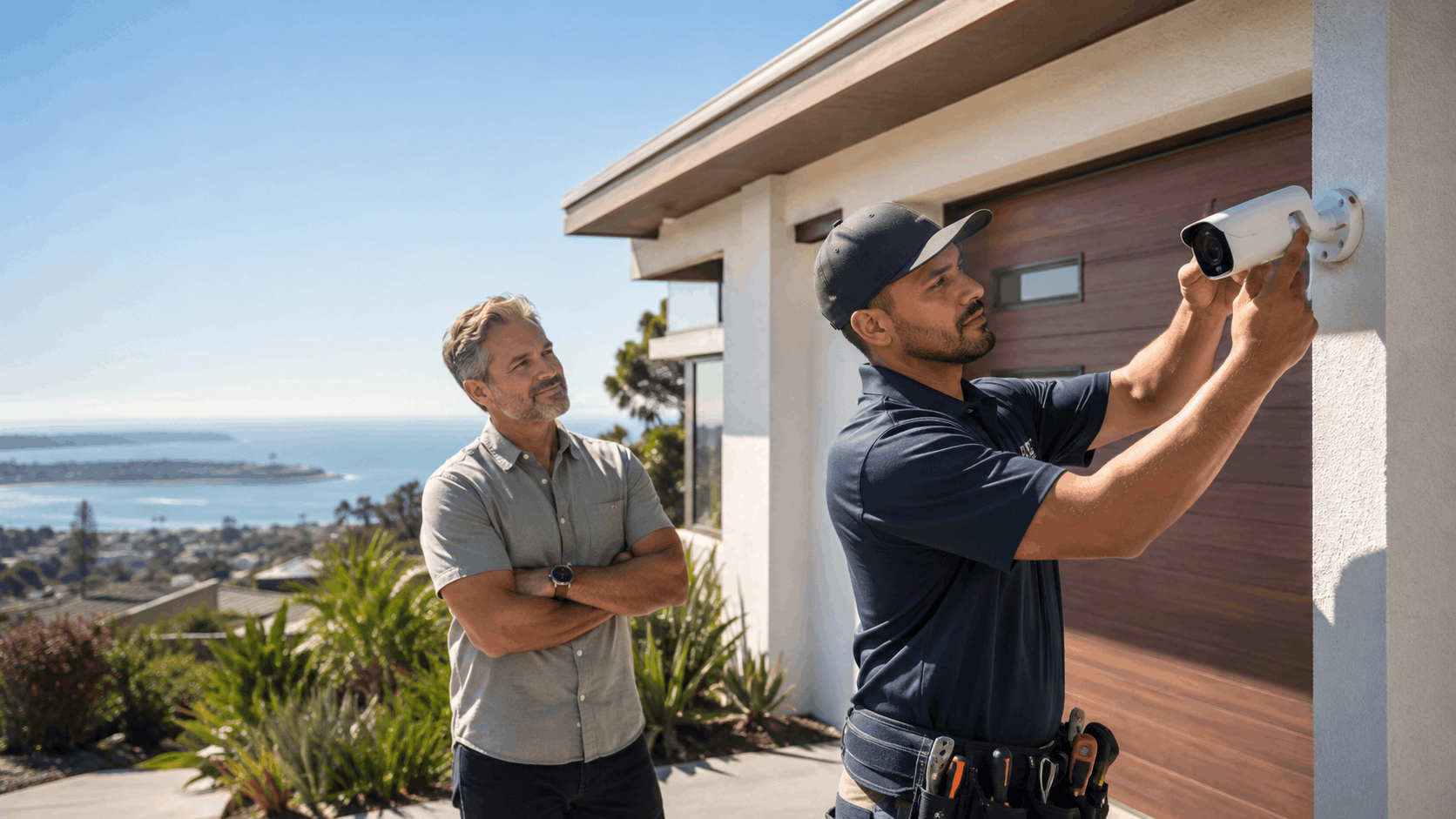
Terraced hilltop properties test any installer. Mounting cameras on multiple levels, running wire up a slope, and reaching high eaves takes the right equipment and care. Our crews handle hilltop installation without tearing up your landscaping to do it.
On a difficult lot, we plan cable routes that follow existing lines and hide runs where we can. We use proper ladders and mounts rather than shortcuts that leave gear crooked or loose. Steep does not mean sloppy.
We also protect the plantings and hardscape that make these yards special. Where a wired run would mean trenching through a mature garden, we look at a wireless point instead. The goal is a clean install that respects the property.
Timelines and What to Expect
A standard Point Loma home usually takes one to two days for a full installation. Simpler setups with a handful of cameras and an alarm can wrap in a single visit. The setup process depends on the size of the home and how much wiring is involved.
Larger hilltop estates with cameras across multiple terraces can stretch to a second or third visit. The installation timeline grows when we are running long wired routes or working around difficult access. We give you a realistic schedule after the walkthrough, not a guess.
Once the hardware is in, we set up the app, test every device, and walk you through using it. You leave knowing how to arm the system, pull up cameras, and manage codes. We do not consider a job done until you are comfortable running it.
Maintenance for Coastal Conditions
Gear near the water needs a little more attention than inland systems. Salt film builds up on camera lenses and housings and dulls the image over time. A wipe-down every few months keeps the picture sharp.
We recommend a professional check once or twice a year for coastal homes, more if you are right on the water at La Playa or Shelter Island. We inspect seals, clean lenses, test sensors, and catch early corrosion before it kills a device. Our security system maintenance service keeps coastal gear running for years.
Simple coastal upkeep between visits helps a lot - rinsing salt off exterior housings and keeping vegetation trimmed away from cameras. Batteries in wireless devices get checked on schedule too. A little maintenance beats replacing corroded equipment early.
Need Help in San Diego?
Smart Shield Systems serves San Diego and all of San Diego County.
Choosing a Local Security Specialist Over a National Chain
A national provider reads from a script written for the whole country. A local security company that works the peninsula every week already knows what Point Loma throws at a system. That difference shows up in the results.
For San Diego security near the coast, local knowledge and real service beat a call center every time. Here is why the local choice matters here.
Knowledge of Coastal Property Challenges
A coastal specialist does not learn about salt air corrosion from a manual. We have replaced enough corroded gear across Point Loma to know exactly which equipment survives and which fails early. That experience goes into every plan we build.
Local knowledge also means we know the neighborhoods. We know the fog patterns near Sunset Cliffs, the steep lots off Catalina Boulevard, and the older window frames near Rosecrans. A national installer sees a generic address, not a peninsula home.
That familiarity saves you from paying for lessons we already learned. We spec the right housing, the right camera angles, and the right sensor types the first time. You get a system built for where you actually live.
Faster Service and Real People
When something goes wrong, a distant call center means holds, tickets, and a wait for someone to be scheduled out from far away. A San Diego team answers and gets to you faster. Local service means shorter response time on repairs and questions.
You also deal with real people who remember your home and your setup. There is no re-explaining your system to a new rep every call. We keep records of what we installed and why, so support is quick and informed.
For coastal gear that occasionally needs attention, that responsiveness matters. A camera down after a storm gets handled in days, not weeks. Being local is the whole advantage.
Custom Plans, Not One-Size Packages
National chains push fixed packages because they scale. That works for a cookie-cutter tract home and fails on a terraced hilltop lot with a bay view. A custom security plan starts from your property, not a catalog.
We build a home-specific system around your sightlines, your entry points, and your salt exposure. You are not paying for cameras you do not need or missing coverage you do. Every piece has a reason tied to your lot.
That approach costs the same or less than an oversold package with the wrong gear. You get exactly what protects your home. Nothing extra, nothing missing.
How Smart Shield Systems Serves Point Loma
Smart Shield Systems works across the peninsula and the wider San Diego area every week. From the hilltop homes on Chatsworth Boulevard to the waterfront near Shelter Island, we know the conditions and the neighborhoods firsthand.
Our team handles cameras, alarms, smart locks, and full integration for Point Loma security, all built around the coastal and hilltop realities of the area. We also serve homes and businesses throughout the county, so we bring broad experience to every job.
If you want a system built by people who actually work these streets, we are ready to help. Reach out through our contact page to set up a walkthrough. You can also see the full range of what we offer on our services page.
Final Thoughts
Point Loma homes face a mix of challenges most systems ignore - salt air corrosion, steep blind spots, marine layer fog, and quiet winding streets. The right setup plans for all of it with coastal-grade gear, smart camera placement that protects your view, and monitoring that shortens response time.
Whether you live here full time or leave a second home empty part of the year, a system built for the peninsula gives you real protection. Local knowledge is the difference between gear that lasts and gear that rusts out in a season.
If you are ready to secure your hilltop or coastal home the right way, our team is here to walk your property and build a plan around it. Call Smart Shield Systems or reach out through our contact page to schedule a free consultation.
Frequently Asked Questions
- How much does a home security system cost in Point Loma?
- Costs vary with home size and coverage. A basic alarm with a few sensors and one or two cameras often runs several hundred to a couple thousand dollars for equipment and install, plus a monthly monitoring fee. Hilltop lots raise the price when they need cameras at multiple elevations, coastal-grade housings, and longer wiring runs. We quote after a walkthrough so the number reflects your actual property.
- Does salt air really damage security cameras?
- Yes. Salt in the ocean air corrodes metal fasteners, door contacts, and cheap housings, often showing rust within 12 to 18 months near the water. Standard inland-rated gear fails early on the peninsula. Marine-grade coatings, sealed gaskets, stainless fasteners, and at least an IP66 rating hold up far longer. Choosing the right materials upfront is how you avoid replacing corroded equipment every year or two.
- Can cameras be placed without blocking my ocean view?
- Absolutely. Cameras belong at the edges of the view, aimed across your approaches rather than out at the water. Low-profile domes and bullets tucked under eaves or in corners, color-matched to your trim, disappear into the architecture. We map your sightlines during the walkthrough and place gear to cover every path to the house while keeping the bay and ocean views completely clear.
- Are wireless systems reliable on a hilltop property?
- Wireless works well for outlying spots, but steep lots challenge signal range. Thick walls, distance, and elevation changes weaken a connection over a large hilltop property. For main coverage points we usually recommend wired cameras for reliability and steady power, then use wireless with mesh points or repeaters for corners a cable cannot reach easily. A hybrid setup gives you the best of both on difficult terrain.
- How do I secure a home that sits empty part of the year?
- Combine remote monitoring, environmental sensors, and access control. Leak and flood sensors catch water damage early, humidity sensors flag mold conditions, and entry alerts warn you the moment a door opens. A mobile app lets you check live cameras and sensor status from anywhere. Temporary access codes handle cleaners or guests without physical keys. Together these give real protection while your Point Loma home sits vacant.
- Do Point Loma HOAs restrict exterior cameras?
- Some communities and condo associations do have rules on exterior cameras and equipment placement. They may limit where cameras can point, whether they capture common areas, and how gear mounts on shared walls. Check your CC and Rs before installing to avoid a costly redo or a dispute with neighbors. We help place cameras that meet both your security needs and your association's guidelines.
- How long does installation take?
- A standard Point Loma home usually takes one to two days. Simpler setups with a few cameras and an alarm can finish in a single visit. Larger hilltop estates with cameras across multiple terraces may need a second or third visit, especially with long wired runs or difficult access. We give you a realistic timeline after the on-site walkthrough rather than a blind estimate.
- Is professional monitoring worth it?
- On the peninsula's quiet, winding streets, yes. A self-monitored system only sends an app alert - if you are asleep, traveling, or at a second home, nobody responds. Professional monitoring puts a real person on every alarm to verify it and dispatch responders immediately, day or night. That verification and dispatch step saves real time when a neighbor may not hear a siren.
- How often should coastal security gear be serviced?
- Plan on a professional check once or twice a year for most coastal homes, and more often if you are right on the water at La Playa or Shelter Island. We clean lenses, inspect seals, test sensors, and catch early corrosion before it kills a device. Between visits, rinse salt off exterior housings and keep vegetation trimmed away from cameras to keep everything working.
- Why choose a local specialist over a national company?
- A San Diego team that works Point Loma every week already knows how salt air and fog affect gear across the peninsula's neighborhoods. We spec the right coastal equipment and camera angles the first time, respond faster on service since we are nearby, and build a custom plan around your specific lot instead of a fixed national package. Local knowledge simply produces a better, longer-lasting system.
S
Smart Shield Systems Team Team
Licensed security systems professionals serving San Diego and San Diego County.
Licensed in California · License #7623
Why trust Smart Shield Systems?
Founded in 2016, Smart Shield Systems is a licensed and insured security systems serving San Diego and San Diego County. All content is reviewed by our licensed technicians.

Need Help in San Diego?
Smart Shield Systems serves San Diego and all of San Diego County.
Related Articles
Tips & Advice
Bird Rock La Jolla Security: Coastal Property Camera Specialists
A local guide to coastal security cameras for Bird Rock and La Jolla homes, covering salt air challenges, gear selection, install, upkeep, costs, and local rules.
Tips & Advice
Del Mar Home Security: Bluff and Oceanfront Property Specialists
Del Mar coastal homes face salt air corrosion, bluff blind spots, and beach-side risks. Learn the equipment, placement, permits, and pricing that keep oceanfront property secure.
Tips & Advice
Coronado Home Security: Island Property and Military Family Service
A local guide to Coronado home security covering island property challenges, salt air corrosion, remote monitoring for deployed military families, camera setups, and honest pricing.