Tips & Advice
Wireless vs Hardwired Sensors: Which Performs Better in Coastal Humidity
Key Takeaways
- San Diego's daily marine layer cycling - not just peak humidity levels - is the primary driver of accelerated sensor wear in coastal neighborhoods like Ocean Beach, Pacific Beach, and Mission Beach.
- Salt air corrosion attacks metal contacts inside both wireless and hardwired sensors, often causing failures within two years in high-exposure locations like Coronado and Sunset Cliffs if low-quality hardware is installed.
- Budget wireless sensors with foam gaskets and alkaline batteries fail fastest in coastal conditions; quality wireless sensors rated IP54 or better with silicone gaskets and lithium batteries can deliver five to seven years with annual maintenance.
- Hardwired sensors offer superior long-term reliability in coastal environments when installed with liquid-tight conduit, weatherproof junction boxes, and corrosion-resistant hardware - but a poorly installed hardwired system can fail faster than a quality wireless one.
- Hybrid sensor systems - hardwired at critical perimeter points and quality wireless for interior zones - are often the most practical and cost-effective solution for older coastal homes with plaster walls and limited wiring access.
- Humidity-related false alarms carry real financial consequences under San Diego's false alarm ordinance, making sensor quality and annual inspections a cost-saving decision, not just a technical one.
- Photoelectric smoke detectors handle coastal marine layer conditions with significantly fewer nuisance alarms than ionization types, making them the correct choice for San Diego beach homes.
- Smart Shield Systems recommends annual professional inspections for any alarm system within two miles of the San Diego coastline to catch early corrosion, gasket degradation, and voltage decline before they become system failures.
In This Article
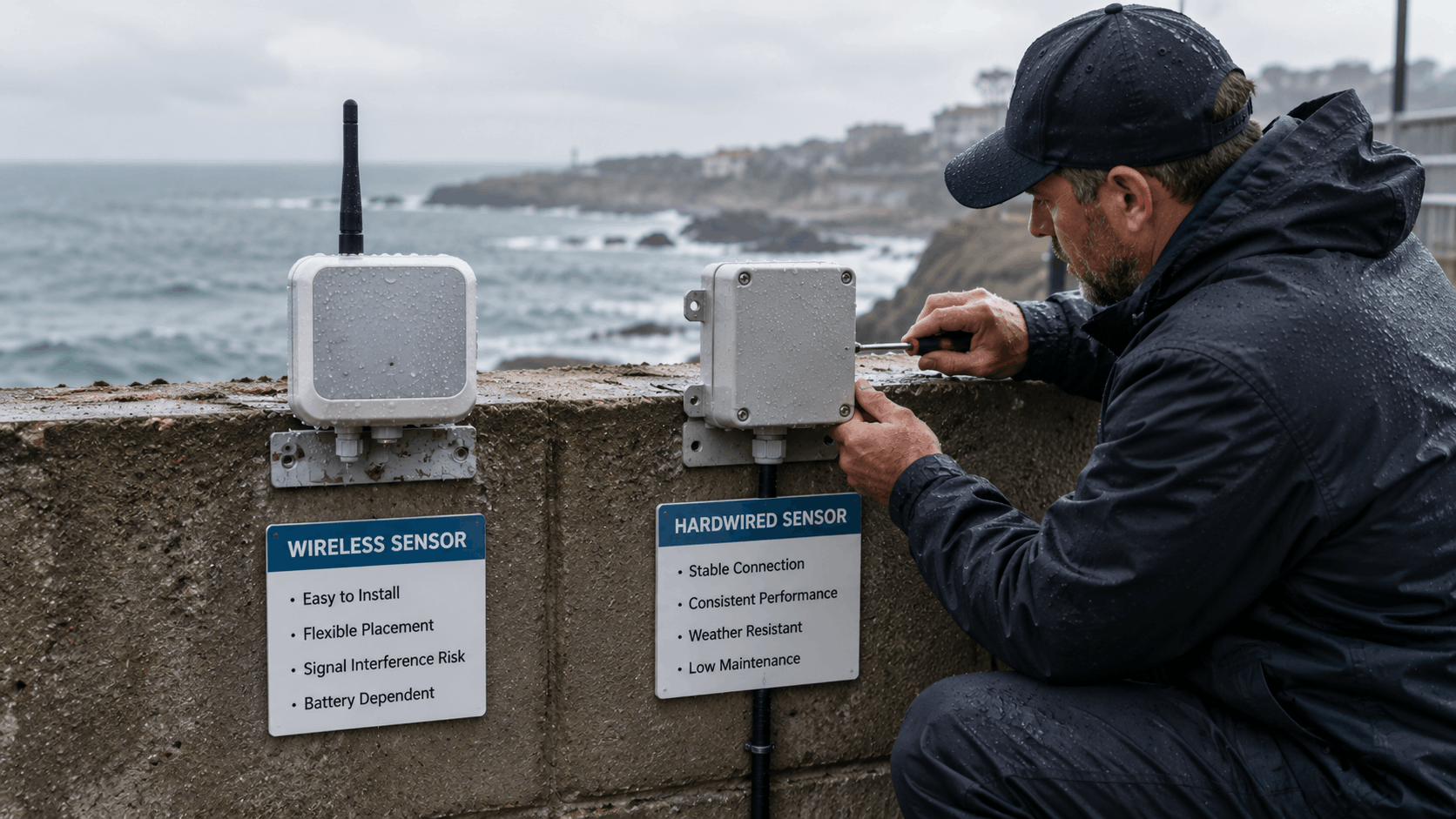
A homeowner on Froude Street in Ocean Beach called us last July after her alarm system started throwing random alerts every morning around 6 a.m. The timing was not random at all. The marine layer was rolling in off the water, pushing relative humidity above 85 percent, and her door contact sensors - installed just two years earlier by a national chain - were soaking it up like a sponge. By the time she called, three sensors had dropped off her panel entirely and two more were triggering false alarms almost daily. The sensors were not cheap, but they were not built for where she lived.
This scenario plays out across coastal San Diego neighborhoods every year. The question of wireless vs hardwired sensors is not just a technical debate about wires and radio frequencies. In a city where the air carries salt off the Pacific and the humidity swings 40 percent between morning and afternoon, the stakes are higher than they are in Phoenix or Sacramento. The choice between sensor types directly affects how long your system lasts, how often you get nuisance alarms, and whether your protection holds up when the marine layer settles in for weeks at a time.
Why Coastal Humidity in San Diego Is Harder on Sensors Than Most People Expect
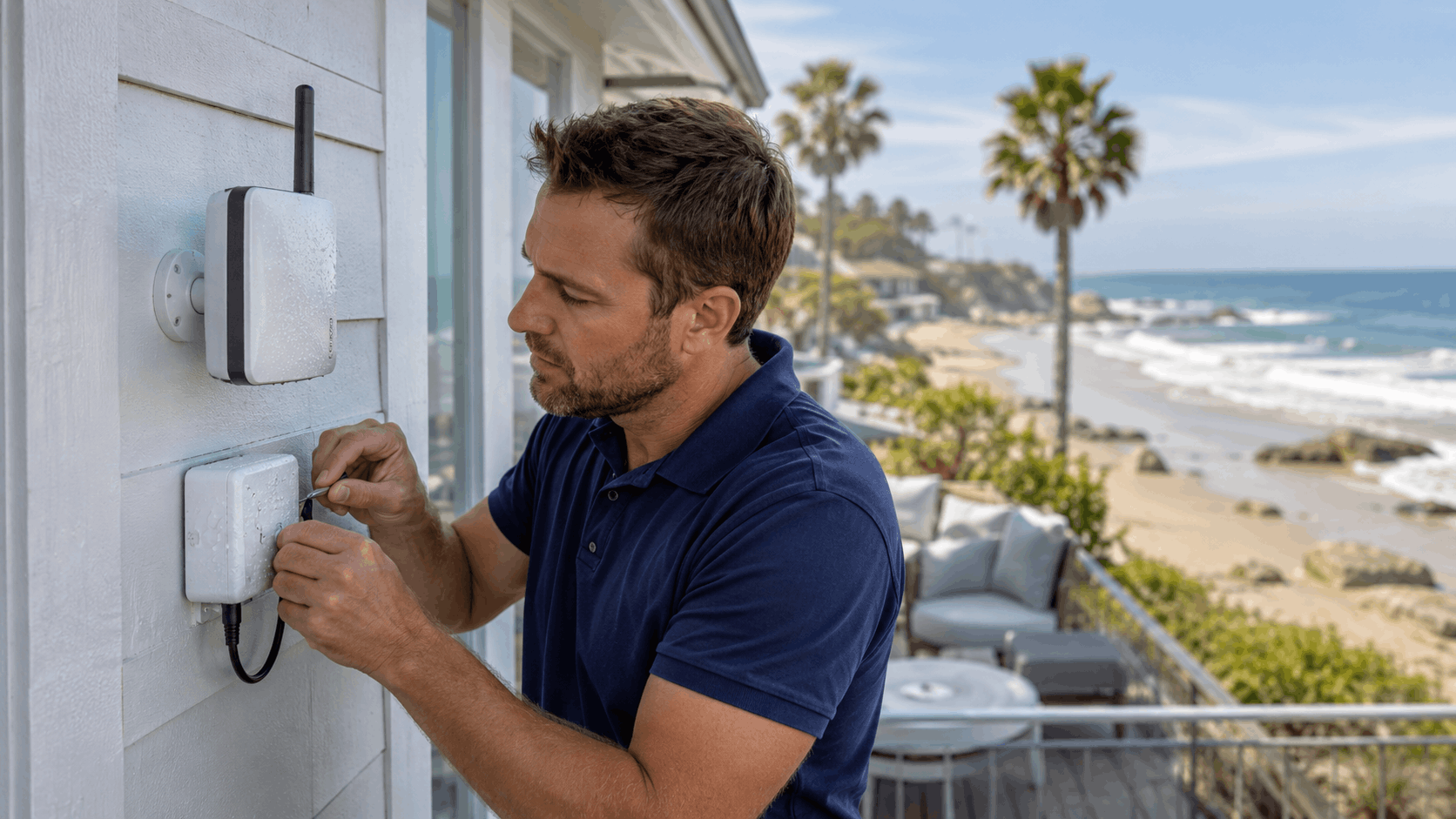
Most sensor manufacturers test their products in laboratory conditions or in climates that resemble the national average. San Diego's coastal strip does not look like that average at all. The combination of daily marine layer, salt-laden air, and rapid humidity swings creates a wear pattern that shortens sensor life and causes failure modes that simply do not show up in inland installations.
The Marine Layer Effect Along the Coast from Ocean Beach to La Jolla
From roughly June through September, the marine layer rolls in off the Pacific most mornings, blanketing neighborhoods from Ocean Beach north through Mission Beach, Pacific Beach, and up to La Jolla. During peak marine layer season, relative humidity in these zip codes routinely climbs above 80 percent before sunrise and stays there until the sun burns the fog off by late morning. That daily cycle repeats five or six days a week for months at a stretch.
What makes this worse for sensors than a rainy climate is the wet-dry cycling itself. A sensor in Portland might sit in consistently damp air for weeks. A sensor near the Crystal Pier in Pacific Beach gets soaked in moisture every morning, then dries out in afternoon sun, then gets soaked again. That expansion and contraction stresses gaskets, corrodes contacts, and degrades adhesive seals faster than constant rain ever would. The cycling is the damage mechanism, not just the raw humidity level.
Marine layer humidity also penetrates places that ordinary weather does not reach. Window frames, door jambs, and wall voids all absorb that morning moisture. Sensors mounted in these locations - which is where most sensors belong - are exposed to ambient humidity that is often higher than what a weather station a mile inland is recording. Homes along La Jolla Boulevard or West Point Loma Boulevard experience this effect almost every morning during summer, and many homeowners do not connect it to sensor problems until the alarms start acting up.
The marine layer also affects Pacific Beach security installations at the panel level. Wireless panels mounted in garages or utility closets near exterior walls can absorb enough ambient humidity to affect internal components over time. This is a detail that matters when deciding where to locate the control panel itself, not just the sensors.
Salt Air Corrosion and What It Does to Sensor Contacts Over Time
Anyone who has lived within a few blocks of the water in San Diego knows what salt air does to metal. Patio furniture, door hinges, and window screens all corrode faster near the coast than they do even a few miles inland. Sensor contacts are no different, and the failure mode is more subtle - and more dangerous from a security standpoint - than rust on outdoor furniture.
Salt particles carried on the breeze deposit on every exposed metal surface, including the tiny contacts inside both wireless and hardwired sensors. Those deposits are hygroscopic, meaning they attract and hold moisture from the air. Over time, this creates a low-level electrochemical reaction on the contact surfaces that degrades conductivity and introduces resistance into circuits that need clean, reliable connections to report accurately. A contact sensor that reads correctly at installation can develop intermittent faults within 18 to 24 months in a home along Sunset Cliffs Boulevard - not because the sensor was defective, but because the environment attacked it.
Coronado security sensor installations demonstrate this problem clearly. Properties on Coronado - surrounded by the bay on one side and the Pacific on the other - see salt air exposure from multiple directions. Homeowners there sometimes notice their first sensor problems within two years of installation, which surprises them because the manufacturer rated the device for five years or more. The rating assumes average environmental exposure, not Coronado's salt-air envelope.
The corrosion problem affects both wired and wireless sensors, but it shows up differently in each type. In hardwired sensors, corroded terminations at the sensor end of a wire run cause intermittent opens in the circuit that the panel reads as a zone fault. In wireless sensors, corroded battery contacts cause voltage drops that mimic a dead battery or cause the sensor to drop off the network entirely. Both failure modes produce the same result from the homeowner's perspective: an unreliable system.
How Humidity Ranges Differ Between Coastal and Inland San Diego Neighborhoods
The difference in daily humidity between zip code 92109 (Pacific Beach) and zip code 92071 (Santee) is not marginal - it is substantial enough to mean completely different sensor performance expectations. Coastal neighborhoods like 92109 and 92107 (Ocean Beach) regularly see morning humidity between 80 and 90 percent during marine layer season. Santee and El Cajon, just 15 to 20 miles east, might see morning humidity in the 50 to 60 percent range on the same morning.
Sensor manufacturers publish humidity ratings, typically expressed as a maximum operating relative humidity, and most fall in the 90 to 95 percent range. That sounds like coastal San Diego would be fine. But those ratings describe static conditions, not the rapid wet-dry cycling described above. A sensor sitting at 90 percent humidity continuously behaves differently than one that swings from 88 percent at 7 a.m. to 45 percent at 2 p.m. and back again every day for five months. The cycling is the stressor, not the peak reading.
Inland neighborhoods like Kearny Mesa or Mira Mesa see enough humidity variation from coastal areas that a sensor spec sheet written for average U.S. conditions is more likely to hold up there. This is not to say inland installations never have humidity problems - summer monsoonal moisture affects the whole region - but the daily marine layer cycling that wears out coastal sensors simply does not happen with the same intensity five miles from the water.
This gap between coastal and inland conditions is why Smart Shield Systems treats San Diego security installations near the water as a separate category from the rest of the service area. The product selection, installation methods, and maintenance schedules we recommend for a home near the beach differ from what makes sense in Rancho Bernardo or Santee, and that difference is grounded in years of watching what actually fails and why.
How Wireless Sensors Handle Coastal Humidity
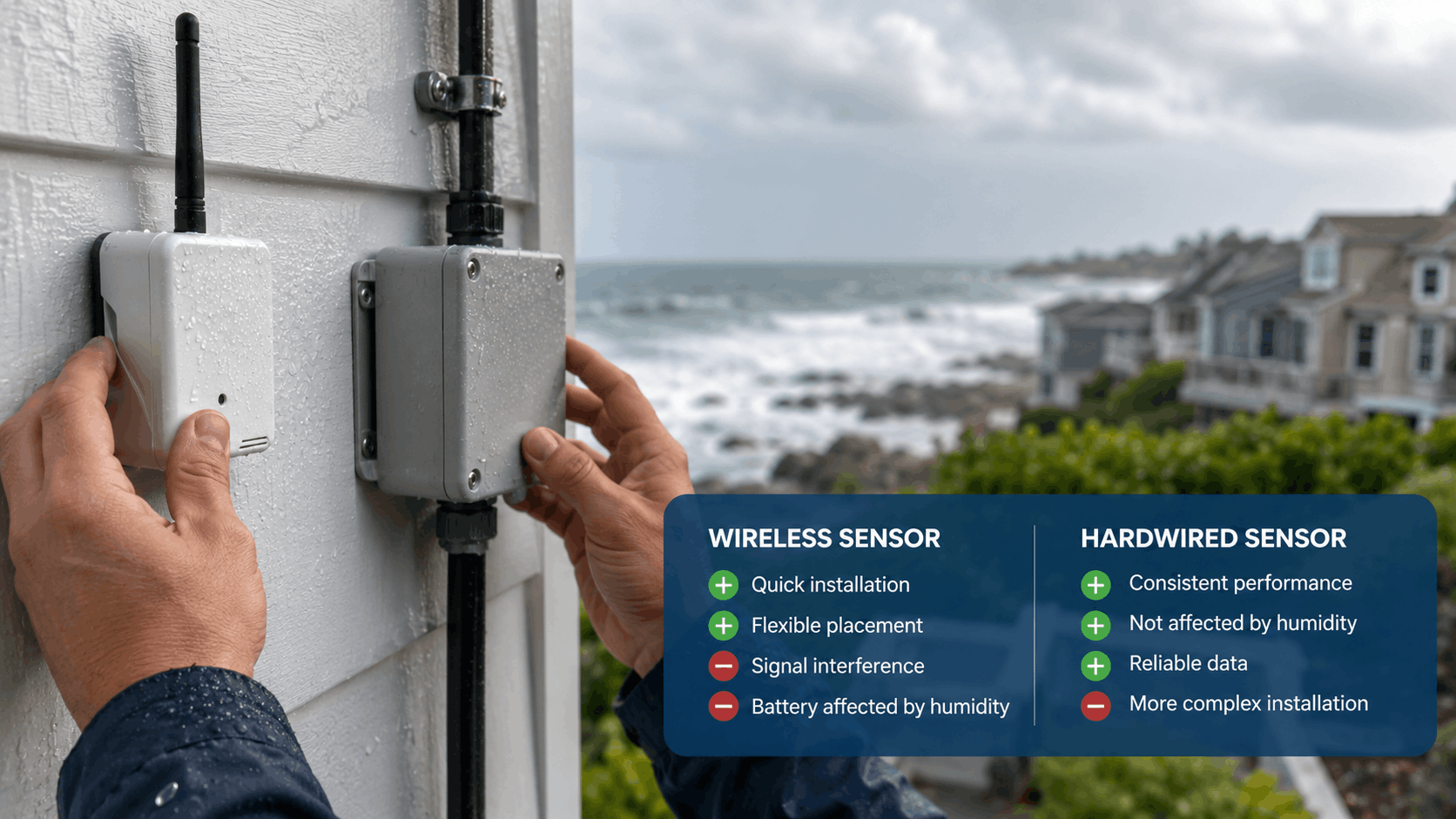
Wireless sensors are popular for good reason - no wire runs, easier placement, and faster installation in homes where fishing wire through walls is a major project. But their performance in coastal San Diego humidity is a mixed picture that depends heavily on sensor quality, placement, and maintenance discipline.
| Factor | Quality Wireless Sensor | Budget Wireless Sensor |
|---|---|---|
| IP Rating | IP54 or higher | Often unlisted or IP20 |
| Gasket Material | Silicone or EPDM | Foam or absent |
| Battery Chemistry | Lithium recommended | Alkaline standard |
| Contact Material | Gold-plated or stainless | Bare copper or tin |
| Expected Coastal Life | 5-8 years with maintenance | 1-3 years |
| False Alarm Risk (humidity) | Low to moderate | High |
Battery Drain Speeds Up When Humidity Is High
Battery-powered wireless sensors carry an inherent weakness in high-humidity environments: moisture in the air accelerates the electrochemical discharge of most battery types. Alkaline batteries are particularly affected. In a dry inland environment like El Cajon, a door contact sensor might run two to three years on a single set of batteries. In a beachside neighborhood like Bird Rock home security installations along La Jolla Boulevard, that same sensor can eat through batteries in 12 to 18 months.
The mechanism is not dramatic. High ambient humidity creates micro-condensation on battery contacts and cell surfaces. This creates a small but persistent parasitic drain even when the sensor is not actively transmitting. Over months, this shaves 30 to 40 percent off the rated battery life. Manufacturers calculate battery life under controlled conditions - typically around 50 percent relative humidity - which bears no resemblance to a sensor on a sliding glass door in Mission Hills during June.
Lithium batteries perform significantly better in humid environments than alkaline. They resist the parasitic drain described above, hold voltage more consistently across temperature swings, and operate reliably at high humidity levels that would stress alkaline cells. For any wireless sensor installed within half a mile of the San Diego coastline, lithium is the correct chemistry to specify from day one - not as an upgrade, but as the baseline. This is one of the first things our team recommends when a homeowner reports unexpected battery failures.
The practical implication for homeowners is that wireless sensor battery replacement near the coast is not a set-and-forget task. A realistic schedule for coastal wireless sensors near the water is annual replacement for alkaline-equipped sensors, and 18-month to 2-year replacement for lithium-equipped sensors. Building that into a maintenance plan - rather than waiting for a low-battery notification - keeps the system reliable and avoids the failure modes that come with a sensor running on a depleted cell.
Signal Interference and Range Issues Near the Water
Radio frequency signals that wireless sensors rely on can be affected by moisture in the air, but the relationship is more nuanced than simple signal blocking. Water vapor absorbs certain RF frequencies, and the degree of absorption depends on signal frequency, distance, and the density of moisture in the air. In most residential installations, this effect is minor. But on larger coastal properties, it can translate into dead zones that never appear during dry-weather commissioning tests.
La Jolla security systems on larger residential lots - particularly properties with detached guest houses, long fence lines, or extensive covered outdoor areas - sometimes show signal degradation during heavy marine layer mornings that did not appear when the system was first tested in October. The installer ran a range test on a dry fall afternoon, got clean signal everywhere, and signed off. By the following summer, two sensors near the back of the property were intermittently dropping off the network during foggy mornings.
Del Mar properties along the bluffs face a similar issue. The combination of distance from a central panel and elevated marine layer humidity can create marginal signal conditions at the outer edges of a wireless coverage zone. The fix is usually a repeater or range extender, but the need for one is rarely apparent until the system has lived through a marine layer season. This is why our team re-evaluates signal maps for coastal properties after the first summer rather than assuming the commissioning-day test tells the whole story.
RF interference near the water is not only from humidity. The San Diego coastline hosts dense residential areas with significant Wi-Fi traffic, Z-Wave devices, and Zigbee products operating in overlapping frequency bands. This electromagnetic background noise is another reason why wireless sensor range can fall short of manufacturer specifications in high-density coastal neighborhoods like Pacific Beach and Mission Beach, where dozens of competing wireless networks occupy the same spectrum within any given block.
Gasket and Casing Quality - What Separates a Good Wireless Sensor from a Bad One
The IP rating on a sensor's spec sheet is one of the most telling numbers for coastal installations. IP54 means the device is protected against dust and splash water from any direction. IP65 means it handles low-pressure water jets. For sensors mounted in covered patios, garages with ocean-facing roll-up doors, or on exterior window frames within a block of the water, IP54 should be considered the minimum acceptable rating - not a premium feature.
Budget wireless sensors sold through big-box stores or national low-cost security services often carry no listed IP rating or show IP20, which means minimal protection from fingers and objects but no meaningful moisture resistance. In a coastal San Diego garage or on a sliding door frame in South Mission Beach, an IP20 sensor's useful life can be measured in months rather than years. The gasket material matters as well. Foam gaskets compress and degrade quickly with repeated wet-dry cycling. Silicone and EPDM gaskets hold their shape and seal integrity for years under the same conditions.
Contact material inside the sensor housing is another differentiator that rarely makes it into sales conversations. Gold-plated or stainless steel contacts resist the electrochemical corrosion that salt air promotes. Bare copper or tin contacts, common in budget devices, oxidize and lose conductivity within a relatively short window in coastal conditions. This is not visible from the outside - the sensor looks fine while the contacts inside are degrading. The only indicator is eventually an intermittent fault or a dropped zone on the panel.
When reviewing a sensor spec sheet for a coastal installation, our team looks at IP rating, gasket material, contact material, battery chemistry compatibility, and the rated operating humidity range. If any of those fields are blank or unspecified, that is an answer in itself. Reputable manufacturers who build for demanding environments list those specifications because they know buyers in coastal markets will ask.
Where Wireless Sensors Actually Work Well in Coastal Homes
Wireless sensors are genuinely well-suited for a large portion of a coastal San Diego home, particularly in interior zones where climate control keeps humidity in check. A living room PIR motion detector, an interior hallway door contact, or a sensor on a bedroom window that stays closed most of the year are all locations where wireless performs reliably even in a beach community. The humidity problem is concentrated at the perimeter, not throughout the structure.
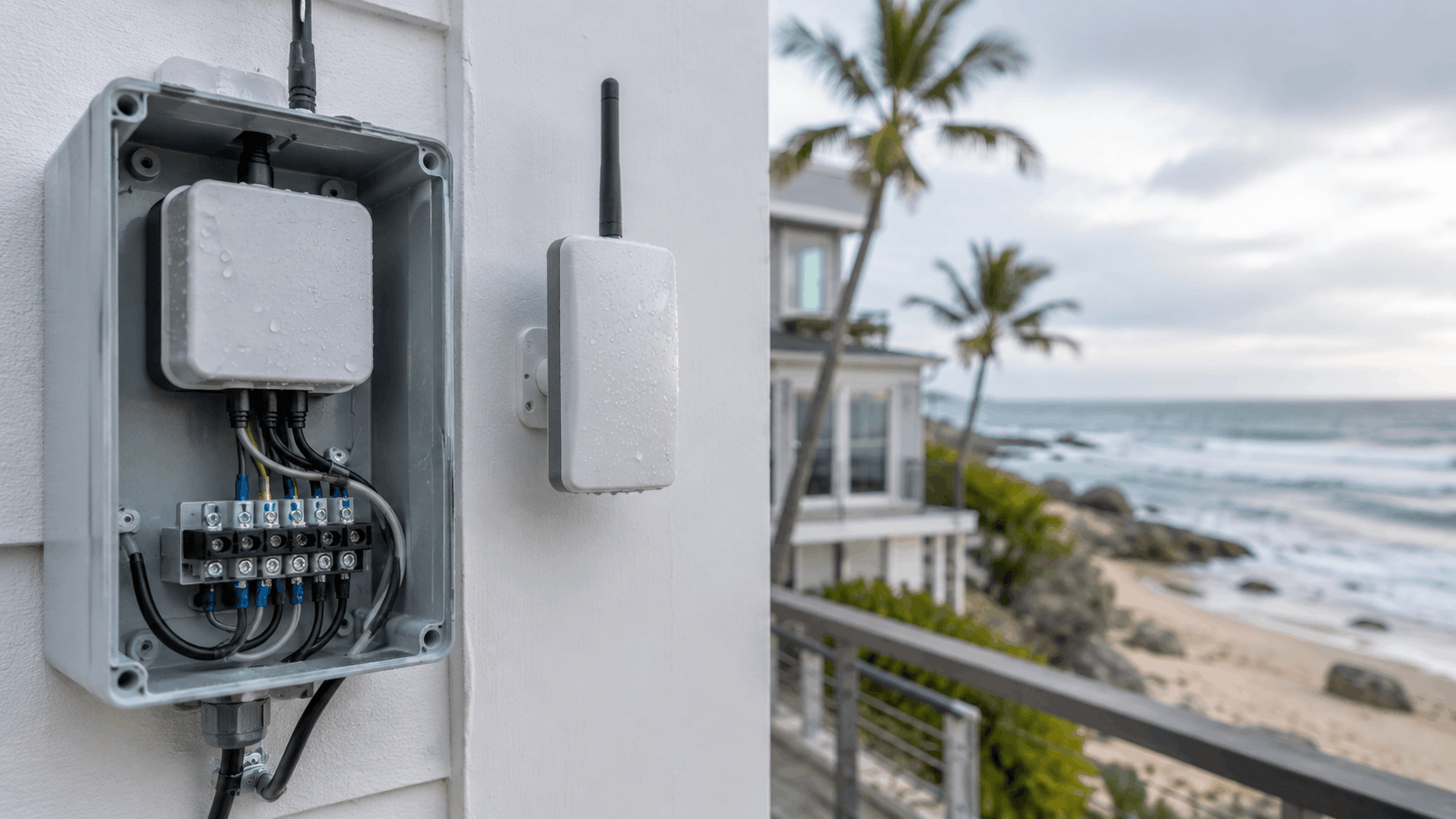
Older beach bungalows in South Mission Beach and North Ocean Beach present a real structural challenge for hardwired systems. Plaster walls, minimal attic access, and finished ceilings make fishing wire a labor-intensive and expensive proposition. In these homes, wireless sensors for interior zones are not just convenient - they are often the most practical choice from a cost and disruption standpoint. A hybrid approach, with hardwired sensors at the most exposed perimeter points and quality wireless sensors for interior zones, is how our team handles many of these properties.
Wireless sensors on interior sliding doors, which are extremely common in California beach homes, also perform well as long as the door track area is not directly exposed to outside air. A sliding glass door that opens to a covered lanai or an interior courtyard has a very different exposure profile than one that opens directly to an oceanfront deck. Placement assessment - looking at where the sensor actually lives, not just what room it is in - drives these decisions more than any general rule about wireless being good or bad near the coast. Our intrusion sensor installation process always includes a detailed placement review for exactly this reason.
Need Help in San Diego?
Smart Shield Systems serves San Diego and all of San Diego County.
Get Your Free Quote
Tell us about your property and we'll get back to you fast.
How Hardwired Sensors Hold Up Against San Diego's Salty Air
Hardwired sensors carry a reputation for reliability, and in many ways that reputation is earned. But the wiring infrastructure that powers them creates its own set of vulnerabilities in coastal San Diego homes, and ignoring those vulnerabilities leads to problems that can be just as disruptive as wireless sensor failures.
Why Wiring Runs and Junction Boxes Become Weak Points Near the Coast
In a well-sealed modern home, hardwired sensor runs live inside conditioned wall cavities where humidity is relatively controlled. In older coastal construction - and there is a lot of it in areas like Point Loma and Barrio Logan - the picture is different. These homes were built decades before modern moisture barriers and vapor management were standard practice. Wall cavities near exterior surfaces breathe with the outside air, meaning wire runs in those cavities experience the same humidity cycling as the exterior sensors they serve.
Junction boxes mounted in garages, utility spaces, or on exterior walls are direct targets for moisture infiltration. Salt-laden condensation can form on the interior surfaces of a metal junction box during marine layer mornings, depositing moisture directly onto wire terminations. Over time, this produces the same corrosion pattern seen on sensor contacts - degraded conductivity, intermittent circuit opens, and eventually panel faults that present as zone drops or false alarms. A Point Loma home security installation in a 1960s-era single-wall construction house can develop these issues within three to four years if the junction boxes and terminations are not properly weatherproofed from the start.
Corroded wire terminations are one of the most common root causes of false alarms in hardwired systems near the coast. When a corroded connection introduces resistance into a normally-closed sensor circuit, the panel can read the increased resistance as a momentary open - an intrusion event. The homeowner sees an alarm they did not expect. The panel log shows the zone triggered. But there is no physical cause beyond a deteriorating solder joint or terminal block connection inside a damp junction box. This is a frustrating failure mode because it is invisible without opening the box and inspecting the connections directly.
The fix is not complicated, but it requires attention during installation. Using weatherproof junction boxes with IP65 or better ratings, applying dielectric grease to all terminations, and securing conduit entry points with liquid-tight fittings prevents the vast majority of moisture-related junction box failures. The problem is that these steps add time and materials cost. In a competitive bid environment, they are sometimes the first thing cut, and the homeowner pays for that shortcut two years later.
The Consistency Advantage - Hardwired Sensors Do Not Lose Signal or Run Out of Battery
The single strongest argument for hardwired sensors in any environment is their independence from batteries and RF signal quality. A hardwired door contact on the front door of a Solana Beach home on Pacific Coast Highway does not go offline because a battery ran down during a foggy November week when the homeowner was traveling. It does not lose signal because a neighbor installed a new Wi-Fi router that competes with its frequency. It is on, always, as long as the wire run and panel are intact.
For large properties in Rancho Santa Fe or along the bluffs north of Del Mar, this consistency advantage is material. A wireless sensor system covering a 5,000-square-foot estate with detached structures, extensive fencing, and a long driveway introduces multiple points where signal or battery failure can create coverage gaps. A hardwired system covering the same property eliminates those failure modes entirely. The upfront cost and installation complexity are higher, but the operational reliability over five or ten years is demonstrably better.
Hardwired systems also perform better in high-security applications where a dropped sensor zone is unacceptable. Commercial properties along the Embarcadero or industrial facilities near the port benefit from the absolute consistency of a hardwired sensor network. Our commercial alarm system installation process in coastal areas defaults to hardwired sensors at all critical points for this reason. The maintenance burden shifts from battery management to periodic inspection of terminations and conduit seals, which is a more controllable and predictable task.
Homeowners who spend significant time away from their coastal properties also benefit from hardwired systems. A beach house in Carlsbad or a vacation property near the Del Mar racetrack is exactly the kind of installation where a dead battery in a window sensor at 2 a.m. during a fall storm should not be the event that leaves the property unmonitored. Hardwired sensors remove that variable entirely.
How Conduit Choice and Proper Sealing Change the Picture in Humid Zones
The difference between a hardwired system that lasts 15 years in a coastal environment and one that starts failing at year three often comes down to conduit selection and installation practice. Liquid-tight flexible conduit - the corrugated metal or polymer conduit with a waterproof outer jacket - is the correct choice for any wire run that passes through exterior walls, enters a garage, or runs through a crawl space in a coastal property. Standard EMT conduit, which is common in interior commercial work, is not moisture-rated and will allow water infiltration at every fitting over time.
Entry points where conduit penetrates exterior walls deserve particular attention. A conduit run that enters a wall from outside without a proper liquid-tight fitting and sealant is an open channel for humid air to track directly into the wall cavity and toward the panel. In a home near Sunset Cliffs, where prevailing winds carry salt air directly toward west-facing walls, an unsealed conduit penetration can introduce corrosive moisture into a wire run within a single season. The fix at installation is inexpensive. The fix after the fact involves opening walls.
Corrosion-resistant hardware throughout a hardwired system extends its service life considerably in coastal conditions. Stainless steel mounting screws, nylon cable clips, and brass terminal blocks at sensor connections all resist the electrochemical attack that salt air delivers over time. These are not exotic materials - they are standard choices in marine-grade electrical work and simply need to be specified for security system installations near the San Diego coast. Our team treats any property within roughly a mile of the water as a marine-grade installation environment, because that is what the conditions actually demand.
A poorly installed hardwired system with standard EMT conduit, unprotected terminations, and no weatherproofing at entry points can fail faster than a quality wireless installation with proper IP-rated housings and lithium batteries. The technology choice matters less than the execution. That said, when a hardwired system is installed correctly for coastal conditions, its long-term reliability generally exceeds what even a well-maintained wireless system can deliver in the same environment.
Side-by-Side Performance Comparison in High-Humidity Conditions
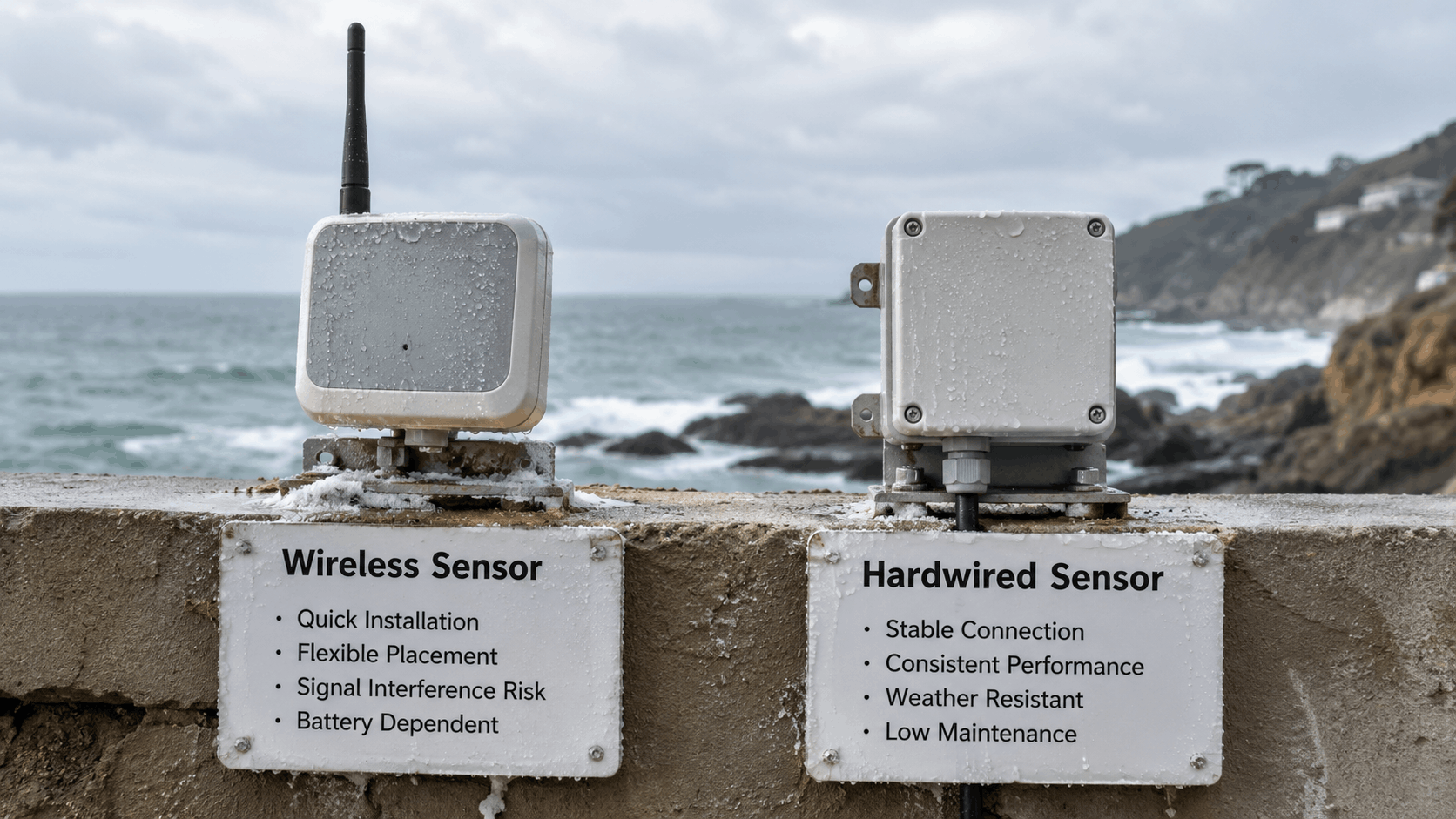
Putting both sensor types directly next to each other across the metrics that actually matter in San Diego's coastal climate gives homeowners and property managers a cleaner decision framework than any single-technology sales pitch can provide.
| Performance Category | Quality Wireless (Coastal) | Hardwired (Properly Installed) |
|---|---|---|
| Sensor Lifespan (within 1 block of ocean) | 5-7 years | 8-15 years |
| Battery/Power Reliability | Requires active management | No batteries - consistent |
| False Alarm Risk (humidity) | Moderate (quality units) | Low (if properly sealed) |
| Installation Cost (older coastal home) | Lower upfront | Higher upfront |
| 5-Year Maintenance Cost | Moderate (batteries + inspection) | Lower (inspection only) |
| Signal/Connectivity Risk | Present (RF + humidity) | None |
| Installation Difficulty (plaster walls) | Low | High |
Lifespan - How Long Each Type Typically Lasts Within a Block of the Ocean
Manufacturer warranties and marketing sheets are written for controlled conditions, not for properties in the Crystal Pier area of Pacific Beach or along Neptune Place in Windansea. What our team actually sees in coastal San Diego neighborhoods tells a different story. Quality wireless sensors - those with IP54 or better ratings, silicone gaskets, and lithium batteries - typically deliver five to seven years of reliable service within a block of the ocean with annual maintenance. Budget wireless sensors in the same location often show failure signs within 18 to 36 months.
Properly installed hardwired sensors in coastal San Diego homes generally last eight to fifteen years before requiring sensor-level replacement. The wiring infrastructure - conduit, terminations, junction boxes - typically outlasts the sensors themselves when installed correctly with marine-grade materials. The sensor elements, particularly the magnets in door and window contacts, can degrade from salt air exposure even inside a sealed housing, but the timeline is much longer than for wireless devices.
Regular maintenance changes both numbers significantly. Wireless sensors that receive annual checkups - battery replacement, housing inspection, contact cleaning - can extend their coastal service life by two to three years beyond what a neglected installation achieves. Hardwired systems that receive periodic termination inspections and conduit seal checks can push toward the upper end of that 8-15 year range. Neglected systems of either type cluster toward the shorter end. Our security system maintenance service is designed specifically around these coastal wear patterns.
The lifespan question also depends on where within the coastal zone a property sits. A home on the west side of Ocean Beach Boulevard facing directly toward the water sees meaningfully more salt air exposure than one two blocks east. Our team maps that gradient for each coastal installation rather than applying a single blanket rule to all San Diego beachside properties.
False Alarm Rates and Humidity - Which Type Triggers More Phantom Alerts
Humidity-related false alarms affect both system types but through different mechanisms and with different frequency patterns. In wireless systems, moisture infiltration into the sensor housing or battery contact corrosion can cause the device to transmit erratic signals - brief open-circuit reads that the panel logs as a zone trip. This tends to happen during the peak of marine layer mornings, which is why so many coastal homeowners describe getting alarms between 6 and 9 a.m. on foggy summer days.
Door contact sensors are the most common source of humidity-driven false alarms in both system types. The small reed switch and magnet assembly in a typical door contact is sensitive to the gap between sensor and magnet. When wood door frames swell with absorbed moisture - which is extremely common in older beach homes near Mission Beach and Ocean Beach - the gap changes, causing the sensor to read the door as open when it is closed. This is a geometry problem compounded by humidity, and it affects wired and wireless contacts equally.
Motion detectors and glass break sensors generally handle humidity better than contact sensors. Passive infrared motion detectors can generate false alarms from rapid temperature changes - opening a door and letting cold marine layer air flood into a warm interior - but this is manageable with sensitivity adjustment. Glass break sensors are largely humidity-insensitive in interior mounting locations. Smoke detectors near the coast are a separate and significant false alarm category, covered in detail in a later section, but they are not intrusion sensors per the traditional comparison.
The pattern Smart Shield Systems sees across coastal San Diego service calls is that wireless systems from budget manufacturers generate false alarms at roughly twice the rate of quality wireless systems in the same environment. Properly installed hardwired systems in good condition generate the fewest humidity-related false alarms, but a poorly maintained hardwired system with corroded terminations can exceed even budget wireless false alarm rates. Again, installation and maintenance quality outweigh the technology choice in determining actual false alarm frequency.
Installation Difficulty and Cost Differences for Coastal Properties
The cost gap between wireless and hardwired installation in coastal San Diego homes is real and significant, and it varies considerably depending on the property's construction era. A newer home in Carmel Valley with open attic access, accessible wall cavities, and modern framing can be hardwired at a labor cost that is perhaps 30 to 50 percent higher than a comparable wireless installation. The gap in older construction is much wider.
A 1940s or 1950s beach cottage in North Park or Hillcrest with plaster over wood lath walls, a finished ceiling, and no attic access can easily see hardwired installation labor costs three to four times higher than a wireless installation covering the same zones. Plaster walls do not accept fish tape well, require patching after every wire run, and demand far more time per sensor point than modern drywall construction. The hardware cost difference between systems is modest; the labor difference in older construction is where the gap really opens up.
Wireless installation in these homes is not just cost-competitive - it is genuinely faster and less disruptive. A quality wireless sensor system can be installed in a 1950s beach cottage in a single day with no wall damage. The same home hardwired could represent two to three days of labor plus plastering and painting. For homeowners in older coastal communities, this practical reality often drives the decision toward wireless or hybrid configurations more than any technical performance argument. Our residential alarm system installation team walks through these tradeoffs with every coastal client before any work begins.
There is also a long-term cost consideration that favors hardwired in the right property type. A new construction home or a recently remodeled coastal home where walls are open during a renovation is an ideal opportunity to run hardwired infrastructure at low incremental cost. Running conduit and wire before walls close is inexpensive compared to retrofitting later. We actively encourage homeowners undertaking coastal renovations to include alarm sensor rough-in as part of the construction scope, regardless of what they ultimately put on the sensors.
Maintenance Requirements Over a Five-Year Period in Coastal vs Inland Conditions
Over a five-year window, a coastal San Diego home requires noticeably more sensor maintenance than an equivalent inland property. For wireless systems near the water, a realistic maintenance picture includes annual battery replacements for all perimeter sensors (using lithium), annual housing inspections for corrosion or gasket degradation, and signal testing after each battery replacement. This adds up to roughly one to two service visits per year for a typical single-family home in the coastal zone.
Hardwired systems in coastal homes require less frequent intervention but demand more thorough inspections when they do occur. Annual checkups should include visual inspection of all junction boxes for moisture staining, resistance testing of wire runs for early signs of corrosion, and seal inspection at all conduit entry points. These inspections are less urgent on a month-to-month basis than wireless battery management, but skipping them for two or three years in a coastal home is a reliable path to a failure at an inconvenient time.
Smart Shield Systems recommends annual service visits for any system - wireless or hardwired - located within two miles of the San Diego coastline. For properties within half a mile of the water, semi-annual quick checks are worth considering, particularly for wireless systems or hardwired systems in older construction. What these visits catch most often is early-stage contact corrosion, gasket compression, and battery voltage that is declining faster than expected - all of which are minor corrections when caught early and genuine system failures when ignored. Our business security wellness monitoring program extends the same proactive maintenance philosophy to commercial coastal properties throughout the San Diego area.
By comparison, inland properties in Santee or El Cajon on the same type of system typically need service visits every two years rather than annually, and the failure rates between visits are markedly lower. The coastal environment genuinely demands more attention, and building that into the ownership cost of a security system is part of an honest conversation before installation.
Need Help in San Diego?
Smart Shield Systems serves San Diego and all of San Diego County.
Specific Sensor Types and How Humidity Affects Each One Differently
Not every sensor type reacts to coastal humidity in the same way or at the same rate. Understanding which devices are most vulnerable - and where - helps homeowners and property managers prioritize maintenance and make better choices about sensor placement and technology at installation.
Door and Window Contact Sensors - The First to Show Wear in Salty Conditions
Door and window contact sensors are almost always the first devices in a coastal San Diego system to show humidity-related problems, and they fail in ways that are frustrating precisely because they are so common. Every door and window in the home has one, which means the failure rate is a numbers game as much as anything else. More sensors mean more chances for a corrosion-related issue to develop somewhere in the system.
The primary mechanism is the alignment shift caused by door and window frames expanding and contracting with humidity absorption. Wood frames in older coastal homes absorb marine layer moisture and swell, shifting the sensor-to-magnet gap outside the tolerance range the device was designed for. This can cause the sensor to read a closed door as open, or create intermittent opens as the frame moves through its daily thermal and moisture cycle. The panel logs a zone trip. The homeowner gets an alert at 7 a.m. The door was never opened. This pattern is one of the most common calls we receive from Ocean Beach and Mission Beach homeowners during marine layer season.
The fix for alignment issues involves either adjusting the sensor mounting to compensate for the swelled frame position or selecting sensors with wider gap tolerance. Some manufacturers offer sensors rated for gaps up to three-quarters of an inch between sensor and magnet, which provides more tolerance for frame movement. In homes with known humidity-driven frame swelling, specifying those wider-tolerance sensors at installation avoids the alignment problem before it starts.
Salt air corrosion on the reed switch contacts inside both wired and wireless door contacts compounds the alignment problem. A sensor that is already marginal on gap tolerance becomes more prone to false trips as contact resistance increases. The two failure modes reinforce each other, which is why door and window contacts near the coast deserve particular attention during every annual inspection. Cleaning the housing, checking the gap, and testing each sensor's response takes only a few minutes per sensor but catches the majority of early failures before they become operational problems.
Motion Detectors in Coastal Garages and Covered Patios
Passive infrared motion detectors are generally more tolerant of humidity than contact sensors because they have no moving parts and their detection mechanism relies on thermal differentials rather than a mechanical circuit. However, their performance in coastal San Diego environments depends heavily on where they are mounted and how their housings are sealed.
Oceanfront garages in Cardiff-by-the-Sea present a specific challenge. A garage door facing the ocean opens and closes multiple times daily, cycling outdoor salt air directly through the space. A PIR sensor mounted in that garage needs housing that can handle the resulting humidity and salt deposition. Standard interior PIR sensors installed in oceanfront garages regularly develop lens fogging and contact corrosion within two to three years. Specifying a PIR rated for outdoor or semi-outdoor use - typically IP54 or better - extends that service life considerably.
Covered lanais and patios are another common mounting location in coastal San Diego homes. These spaces are not fully exterior but are not conditioned either. They see ambient coastal humidity directly, with wind-driven moisture during storms and daily marine layer condensation on all surfaces. Microwave motion detectors, which detect motion through microwave RF reflection rather than thermal detection, are more affected by humidity than PIR sensors because moisture can attenuate the microwave signal. In covered outdoor applications near the water, PIR is generally the better technology choice, provided the housing is appropriately rated.
Mounting height and angle also affect how much salt air deposition a motion detector accumulates. Sensors mounted in the highest points of a covered patio see more air circulation and more salt deposition than sensors mounted lower and partially sheltered by the structure. Our team takes note of air flow patterns during site assessments for coastal properties - it is one of those details that does not make it into generic installation guides but genuinely affects how long a sensor lasts in a specific location.
Smoke and CO Sensors Near the Water - When Humidity Causes Nuisance Alarms
Coastal humidity is one of the leading causes of nuisance alarms from smoke detectors in San Diego beach homes, and it accounts for a meaningful percentage of false alarm calls across Mission Beach, North Ocean Beach, and Sunset Cliffs every summer. The problem is not unique to San Diego, but the marine layer intensity here makes it more common than in most coastal cities.
Ionization smoke detectors are the most humidity-sensitive type. They work by running a small electrical current through a chamber of ionized air and detecting disruption of that current by smoke particles. Water vapor at high concentrations can disrupt the ionization chamber in the same way smoke does, triggering the alarm. In a beach home kitchen that faces west and gets morning marine layer through a drafty door seal, an ionization detector can trigger at 7 a.m. when the homeowner has not cooked anything and no smoke is present. This scenario is reported to our team regularly from homes near the Sunset Cliffs area during June and July.
Photoelectric smoke detectors use a light beam and sensor to detect smoke particles scattering light into the detection chamber. They are significantly less susceptible to humidity false trips than ionization types because water vapor does not scatter the light beam the way smoke particles do. For coastal San Diego homes - particularly in kitchens, bathrooms, and any room with exterior-facing windows or doors - photoelectric smoke detectors are the appropriate choice. The difference in false alarm rates between the two types in coastal conditions is substantial and well-documented. Our fire and smoke detection systems selection process for coastal properties accounts for this directly.
Carbon monoxide sensors are less sensitive to humidity than smoke detectors but are not immune to false trips in high-humidity conditions. Electrochemical CO sensors can exhibit drift in extreme humidity, which in rare cases produces a nuisance alarm. For coastal homes, CO sensors should be mounted away from direct sources of marine layer infiltration - not on exterior walls adjacent to drafty doors or windows. Interior placement in a well-ventilated but not directly exposed location gives the sensor stable readings while still covering the home effectively. Our carbon monoxide detection installations near the coast follow this placement practice consistently.
What San Diego Building Codes and HOA Rules Say About Sensor Installation
Sensor technology and installation quality are only part of the decision. Before a single device goes on a wall in a San Diego coastal home, it is worth understanding what the City, county, and any applicable HOA actually require. These rules can shape which system type makes the most practical sense for a given property.
City of San Diego Permit Requirements for Hardwired Alarm Systems
The City of San Diego requires a low-voltage electrical permit for hardwired alarm system installations in residential and commercial properties. This permit is processed through the Development Services Department and applies when new wire runs are installed in a structure - not simply when existing equipment is replaced on an existing wired system. The permit process involves plan review for larger commercial installations but is typically over-the-counter for standard residential hardwired alarm work.
Wireless-only alarm system installations generally fall below the permit threshold in San Diego because they do not involve new wiring within the building structure. However, any installation that involves hardwired power connections - such as a transformer for a hardwired panel or a wired keypad - can bring the project back into permit territory. Homeowners in University Heights and Normal Heights frequently ask our team about this distinction because those neighborhoods have a high proportion of older single-family homes where the permit question comes up early in the planning conversation.
Smart Shield Systems handles the permit process for all hardwired installations as part of the service. Homeowners should not attempt to skip this step. An unpermitted hardwired alarm installation can create complications at resale, affect homeowner's insurance claims, and in some cases require removal and re-inspection if discovered during a property transaction. The permit fee is modest relative to the installation cost and the risk of unpermitted work is real. Working with a licensed contractor who knows the Development Services Department process keeps this step straightforward.
HOA Restrictions in Coastal Communities Like Coronado Cays and La Jolla Shores
Gated coastal communities in San Diego often have architectural review requirements that extend to security system installations, particularly anything visible from the street or from shared spaces. Coronado Cays security installations, for example, may require HOA approval for any exterior conduit runs, visible sensor placements on exterior walls facing common areas, or hardware that does not match the community's approved finish specifications. These restrictions vary by community and are enforced with varying degrees of consistency, but ignoring them can result in required removal of installed equipment.
La Jolla Shores alarm system installations in HOA communities near the cove face similar review processes for exterior-facing work. Some HOAs in that area have approved vendor lists or specific hardware finish requirements. Our team requests and reviews HOA architectural guidelines before beginning any work in a managed community. This avoids the frustration of completing an installation only to receive a compliance notice requiring modifications.
The practical effect of HOA restrictions on the wireless-versus-hardwired decision is that in some communities, visible exterior conduit associated with a hardwired system may face architectural review that wireless exterior sensors would not trigger. In communities where conduit must be concealed or specifically approved, the installation complexity of a hardwired system increases further. Wireless sensors with low-profile housings in approved finishes often clear HOA review more easily, which is a legitimate factor in the decision for coastal community homeowners.
False Alarm Ordinances and Why Sensor Reliability Affects Your Wallet
San Diego has a false alarm ordinance that carries real financial consequences. The City of San Diego charges permit fees for alarm systems and assesses fines for excessive false alarms. After the first allowed false alarm in a registration period, fines begin. By the third or fourth false alarm, the fines are several hundred dollars per incident. For a coastal homeowner whose sensors trigger nuisance alarms three or four times during marine layer season, the cumulative fine exposure can easily exceed the cost of upgrading to better sensors.
The connection between sensor quality and false alarm fines is direct and predictable. Budget wireless sensors with poor gaskets and no corrosion-resistant contacts in coastal locations are a reliable source of humidity-related false trips. Each one carries the potential for a police response and a fine. The upgrade from a budget sensor to a quality IP-rated device might add $30 to $50 per sensor at installation, but it eliminates a failure mode that can cost $200 to $400 per incident in fines and police response fees.
Our team has seen homeowners in North Ocean Beach and Sunset Cliffs receive multiple false alarm fines in a single summer before tracing the problem to failing door contact sensors or humidity-sensitive smoke detectors. A sensor inspection and targeted replacement resolved the issue permanently. The false alarm ordinance information is available directly from the City of San Diego's alarm administration, and the City of San Diego alarm registration page covers current fees and fine structures. Proactive sensor quality decisions are genuinely less expensive than repeated false alarm penalties.
Need Help in San Diego?
Smart Shield Systems serves San Diego and all of San Diego County.
How Smart Shield Systems Approaches Sensor Selection for Coastal San Diego Homes
There is no single correct answer to the wireless-versus-hardwired question for coastal San Diego properties. The right recommendation depends on the specific property, its location relative to the water, its construction era, and the homeowner's operational preferences. Our process starts with those specifics rather than with a predetermined system type.
The Site Walk - Why We Look at More Than Just the Floor Plan
A floor plan tells us how many doors and windows a home has. It does not tell us which exterior walls face prevailing ocean winds, where moisture tends to pool in the structure, or how the garage behaves when the marine layer rolls in at 6 a.m. Those are the details that drive sensor selection and placement in coastal homes, and they require walking the property rather than reviewing a drawing.
During a site assessment for a coastal property, our team looks at prevailing wind direction relative to the home's orientation, estimated distance to the waterline, evidence of existing salt air or moisture damage on exterior hardware, and the construction era and method of the structure. A South Mission Beach home with a west-facing garage and wood-frame single-wall construction gets a very different recommendation from a Sunset Cliffs property than a newer stucco home in Kearny Mesa. The environment at the sensor level is what matters, not the city or neighborhood name alone.
We also look at where humidity tends to concentrate inside the home. Bathrooms with exterior walls, laundry rooms, garages with ocean-facing doors, and below-grade spaces all accumulate more moisture than interior rooms. Sensors in these locations are subjected to more aggressive conditions than sensors in a second-floor bedroom, even in the same coastal home. Identifying those microclimates within the property and specifying sensors accordingly is part of what separates a site-assessed installation from a cookie-cutter system.
Age of construction is a particularly telling detail. Homes built before the 1970s in Point Loma, Ocean Beach, and Mission Beach typically lack modern vapor barriers and have wall cavity conditions that are harsher for sensor components than the exterior weather data alone would suggest. These homes get recommendations weighted toward either hardwired-with-marine-grade-hardware or quality wireless sensors in IP54-plus housings, depending on the specific wiring access situation. We never assume a floor plan from a 1955 cottage near Sunset Cliffs is comparable to a 2005 build in Carmel Valley.
When We Recommend Wireless, When We Recommend Hardwired, and When We Mix Both
The three most common scenarios our team encounters in coastal San Diego translate into three distinct recommendation patterns. The first is the older beach cottage - a 1950s or 1960s structure in Ocean Beach, South Mission Beach, or North Pacific Beach with plaster walls, minimal attic access, and a tight footprint. For these homes, a hybrid sensor system is almost always the right call: hardwired sensors at the two or three highest-exposure perimeter points where reliability is most critical, and quality wireless sensors with IP54 ratings for the remaining interior and secondary perimeter zones. The labor cost of fully hardwiring these homes is prohibitive, but the critical points warrant the investment.
The second scenario is a newer coastal construction or recently remodeled home with accessible wall cavities and modern framing - properties in newer sections of Carmel Valley or recently rebuilt homes in Del Mar. These properties get a recommendation for fully hardwired sensors using liquid-tight conduit and marine-grade hardware throughout. The installation cost is manageable given the accessible construction, and the long-term reliability advantage of hardwired over wireless in coastal conditions justifies the investment over a 10-plus year ownership horizon.
The third scenario is a large coastal estate or a property with detached structures, extensive outdoor coverage requirements, and complex site geometry. Rancho Santa Fe properties, bluff-top homes in La Jolla, and larger beachfront properties often benefit from a hybrid that uses hardwired sensors in all primary structures and quality wireless sensors for outbuildings, gates, and perimeter coverage points where running wire is impractical. This approach gets the reliability of hardwired at the core of the system while using wireless where its installation flexibility genuinely adds value. Our smart home security integration services often come into play for these larger coastal properties where sensor networks connect to broader home automation systems.
Products and Hardware We Trust in Humid Coastal Conditions
Without turning this into a product catalog, there are general hardware characteristics that our team treats as non-negotiable for coastal San Diego sensor installations. IP54 is our minimum external rating for any sensor mounted in a garage, covered patio, or on an exterior-facing surface within half a mile of the water. For sensors that live in more exposed positions - oceanfront garage doors, exterior gate contacts, any sensor within 200 feet of the high tide line - IP65 is the starting point.
Gasket material matters as much as IP rating on the label. We look for silicone or EPDM gaskets rather than foam. Foam compresses and loses its seal over repeated wet-dry cycles within 18 to 24 months in coastal conditions. Silicone gaskets maintain their compression and seal integrity across a much wider range of cycling conditions. This is a detail that requires asking the distributor or reading the sensor's technical data sheet, not just the product marketing page.
Battery chemistry specification is another non-negotiable for wireless sensor selections near the coast. Lithium cells are specified as the default for all coastal wireless sensor installations. The cost difference over the life of a sensor is modest. The performance difference in terms of consistent voltage and reduced false-low-battery notifications is substantial. Contact materials in sensor terminals and battery holders should be gold-plated or stainless steel for any sensor destined for a high-salt-air location. These specifications filter out a large proportion of the budget hardware that fails quickly in this environment and directs selection toward products with genuine coastal durability.
Ongoing Service and What to Expect After Installation Near the Water
Our relationship with coastal San Diego customers does not end at installation. The environment demands ongoing attention, and we build that expectation into every client conversation before the first sensor goes on the wall. For properties within a mile of the water, annual inspection visits are the baseline recommendation. Those visits cover battery voltage checks and replacement where needed, housing inspection for corrosion or gasket degradation, signal strength verification for wireless systems, and termination resistance testing for hardwired systems.
What annual inspections most commonly catch in coastal homes is early-stage contact corrosion on door and window sensors, compressed or degraded gaskets on wireless sensor housings, and battery voltage that has dropped below the threshold where reliable operation is assured but before the panel has generated a low-battery notification. Each of these is a minor correction when caught during a scheduled visit and a system failure event if left until it manifests as a false alarm or a dropped zone.
Homeowners who have lived through a marine layer season with a failing sensor system sometimes ask whether the annual service cost is worth it. The math is straightforward: an annual inspection visit costs a fraction of the false alarm fines from a single humidity-related sensor failure, and a fraction of the sensor replacement cost when corrosion progresses to the point of device failure rather than early-stage contact cleaning. The service visit is not an upsell - it is the mechanism that makes a coastal sensor system actually deliver on what it was installed to do. To schedule an inspection or discuss sensor options for a coastal San Diego property, reach out to Smart Shield Systems directly.
Final Thoughts
The wireless-versus-hardwired debate looks different on a foggy morning in Ocean Beach than it does in a product comparison chart written for the national market. San Diego's marine layer, salt air, and daily humidity cycling create a real-world test that separates quality sensors from marginal ones and well-installed systems from shortcuts. Neither technology wins outright in every situation - the right answer depends on the property, its location, and how it was built.
What the evidence from years of coastal San Diego installations does show clearly is that sensor quality and installation practice matter more than the wireless-versus-hardwired choice alone. A budget wireless sensor with foam gaskets and alkaline batteries near Windansea Beach will fail faster than a properly installed hardwired system. But a hardwired system run through unprotected EMT conduit with bare copper terminations in a Barrio Logan garage will develop problems as fast as any budget wireless device. The technology is secondary to the execution.
For homeowners and property managers on San Diego's coast who want a system that actually holds up through marine layer season after season, the starting point is an honest site assessment with someone who knows what the environment actually does to sensor components over time. That is where a good decision begins - not with a brochure, but with a walk around the property on a foggy morning. If your current system is more than three years old and has not had a professional inspection, contact Smart Shield Systems to schedule a coastal sensor assessment before the next marine layer season arrives.
Frequently Asked Questions
- Do wireless sensors really fail faster near the ocean in San Diego?
- Cheaper wireless sensors do show faster wear in coastal conditions - often failing within 18 to 36 months in neighborhoods like Pacific Beach or Ocean Beach. However, sensor quality and placement matter more than the wireless-versus-wired distinction alone. A quality wireless sensor with IP54 or better housing, silicone gaskets, and lithium batteries can deliver five to seven reliable years near the water when maintained annually. The technology choice matters less than the specification level of the device selected.
- How often should I replace the batteries in wireless sensors near the beach?
- Most manufacturer battery life estimates assume roughly 50 percent relative humidity - nothing like what sensors near Mission Beach or Pacific Beach experience during marine layer season. In coastal San Diego neighborhoods, alkaline battery life can run 30 to 40 percent shorter than the stated estimate. Realistic replacement intervals are 12 to 18 months for alkaline cells and 18 to 24 months for lithium. Our team strongly recommends specifying lithium batteries as the baseline for any wireless sensor within half a mile of the San Diego coast.
- Can I mix wireless and hardwired sensors in the same system?
- Hybrid alarm systems are common and often the most practical approach for older coastal San Diego homes where running wire through plaster walls is difficult and expensive. Most modern alarm panels support both sensor types on the same system without issue. Smart Shield Systems regularly installs hybrid setups in older Point Loma and Ocean Beach properties - hardwired at the highest-exposure perimeter points and quality wireless sensors for interior zones and secondary access points where wiring would require significant wall disruption.
- What IP rating should sensors have for a home near the San Diego coast?
- IP ratings describe protection against dust and moisture penetration using two numbers - the first for solids, the second for liquids. IP54 means protected against limited dust ingress and splash water from any direction. For sensors in garages, covered patios, or on exterior-facing window frames within half a mile of the San Diego coastline, IP54 is the minimum practical threshold. Sensors in more exposed positions - oceanfront garage entries or exterior gate contacts - should carry IP65 or better. Interior sensors in climate-controlled rooms have more flexibility and can operate reliably at lower ratings.
- Why is my alarm going off randomly during foggy mornings near the beach?
- Random alarms during foggy marine layer mornings are almost always caused by humidity infiltrating sensor contacts or moisture-sensitive smoke detectors triggering on water vapor rather than smoke. Door and window contacts in swelled wood frames are a common culprit - the frame expands overnight, shifts the sensor gap, and the panel reads it as an open zone. Ionization smoke detectors are highly susceptible to this as well. This is one of the most frequent service calls Smart Shield Systems receives from North Ocean Beach and Sunset Cliffs homeowners during summer marine layer season.
- Do I need a permit to install a hardwired security system in San Diego?
- A low-voltage permit from the City of San Diego's Development Services Department is typically required for hardwired alarm system installations that involve new wire runs within a residential or commercial structure. Wireless-only installations generally fall below the permit threshold, but any hardwired power connections to the panel can change that. Smart Shield Systems handles permit applications as part of the installation process for all hardwired projects. Skipping the permit creates complications at property resale and can affect insurance claims, so it is not a step worth bypassing.
- How much does it cost to replace corroded sensors in a coastal San Diego home?
- Individual sensor replacement for a standard door or window contact runs roughly $75 to $150 per sensor including labor, depending on sensor type and access difficulty. A full system refresh - replacing all perimeter sensors in a typical coastal home - can range from $400 to $1,200 or more depending on the number of zones and the type of sensors specified. Catching early-stage corrosion during an annual inspection and cleaning or replacing individual sensors before full failure is almost always cheaper than a full replacement triggered by system-wide deterioration. Proactive maintenance genuinely pays off in coastal environments.
- Are smart home wireless sensors - like Z-Wave or Zigbee - reliable near the water?
- Z-Wave and Zigbee sensors face exactly the same humidity and salt air challenges as any other wireless device in coastal San Diego environments. The wireless protocol itself does not change the physics of moisture infiltration into a sensor housing or corrosion on battery contacts. Housing quality, gasket material, IP rating, and battery chemistry are the variables that determine how a Z-Wave or Zigbee sensor performs near the water - not the mesh network protocol. A well-housed Z-Wave sensor with appropriate coastal specifications can perform reliably. A budget Zigbee sensor in a foam-gasket housing near the shore will not, regardless of the protocol's theoretical range or reliability characteristics.
- How do I know if my current sensors have already been damaged by humidity?
- Warning signs of humidity damage in existing sensors include intermittent alerts that do not correspond to any physical event, sensors that periodically drop off the panel and reappear, visible white or gray residue or discoloration on sensor housings - which indicates salt deposition - and sluggish response times where the panel takes noticeably longer to register a door opening than it used to. Any system more than three years old in a coastal neighborhood that has not received a professional inspection should be evaluated before another marine layer season begins. Our team can assess the condition of existing sensors and recommend targeted replacements rather than full system swaps in most cases.
- Does Smart Shield Systems service areas outside of central San Diego near the coast?
- Smart Shield Systems services coastal and near-coastal communities well beyond central San Diego, including Coronado, Del Mar, Carlsbad , Oceanside , Solana Beach, Cardiff-by-the-Sea, and Encinitas. Each of those communities has its own salt air exposure profile and construction characteristics that our team is familiar with from regular installations in those areas. The sensor challenges in Coronado, surrounded by water on multiple sides, differ from those in Encinitas where coastal exposure is more directional. That community-specific knowledge shapes the recommendations we make for each location rather than applying a single coastal template everywhere. For more information about service coverage, visit our locations page or reach out directly to discuss a specific property. You can also explore details about 24/7 alarm monitoring options that complement any sensor installation in high-humidity coastal environments. For additional guidance on sensor performance standards, the National Fire Protection Association publishes relevant codes covering detector placement and environmental specifications. The UL certification standards for security systems also provide useful
S
Smart Shield Systems Team Team
Licensed security systems professionals serving San Diego and San Diego County.
Licensed in California · License #7623
Why trust Smart Shield Systems?
Founded in 2016, Smart Shield Systems is a licensed and insured security systems serving San Diego and San Diego County. All content is reviewed by our licensed technicians.

Need Help in San Diego?
Smart Shield Systems serves San Diego and all of San Diego County.
Related Articles
Cost Guides
Wired vs Wireless Security Cameras: Which is Right for Your Property?
Wired and wireless security cameras each have pros and cons. Compare reliability, power, and installation for your San Diego home or business.
Tips & Advice
Bird Rock La Jolla Security: Coastal Property Camera Specialists
A local guide to coastal security cameras for Bird Rock and La Jolla homes, covering salt air challenges, gear selection, install, upkeep, costs, and local rules.
Tips & Advice
Best Security System for Chula Vista Homes: Wired vs Wireless
Wired or wireless? Chula Vista homeowners in Otay Ranch, Eastlake, and older neighborhoods near Hilltop need different answers. Here is what actually matters locally.