Safety & Prevention
La Jolla Shores Home Security: Beach Block and Tourist Foot Traffic Considerations
Key Takeaways
- La Jolla Shores beach-block homes face risks inland neighborhoods do not - heavy tourist crowds, salt air corrosion, open beach access points, and rotating short-term renters.
- Summer foot traffic near Kellogg Park and Avenida de la Playa masks suspicious activity and triggers constant false camera alerts that AI person detection and motion zones can filter out.
- Standard cameras can fail within a year near the water; marine-grade housings with IP66 ratings and frequent maintenance are needed to survive coastal salt exposure.
- Camera placement should cover side yards and alleys, respect California privacy rules with proper angling and masking, and include night vision plus motion lighting for dark shoreline stretches.
- Smart locks with temporary codes, video doorbells, and reinforced side gates handle the constant flow of guests, cleaners, and renters along the Shores.
- Vacation and seasonal homes benefit from remote monitoring, occupancy simulation with smart lighting, and 24/7 professional monitoring with fast local San Diego response.
- Coastal systems need lens cleaning every one to two months and twice-a-year inspections, roughly double the maintenance of inland homes.
- Smart Shield Systems assesses foot traffic patterns on site, selects corrosion-resistant coastal equipment, and provides ongoing local support across La Jolla Shores and San Diego.
In This Article
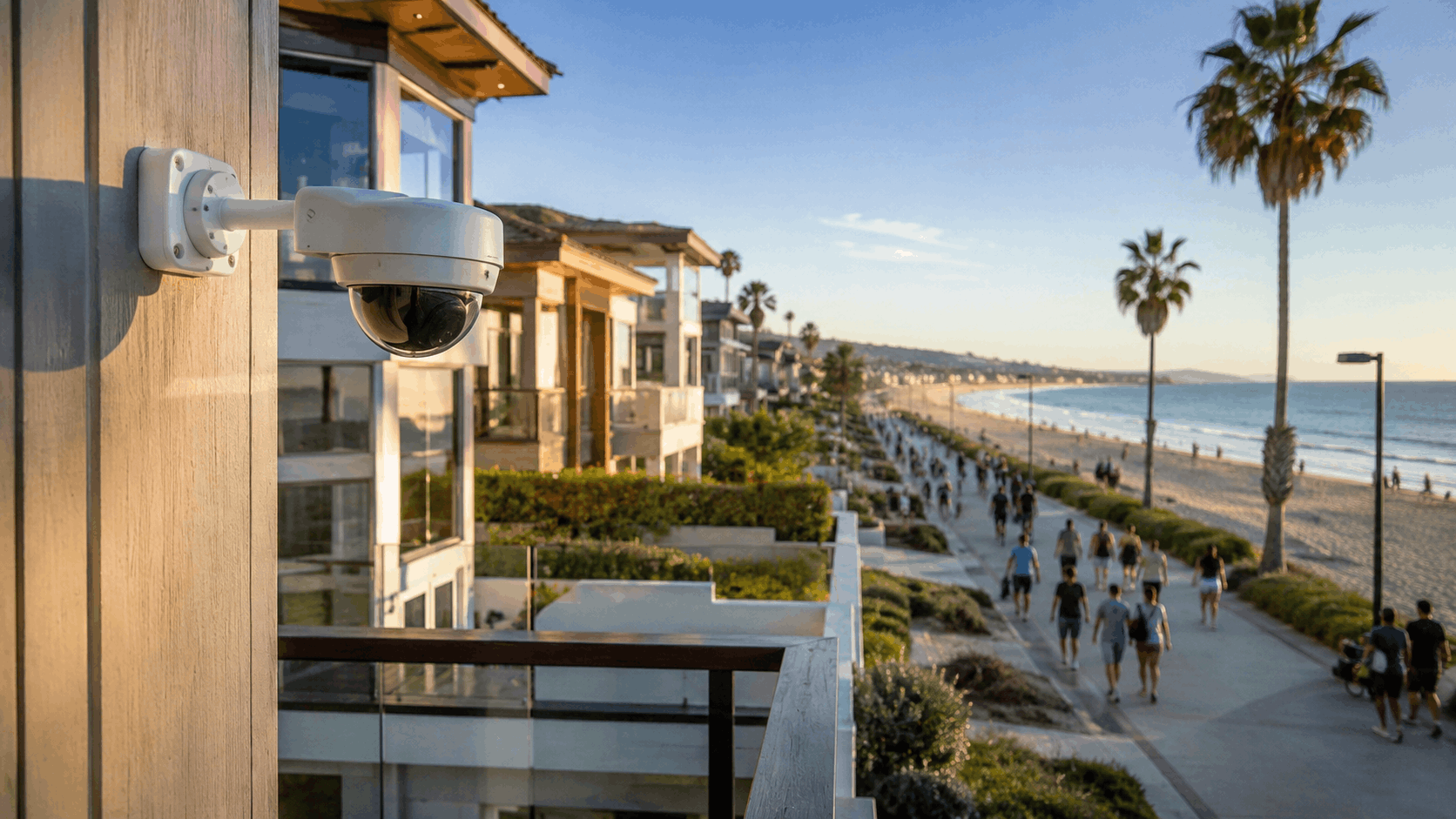
It is a Saturday in July on Avenida de la Playa. By 8 a.m., the metered spots are gone, surf racks are strapped to roof bars, and a steady river of beachgoers flows past the front porches of homes just steps from the sand. By noon, that trickle has become a flood of strangers in swimsuits, families hauling coolers, and divers heading toward the boat launch.
For homeowners along the Shores, this scene is part of the charm. It is also a security problem most inland San Diego neighborhoods never have to think about. When hundreds of unfamiliar faces walk past your door every hour, telling a lost tourist apart from someone casing your property gets a lot harder.
Why La Jolla Shores Homes Face Different Security Challenges
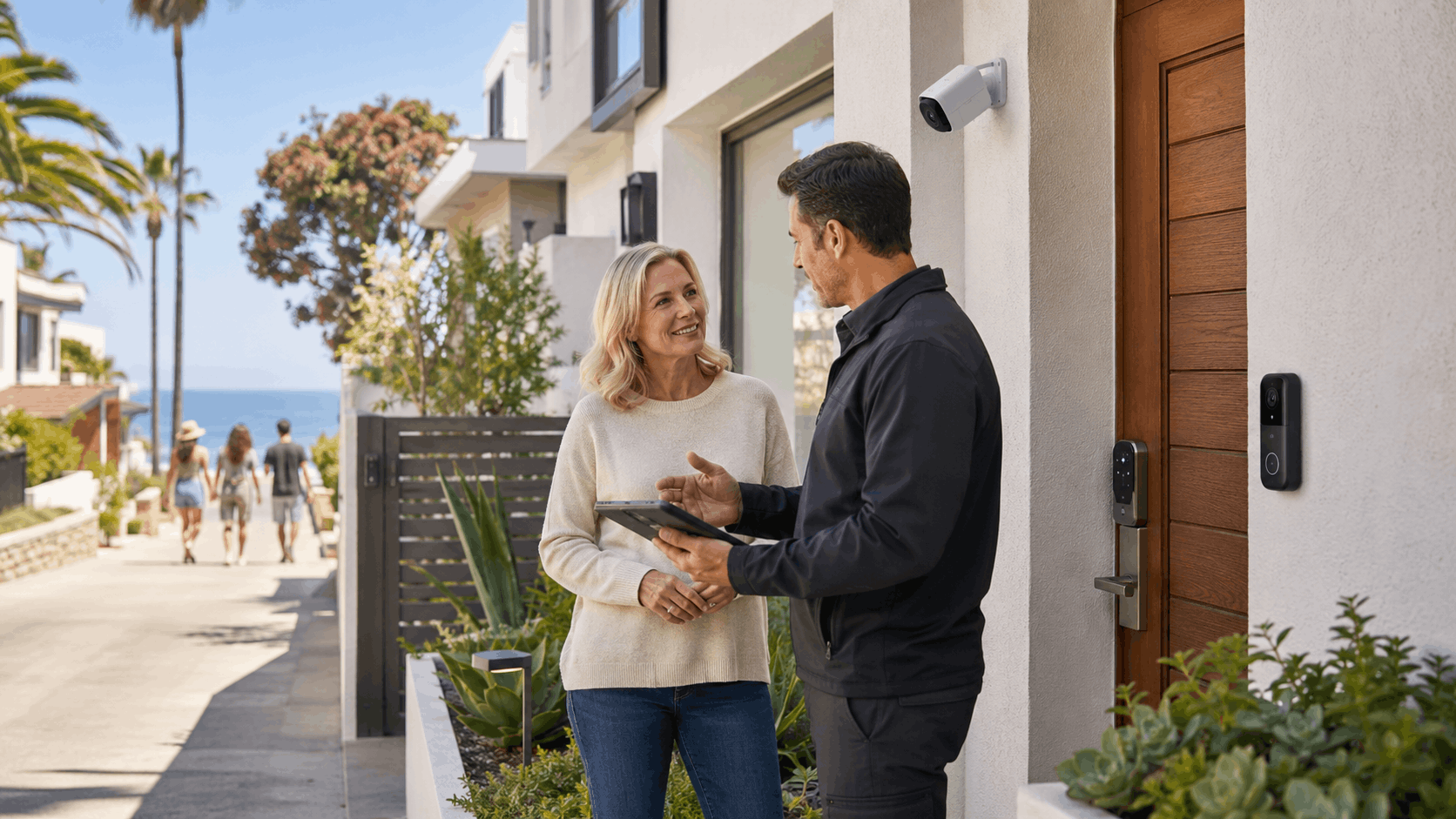
Most security advice is written for cul-de-sacs and gated streets where strangers stand out. La Jolla Shores is the opposite. Homes here sit on a thin strip of land between the water and La Jolla Shores Drive, surrounded by public access points and a constant churn of visitors.
The mix of beach proximity, heavy visitor volume, and an open street grid creates risks that a home in Rancho Bernardo or Tierrasanta simply does not deal with. La Jolla Shores security has to account for crowds, salt, and the fact that almost no one passing by actually lives there.
| Risk Factor | Inland San Diego Home | La Jolla Shores Beach Block Home |
|---|---|---|
| Daily foot traffic | Low, mostly residents | Thousands of strangers in summer |
| Neighbor recognition | High, stable households | Low, rotating renters |
| Salt air exposure | Minimal | Severe, accelerates corrosion |
| Public access points | Few | Alleys, walkways, beach paths |
| Package theft season | Year-round, moderate | Spikes sharply in summer |
The Beach Block Layout and Its Blind Spots
Homes near Camino del Oro and El Paseo Grande were built close to the sand, often with shared walkways and narrow side passages between properties. These layouts give people easy approach routes that never come within view of a front door. A person can walk a public path to the beach and end up three feet from a side gate without looking out of place.
The trouble with beach access points is that they blur the line between public and private space. Where does the public walkway end and your yard begin? On many Shores lots, that line is a low fence or a hedge that anyone can step over in two seconds.
Blind spots multiply on these blocks. Recessed entries, garages that open onto alleys, and gates tucked behind landscaping all create pockets a camera at the front door will never see. We have walked dozens of these homes and found that the most exposed point is rarely the front - it is the side or rear that faces a shared path.
Mapping those approach routes is the first step. Before anyone mounts a single camera, the angles of approach from the beach, the alley, and the sidewalk all need to be drawn out so coverage matches how people actually move around the property.
Seasonal Crowds From Kellogg Park and the Boat Launch
Kellogg Park sits in the middle of it all, and on a warm weekend it draws thousands of people to the grass and sand. The dive boat launch adds another wave of divers loading and unloading gear at all hours. All that movement passes directly in front of homes lining the park.
Summer crowds create a kind of camouflage. When fifty people walk past your porch every few minutes, a person who pauses to check whether a door is locked does not stand out. The volume of foot traffic hides the one individual who has bad intentions among the hundreds who do not.
This is the opposite of how security usually works. In a quiet neighborhood, an unfamiliar car or a lingering stranger triggers attention. Near Kellogg Park, unfamiliar is the default state, so the usual instinct to notice something off stops working.
That is why homes here lean harder on technology than on neighborly watchfulness. Cameras with smart detection and recorded video do the noticing that residents cannot do when the sidewalk never empties out between sunrise and sunset.
Vacation Rentals and Rotating Neighbors
A large share of La Jolla Shores homes are short-term rentals or second homes. That means the family next door this week may be gone by Monday, replaced by a new group of strangers wheeling suitcases up the walk.
Neighbor recognition is one of the oldest forms of security, and vacation rentals quietly erase it. When you cannot tell who belongs on the block, you cannot flag who does not. A stranger trying door handles looks exactly like a guest who locked themselves out.
Rotating renters also means more people have temporary access to nearby properties - cleaners, maintenance crews, delivery drivers, and guests who may prop a gate open or leave a code written on a notepad. The general level of access control on the block tends to be loose.
For owners, this raises the bar on protecting their own home. You cannot rely on the street to look out for you, so the property has to defend itself through cameras, locks, and monitoring that work whether or not anyone is paying attention outside.
How Tourist Foot Traffic Affects Front-of-Home Security
Tourist foot traffic does not just create more people to watch. It changes how every piece of front-of-home security behaves, from cameras to package deliveries to the basic question of who is standing at your door.
The shops and restaurants along Avenida de la Playa pull crowds right up to residential front walks. That density is what makes front door security on the Shores its own specialty.
Package Theft During Peak Beach Season
Porch piracy climbs every summer along the Shores. A delivery box left on a step blends into the busy sidewalk, and a porch pirate can grab it and disappear into the crowd heading toward Avenida de la Playa in seconds.
The crowd is the cover. On a quiet street, someone snatching a package draws stares. Here, a person carrying a box looks like every other shopper or beachgoer hauling gear, so the theft barely registers to anyone watching.
We see package theft reports cluster in June through August, tracking exactly with peak visitor volume. The homes that get hit most are the ones with open front steps visible from the public walkway and no camera covering the drop zone.
The fix is a layered one - a doorbell camera that records the drop, delivery alerts so packages get grabbed quickly, and a lockbox or parcel drop for high-value items. A home security camera installation aimed at the porch turns a blind drop point into a recorded one.
Camera Motion Alerts That Never Stop
The first thing Shores homeowners notice after installing cameras is the flood of alerts. Every passing stroller, dog walker, and surfer trips the motion sensor, and the phone buzzes nonstop from morning to dark.
Constant false alarms are worse than no alerts at all. When a camera cries wolf two hundred times a day, people stop looking, and the one notification that actually mattered gets swiped away with the rest.
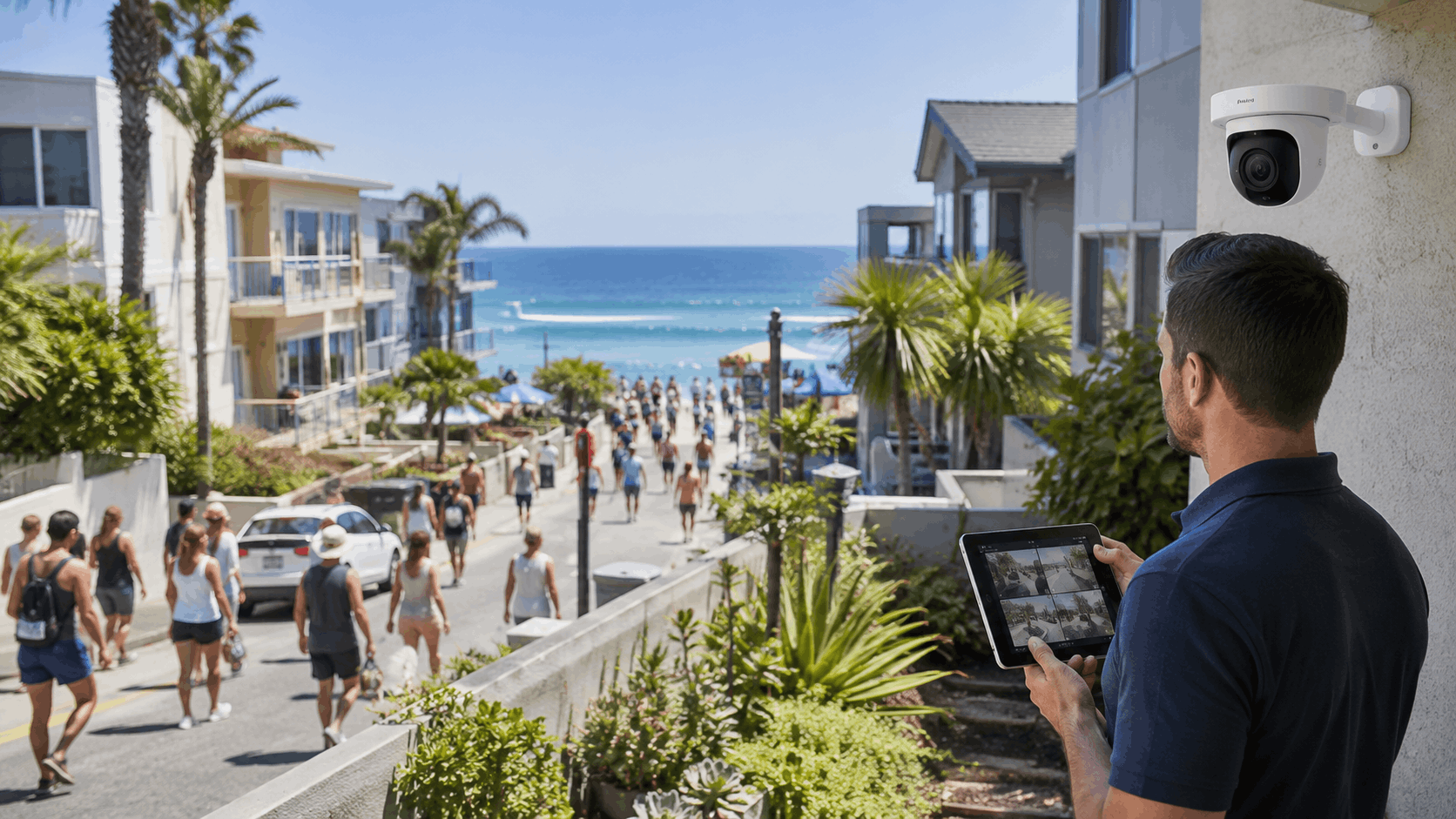
The answer is smarter detection, not less coverage. Motion zones let a camera ignore the public sidewalk while still watching the steps and gate. AI person detection filters out cars and shadows so only a human approaching the property sends an alert.
Setting these zones correctly takes local knowledge of how foot traffic flows past a specific home. We tune detection so a tourist walking the public path is ignored while someone stepping onto private space gets flagged, often paired with remote video monitoring and analytics for the busiest properties.
Telling Lost Tourists From Real Threats
Plenty of people who wander onto a Shores property are simply lost - looking for beach access, a vacation rental address, or a friend's place. The challenge is separating them from the rare person who is testing doors or scoping out a home.
Loitering detection helps draw that line. A camera can flag when someone lingers near an entry point longer than a passerby would, which is a far better signal than raw motion in a place where motion never stops.
Video monitoring adds a human or AI layer that reads behavior, not just presence. Someone who walks the property line, peers in windows, or returns to the same gate twice fits a pattern worth a closer look, while a confused beachgoer checking a phone does not.
For threat assessment to work near the Shores, the system has to be calibrated for crowds. Generic settings drown the owner in noise, so the goal is detection tuned to behavior and dwell time rather than every body that crosses the frame.
Need Help in San Diego?
Smart Shield Systems serves San Diego and all of San Diego County.
Get Your Free Quote
Tell us about your property and we'll get back to you fast.
Salt Air and Coastal Conditions That Damage Security Equipment
The ocean that makes La Jolla Shores beautiful is also hard on hardware. Salt air carries fine, corrosive particles that settle on every surface, and equipment built for inland yards simply does not last here.
Coastal security equipment has to be chosen and maintained differently. The difference between a system that lasts five years and one that fails in eighteen months often comes down to the housing and the upkeep, not the camera resolution.
Why Standard Cameras Fail Within a Few Blocks of the Water
Homes within a few blocks of the water, especially those near La Jolla Shores Drive, see salt air corrosion that inland homes never face. Salt and humidity attack the metal contacts, screws, and housing seams on standard cameras far faster than the manufacturer's lifespan suggests.
The damage usually starts where you cannot see it. Connectors corrode inside the housing, mounting brackets rust and weaken, and moisture works past worn gaskets to fog lenses and short out boards. A camera can look fine on the outside while failing on the inside.
We have replaced consumer-grade cameras on Shores homes that lasted barely a year before humidity damage killed them. The owners assumed they bought a lemon, but the real problem was hardware never rated for marine exposure mounted three blocks from breaking waves.
Wiring suffers the same fate. Exposed cable runs and unsealed junction points corrode, leading to intermittent dropouts that get blamed on the network when the real culprit is salt creeping into the connections.
Marine-Grade Hardware and Sealed Components
Equipment that survives the coast starts with the right weather rating. Cameras with an IP66 rating or higher are sealed against dust and heavy water, which keeps salt-laden moisture out of the electronics that fail first.
Beyond the rating, the materials matter. Marine-grade hardware uses corrosion-resistant housings, stainless steel mounts, and sealed cable entries so the points that usually rot away hold up against years of salt exposure.
Polycarbonate and powder-coated aluminum housings handle the marine layer far better than the thin plastic or bare metal found on budget gear. The upfront cost is higher, but on a beach block it pays for itself by not needing replacement every year.
The same logic applies to outdoor sensors, locks, and wiring junctions. Weatherproof components and properly sealed conduit keep the whole system running instead of leaving one corroded connection to take everything down.
Maintenance Schedules for Beach-Adjacent Systems
Coastal systems need more attention than inland ones, and skipping that upkeep is how a good install slowly fails. We recommend lens cleaning every one to two months on Shores homes, since salt film builds up fast and clouds the picture before owners notice.
Connection checks belong on the calendar too. A twice-a-year inspection of mounts, gaskets, and cable junctions catches early corrosion while it is still a cleaning job and not a replacement job.
Compare that to an inland San Diego home, where an annual check is usually fine. The marine environment roughly doubles the maintenance cadence, and homes closer to the water need the most frequent coastal upkeep.
Regular service also keeps weather seals intact. A gasket that has dried and cracked lets in the exact moisture the housing was meant to block, so periodic inspections and reseals are what keep marine-rated gear performing as designed. Many owners fold this into a security system maintenance service so it never gets forgotten.
Camera Placement Strategies for Beach Block Properties
Where you mount a camera matters more on a beach block than almost anywhere else. The public walkways, alleys, and shared access points around a Shores home each need coverage, and the wrong angle either misses the threat or records the neighbors.
Good camera placement balances three things - covering the real entry points, respecting privacy, and seeing clearly after dark. Beach block cameras have to do all of that on lots that were never designed with surveillance in mind.
Covering Side Yards and Alley Access
The narrow side passages and rear alleys near El Paseo Grande are favorite entry points precisely because crowds hide approach and the spaces stay out of public view. A person can slip into a side yard from the alley and work unseen by anyone on the main sidewalk.
Side yard cameras need to cover the full length of the passage, not just the gate. A camera that only watches the entrance misses someone who has already slipped past it and is working on a window or a back door.
Alley access points deserve their own dedicated coverage. Garages, trash enclosures, and rear gates that face the alley are common breach points, and a single well-placed camera on that side often catches more real activity than three on the busy front.
We map these passages during the site visit and place cameras to close the gaps people exploit. The goal is no blind corridor between the public path and any door or window on the property.
Respecting Privacy and Public Right-of-Way
California privacy laws expect cameras to record your own property, not the inside of a neighbor's home or a stretch of public beach. Angling matters because a camera aimed too wide on a beach block can sweep in the public right-of-way and the house next door.
The fix is tight framing and privacy masking. Cameras get angled down and inward to capture entry points, walkways, and yards while keeping the public beach path and neighboring windows out of frame.
Many modern cameras let you black out portions of the image so recorded video never includes areas you should not capture. On crowded blocks where the sidewalk sits feet from the door, that masking keeps coverage legal and neighborly.
Getting camera angles right protects the homeowner two ways - it keeps the footage admissible if something happens, and it keeps the system from creating privacy complaints with the people next door. The California Attorney General's office publishes guidance on these privacy expectations worth reviewing.
Lighting and Night Visibility Near the Shoreline
Street lighting thins out as you move toward the water on the Shores, leaving darker stretches where a camera with poor low-light performance shows little more than grain. Night vision is where cheap cameras fall apart.
Low-light cameras with quality infrared or color night vision pull usable detail out of dark walkways and yards. On beach blocks where ambient light is scarce, that capability is the difference between identifying a face and seeing a vague shape.
Motion lighting backs up the cameras. A light that snaps on when someone enters a side yard both deters the casual prowler and gives the camera the illumination it needs to capture a clear image.
We pair night-capable cameras with motion-triggered lighting at the darkest approach points. Together they cover the hours when most break-in attempts happen and when foot traffic finally thins enough for trouble to move unseen.
Need Help in San Diego?
Smart Shield Systems serves San Diego and all of San Diego County.
Smart Locks and Entry Control for High-Traffic Areas
On a block with constant foot traffic, guests, and rental turnover, the front door key is a liability. Smart locks and access control replace the lost-key, shared-key chaos with codes you can grant and revoke on demand.
Keyless entry fits the Shores lifestyle, where cleaners, renters, and guests all need access at different times. The right setup gives each person exactly the access they need and nothing more.
Keyless Entry for Rentals and Frequent Guests
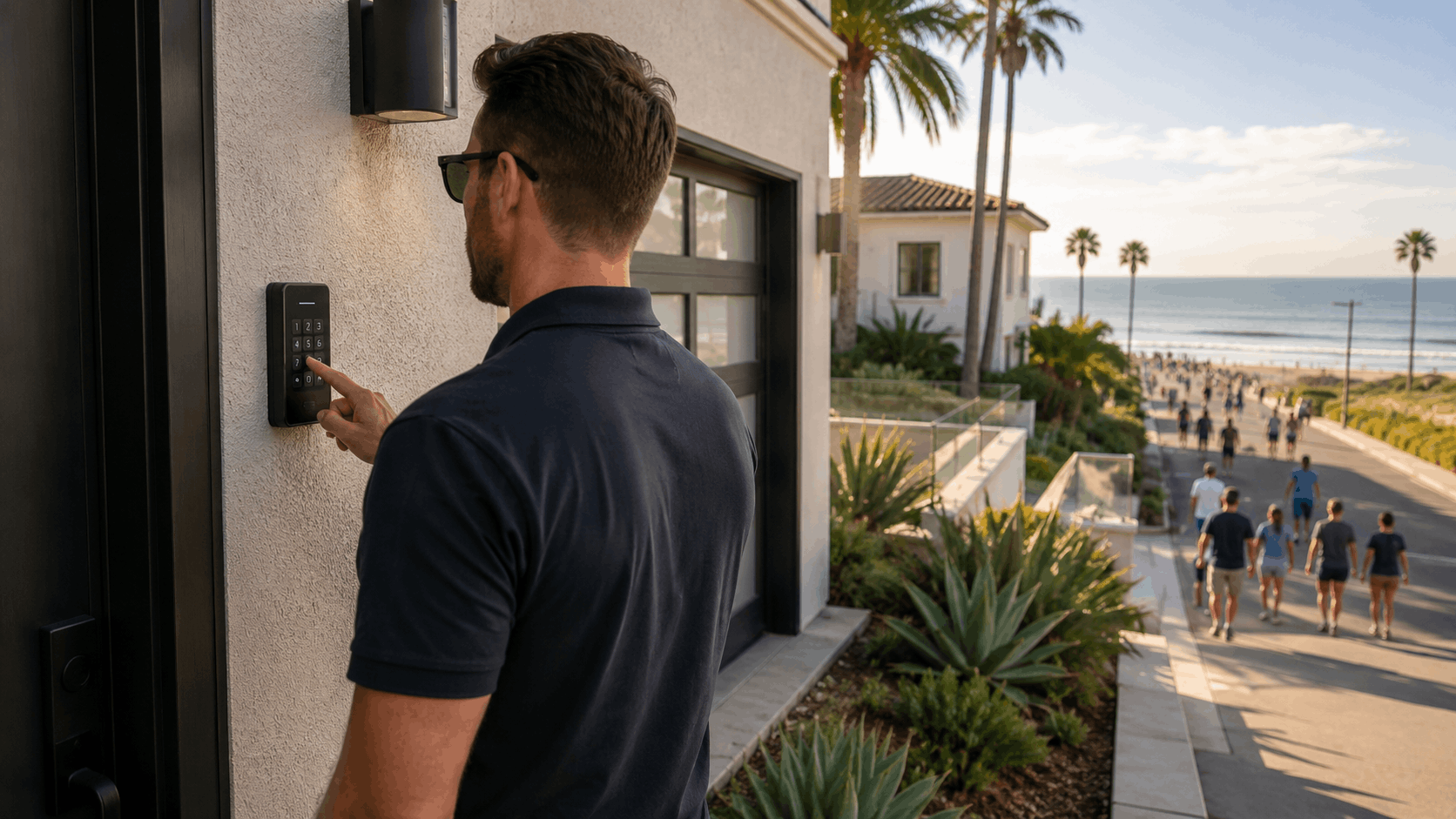
Short-term rentals along the Shores cycle through guests constantly, and handing out physical keys is both insecure and a hassle. Keyless entry with temporary codes solves this by giving each guest a code that works only for their stay.
The same applies to cleaning crews and maintenance. A time-limited code lets a cleaner in on turnover day between 10 a.m. and 2 p.m. and stops working after, so no one keeps standing access to the home.
When a guest checks out, their code is gone, and there is no lost key floating around the neighborhood. For rental owners, that control over rental access is the difference between hoping a key came back and knowing the door is locked to anyone who should not have it.
We set up guest temporary access codes so owners can generate and expire them from a phone. It turns a rotating cast of visitors into a managed list instead of a security gap.
Video Doorbells for Crowded Front Walks
With sidewalks busy from morning to sunset, a Shores resident often has no idea who is at the door until they open it. A video doorbell lets them screen visitors from inside or from anywhere, which matters when the front walk never empties.
Visitor screening cuts down on the awkward and the risky alike. The owner can see whether it is a delivery, a lost tourist, or someone they actually want to answer for, all without opening the door to the crowd outside.
For rentals, a doorbell camera also documents who comes and goes at the front entry. That record is useful when guests dispute access or when something goes missing during a stay.
Paired with the door lock and cameras, the doorbell becomes the front-line filter. It catches the package thief, greets the legitimate guest, and gives the owner eyes on the busiest part of the property at all times.
Gate and Side-Entry Reinforcement
The front door usually gets the attention, but on beach blocks the side gates and secondary doors facing public walkways are the softer targets. A flimsy gate latch on a path to the beach is an open invitation.
Gate security starts with solid hardware - a real lock, reinforced hinges, and a latch that cannot be reached and flipped from outside. Many Shores gates were built for looks, not for keeping a determined person out.
Side entries and back doors deserve the same reinforcement as the front. Stronger strike plates, longer screws, and quality deadbolts turn a kick-in target into a real obstacle, and adding a sensor or smart lock extends monitoring to that door.
We treat every door and gate that faces a public path as a primary entry point, because on the Shores it effectively is. Closing those gaps with smart lock installation on secondary doors removes the easy way in that crowds help conceal.
Protecting Vacation Homes and Seasonal Residences
Plenty of Shores properties sit empty for stretches - second homes used a few weeks a year, or rentals dark between bookings. An empty beach-block home is a tempting target, and protecting it calls for a system that works without anyone present.
Vacation home security leans on remote tools and automation. The owner may be a thousand miles away, so the home has to watch itself and call for help on its own.
Remote Monitoring While Owners Are Away
App-based remote monitoring lets out-of-town owners check on a seasonal residence from anywhere. They can pull up live camera feeds, review recorded clips, and confirm the home is fine without driving across the state.
Mobile alerts turn the system into an early warning. A motion event at a side gate, a door opening, or a triggered sensor pushes a notification to the owner's phone in seconds, even when the home has been empty for weeks.
For absent owners, that real-time window is what makes leaving a beach home behind tolerable. Instead of wondering whether everything is fine, they can look and know within a minute.
We configure these systems so the alerts that reach an owner are the ones that matter, filtered the same way as occupied homes so a vacant property does not bury the owner in passing-crowd noise. A connected residential alarm system installation ties cameras, sensors, and alerts into one app.
Occupancy Simulation and Smart Lighting
An empty home advertises itself with dark windows night after night. Occupancy simulation fights that by automating lights and routines so a vacant home near Vallecitos looks lived-in to anyone watching from the street.
Smart lighting can vary the schedule so it does not look mechanical. Lights that come on at different times, a TV simulator glow, or interior lights that shift room to room read as a real household going about its evening.
The point is to remove the empty-house signal that draws opportunists. On a block where renters come and go, a home that looks occupied blends in instead of standing out as the dark one nobody is using.
We build these routines into the home's automation so they run on their own. Pairing smart home automation with security gives a vacant property the rhythm of an occupied one without the owner touching a thing.
Professional Monitoring and Local Response
Cameras and alerts are only half the picture for a vacant home. Professional monitoring adds a 24/7 team that sees an alarm, verifies it with video, and dispatches help while the owner is asleep or out of reach.
A San Diego based monitoring team brings faster verification and dispatch than a distant call center. When a sensor trips at a Shores home, knowing the local geography and response times speeds up the call to authorities.
Verification also cuts false dispatches. When the monitoring center can check the camera feed before calling police, a passing raccoon or a wind-blown gate does not waste an emergency response or rack up false alarm fees.
For seasonal owners, that combination of 24/7 alarm monitoring and local response is the backstop. The home is watched, alarms are verified, and someone reacts even when the owner cannot.
Need Help in San Diego?
Smart Shield Systems serves San Diego and all of San Diego County.
How Smart Shield Systems Approaches La Jolla Shores Installs
Securing a beach-block home is not a catalog order. Our team has worked the Shores long enough to know how foot traffic moves, where salt does the most damage, and which approach routes crowds use to hide. Every install reflects that.
As a local installer, we build each system around the specific conditions of the property rather than dropping in a generic package. That is what custom security means on a block like this.
On-Site Assessment of Foot Traffic Patterns
We start with a site assessment that studies how people actually move around the home. Where does the beach crowd flow? Which alley or walkway sees the most traffic? Where do strangers naturally pause?
Watching foot traffic before placing anything tells us where motion zones need to be tight and where coverage gaps hide. A home facing Kellogg Park needs a different layout than one tucked on a quieter stretch toward the launch.
The assessment also maps every door, gate, and window against the public paths around the lot. That custom layout is what keeps the system from either missing the real entry points or drowning the owner in sidewalk alerts.
By the time we recommend equipment and placement, the plan reflects how that specific home sits in the flow of the neighborhood. No two Shores lots present the same picture.
Equipment Choices Built for the Coast
We select coastal equipment that survives salt air instead of failing in a year. Corrosion-resistant housings, marine-rated mounts, and sealed connections go in by default on beach-block homes, because we have seen what the alternative does.
AI detection is the other half of the equation. On streets this busy, cameras with person detection and behavior analytics are what make the footage usable, filtering crowds down to the events worth a look.
We match the gear to the home's exposure and traffic. A property near the water gets more aggressive corrosion protection, while a high-traffic front gets the smartest detection settings we can dial in.
The result is a system built for the conditions it lives in. Coastal-rated, crowd-aware, and integrated through video surveillance cameras and access control that work together rather than as separate pieces.
Local Support and Ongoing Service
Beach-block systems need upkeep, and a local San Diego team makes that practical. We handle the lens cleanings, gasket checks, and connection inspections that coastal gear demands, in person and on schedule.
When something needs an upgrade or a question comes up, the owner talks to the same team that did the install. That continuity matters more on the coast, where small maintenance lapses turn into expensive failures fast.
We serve the Shores alongside the rest of San Diego, so response and service stay close to home. Local support is not a slogan here - it is what keeps a salt-exposed system running year after year.
Ongoing service also means the system grows with the property. As rentals change, as needs shift, and as gear ages, we adjust the setup instead of leaving owners with a system frozen at install day.
Final Thoguhts
La Jolla Shores rewards the people who live there with sand at their doorstep and a beach-town rhythm few neighborhoods can match. It also asks more of their home security than almost any inland street in San Diego.
The crowds that hide trouble, the salt that eats hardware, the rotating renters, and the empty stretches between seasons all call for a system built for this exact place. Generic gear and generic settings do not hold up here.
If you own a home on the Shores and want a setup matched to the foot traffic, the salt air, and the way your block actually works, reach out to our team. Contact Smart Shield Systems to schedule a consultation and we will walk your property and build a plan around it.
Frequently Asked Questions
- Does heavy tourist foot traffic increase the risk of home break-ins in La Jolla Shores?
- Yes, indirectly. The crowds themselves are not the threat, but they camouflage it. When hundreds of strangers pass a home daily, the usual instinct to notice someone testing a door or lingering at a gate stops working. That cover is why monitoring matters more here than in quiet neighborhoods. Cameras with smart detection do the watching that residents cannot do when the sidewalk never empties out.
- How quickly does salt air damage security cameras near the beach?
- Faster than most owners expect. Standard consumer cameras within a few blocks of the water often show corrosion within a year, sometimes failing in twelve to eighteen months as salt attacks contacts and seals. Marine-grade equipment with an IP66 or higher rating and corrosion-resistant housings holds up for years instead. The hardware choice and regular maintenance, not the camera brand, decide how long a coastal system lasts.
- Can cameras be set up to ignore people walking by on a busy sidewalk?
- Yes. Motion zones let a camera ignore the public sidewalk while still watching the steps, gate, and yard. AI person detection filters out cars, shadows, and pets so only a human approaching the property triggers an alert. On a beach block, this tuning is what keeps the system useful - without it, the constant foot traffic buries the owner in false alerts they quickly start ignoring.
- Is it legal to point a security camera toward a public beach access path?
- California privacy rules expect cameras to record your own property, not the inside of a neighbor's home or to deliberately surveil public areas. A camera can capture some public walkway incidentally, but it should be angled down and inward toward your entry points, with privacy masking applied to areas you should not record. Proper angling keeps footage admissible and avoids privacy complaints from neighbors and passersby.
- What is the best way to stop package theft during summer beach season?
- Layer your defenses. A video doorbell records the drop and alerts you the moment a package arrives, so it can be grabbed quickly. A lockbox or parcel drop protects high-value items, and delivery alerts from carriers help you time pickups. The goal is to remove the unattended box from the busy sidewalk before a porch pirate blends into the crowd and walks off with it.
- How can owners protect a vacation rental between guests?
- Use temporary access codes that expire after each guest or cleaning visit, so no key floats around the block. Remote monitoring lets you check cameras and receive alerts from anywhere, and occupancy routines with smart lighting keep a dark home from looking empty. Together these tools secure the property during the gaps between bookings without anyone needing to be physically present at the home.
- How often should coastal security systems be maintained?
- More often than inland systems. We recommend lens cleaning every one to two months on Shores homes, since salt film clouds the picture fast. Connection checks, gasket inspections, and mount reviews belong on a twice-a-year schedule. By comparison, an inland San Diego home usually needs only an annual check. Homes closest to the water sit at the frequent end of that range because salt exposure is most severe there.
- Do smart locks work well for homes with frequent guests and cleaners?
- Very well. Smart locks let owners issue temporary codes set to work only during a guest's stay or a cleaner's window, then expire automatically. There is no physical key to lose or copy, and access can be granted or revoked from a phone. For Shores rentals with constant turnover, this managed access is far more secure than handing out keys and hoping they all come back.
- What does a home security install cost in La Jolla Shores?
- Costs vary with property size, number of cameras, locks, and whether you add professional monitoring. Beach-block homes often run higher than inland installs because they need marine-grade corrosion-resistant gear and more careful camera placement around public paths. A small system may start in the low four figures, while a full coastal setup with monitoring runs more. We provide a clear quote after assessing the specific property.
- Does Smart Shield Systems service all of La Jolla Shores?
- Yes. We cover all of La Jolla Shores along with the surrounding San Diego area, from the homes lining Kellogg Park to the streets reaching back toward La Jolla Shores Drive. As a local team, we handle installs, maintenance, upgrades, and service in person. Reach out through our contact page to schedule a consultation for your beach-block property.
S
Smart Shield Systems Team Team
Licensed security systems professionals serving San Diego and San Diego County.
Licensed in California · License #7623
Why trust Smart Shield Systems?
Founded in 2016, Smart Shield Systems is a licensed and insured security systems serving San Diego and San Diego County. All content is reviewed by our licensed technicians.

Need Help in San Diego?
Smart Shield Systems serves San Diego and all of San Diego County.
Related Articles

Safety & Prevention
How Carjacking Trends in San Diego Are Changing Home Security Priorities
Rising carjacking trends in San Diego are pushing homeowners to rethink driveway and garage security. Here's what the data shows and what actually helps.
Tips & Advice
La Jolla Home Security: Estate-Grade Systems for Muirlands and La Jolla Farms
Estate-grade home security for La Jolla's Muirlands and La Jolla Farms: camera placement on coastal lots, gated access, monitoring, and wildfire readiness.
Safety & Prevention
Home Security for Linda Vista Homes and Rentals That Actually Works
Discover proven home security solutions for Linda Vista homes and rentals. Smart Shield Systems provides neighborhood-specific security systems that actually work.