Tips & Advice
The Bridges Rancho Santa Fe Security: Custom Estate System Service
Key Takeaways
- Estate homes at The Bridges need custom systems because large lots, long driveways, and multiple structures leave standard packages full of gaps.
- A full estate system combines high-resolution cameras, motion and perimeter sensors, smart locks, automated gates, and one central hub with app control.
- Good design starts with an on-site walkthrough that maps every entry point and blind spot before any equipment is chosen.
- 24/7 professional monitoring with cellular failover and backup power keeps protection active during SDG&E outages and internet drops common in rural Rancho Santa Fe.
- Local conditions like coastal fog, wildfire season, wildlife, and weak signal on remote lots all shape how a system is built and maintained.
- Smart home integration adds automated lighting, gate intercoms, and temporary staff access codes for both convenience and stronger security.
- Estate systems typically run $15,000 to $60,000-plus with a two to six week install, and exact pricing comes from a property walkthrough.
- A local San Diego team offers faster response, community knowledge, and custom design that national providers cannot match.
In This Article
A homeowner off San Dieguito Road called us last spring after a landscaping crew found a side gate standing open one morning. Nothing was taken, but the estate spanned nearly three acres with a main house, a casita, and a pool house - and the old alarm only covered the front door and a couple of windows. That gap between what they thought was protected and what actually was is exactly why estate homes at The Bridges need a different approach.
The Bridges Rancho Santa Fe is a private gated golf community where properties sit on large lots, often screened by mature trees and long driveways. A standard security package built for a tract home in the suburbs does not fit these grounds. Multiple structures, wide-open acreage, and a strong expectation of privacy all change how a system has to be built.
Why Estate Homes at The Bridges Need Custom Security Systems?
Estate security at The Bridges is a different animal than protecting a typical home. The scale alone changes everything, and off-the-shelf packages leave big holes. Here is why a custom system built for The Bridges Rancho Santa Fe makes sense for these properties.
- Lots often run two to five acres or more, far beyond a standard camera package
- Many estates have multiple buildings that each need their own coverage
- Residents value discretion, so equipment cannot be bulky or obvious
- The community guard gate is one layer, but it does not protect the home itself
Large Lots and Long Driveways Create Coverage Gaps
The estates off Del Dios Highway and San Dieguito Road are not measured in feet from the street. Many have driveways that stretch several hundred feet, wrapping past gardens and mature oaks before reaching the front door. A basic four-camera kit cannot see any of that.
Perimeter coverage is the first thing our team maps on these properties. We look at where the fence line runs, where the driveway curves out of sight, and which corners of the acreage sit in permanent shadow. Those blind spots are where trouble tends to slip in unnoticed.
Driveway monitoring matters because a long approach gives you early warning. A camera at the gate and another halfway up the drive means an owner sees a vehicle long before it reaches the house. On a large lot, that head start changes how you respond.
We often add license plate recognition cameras at the entry so the system logs every vehicle that comes and goes. On acreage this size, knowing who arrived and when is the difference between guessing and knowing.
Guest Houses, Pools, and Outbuildings
Casitas, pool houses, and detached garages are common across The Bridges. Each one is a separate building with its own doors, windows, and value inside. Treating them as an afterthought leaves the weakest points wide open.
Guest house security needs its own zone in the system. That way an owner can arm the main home at night while a guest stays in the casita, without setting off alarms every time someone steps outside. Separate zones give real flexibility on a multi-structure property.
Pool areas and outbuildings also draw attention because they are often out of sight from the main house. A pool house with an outdoor kitchen or a detached garage full of vehicles deserves the same sensors and cameras as the primary residence.
The goal is integrating multiple structures into one system that an owner controls from a single app. We wire or connect each building so they report to the same hub, giving one clear picture of the entire estate instead of scattered pieces.
Privacy Expectations in a Gated Community
People who choose The Bridges value their privacy, and their security should respect that. Nobody wants a home that looks like a fortress or bristles with obvious cameras. Discreet security is part of the design here.
We use low-profile camera housings, hidden wiring, and mounting that blends into the architecture. A dome camera tucked under an eave protects the entrance without announcing itself to guests arriving for dinner.
This gated community already carries a private character, and the security should reinforce that feeling rather than break it. Sensors and keypads can be placed where the family uses them but where visitors never notice.
Privacy also means keeping footage and data controlled. Owners decide who can view cameras, and access logs stay in the family's hands. That level of discretion is something estate owners at The Bridges expect from the start.
Coordinating With HOA and Guard Gate Protocols
The Bridges front gate is staffed, and that staffing is a real benefit. It screens who enters the community and keeps casual traffic out. But the guard gate does not watch individual homes once a vehicle is inside.
HOA security at the community level and a home system at the property level are two layers that work together. The gate controls who gets in the front door of the neighborhood, and the home system controls who gets near the house itself.
We build systems that respect the community's access protocols. Delivery drivers and service crews still check in at the gate, then the home system takes over with its own access control for the actual property.
When both layers are set up well, an owner gets defense in depth. The gate stops the obvious problems, and the home system catches anything that slips past. Neither one replaces the other.
Core Components of a Custom Estate System
Before signing off on a system, it helps to know what the parts actually do. An estate system is built from a handful of core security components, each with a job. Here is what an owner is really paying for.
High-Resolution Cameras and Night Vision
Cameras are the eyes of the system, and on a large property they carry a lot of weight. We install 4K cameras where detail matters most, like the gate, the front entry, and the driveway approach. That resolution lets you read a plate or recognize a face instead of squinting at a blur.
Coverage angles matter as much as resolution on wide grounds. A mix of wide-angle cameras for open areas and focused lenses for choke points gives full surveillance without gaps. We plan placement so fields of view overlap and no corner goes unwatched.
Night vision is where cheap cameras fail. Estates at The Bridges have dark stretches of lawn and tree cover where street light never reaches. Infrared and low-light sensors keep footage clear after sundown, which is exactly when most owners worry.
Our home security camera installation is planned around each property's layout so the footage is useful, not just recorded. Good placement beats piling on more cameras that all point at the same spot.
Motion Sensors and Perimeter Alarms
Motion sensors cover the ground cameras cannot always watch. Indoors, they detect movement in hallways and main rooms after the system is armed. Outdoors, they pick up activity near doors, the pool, and outbuildings.
Perimeter alarms are built for the long fence lines and open grounds common at The Bridges. Beam sensors can run along a property edge and trip when someone crosses, giving early warning before an intruder reaches the house.
Detection has to be tuned for the setting. A sensor set too sensitive on a three-acre lot will fire every time a rabbit crosses the lawn. We calibrate range and sensitivity so the system reacts to real threats, not passing wildlife.
Pairing motion sensors with cameras means every trigger comes with a picture. When a sensor fires, the nearest camera shows what caused it. That link between detection and video is what makes the whole thing dependable. Our intrusion sensor installation covers both indoor and outdoor placement.
Smart Locks and Automated Gates
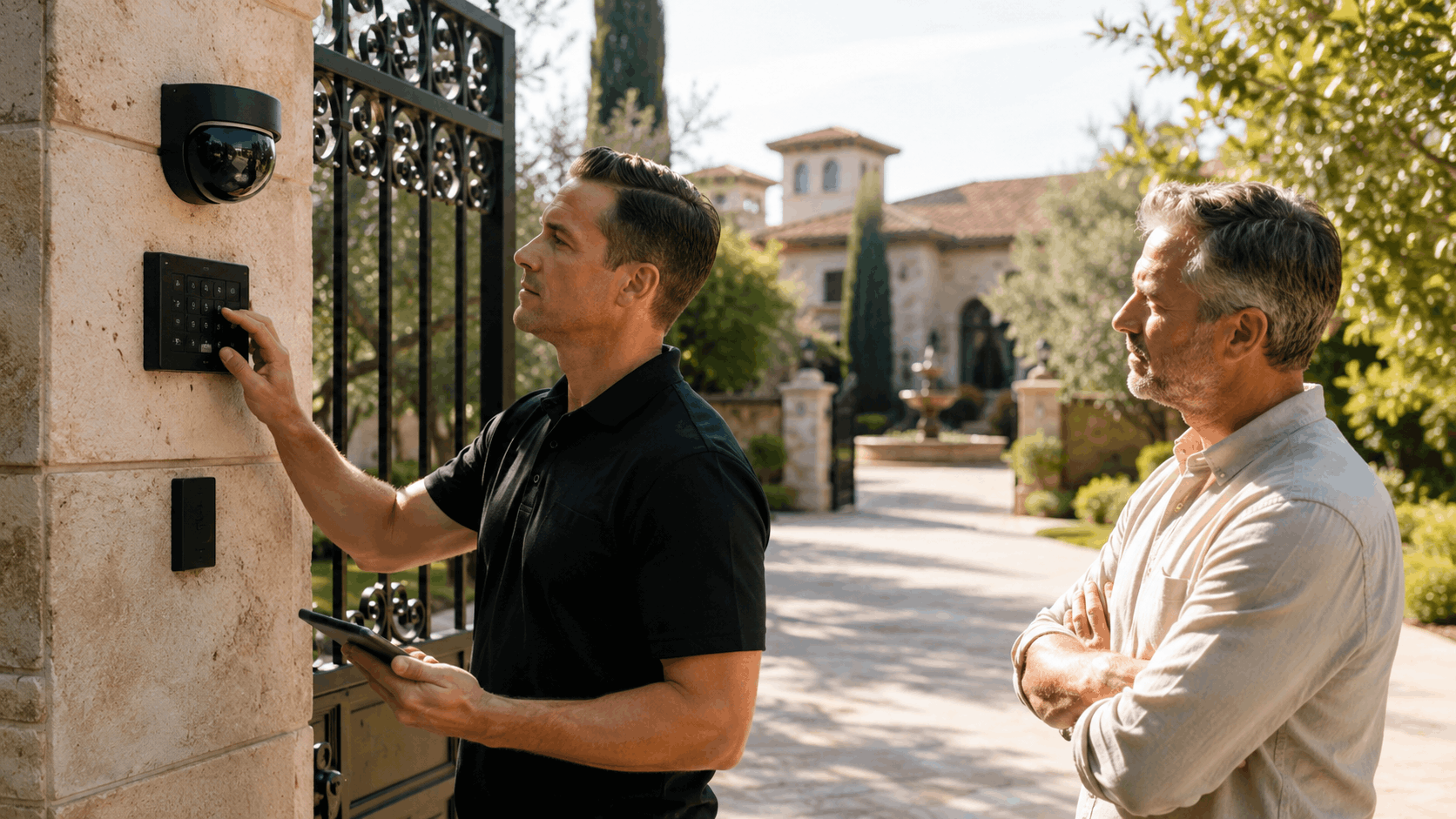
The front gate is the first barrier on most Bridges estates. An automated gate with keypad entry lets owners open it from a phone or grant a code to a visitor without leaving the house. It also logs every entry.
Smart locks handle the doors on the main home and guest structures. A housekeeper can have a code that works only during set hours, and that code can be changed the moment it is no longer needed. No more hidden keys under a pot.
Access control ties the gate and the locks together. One system decides who can pass the gate, enter the main house, or reach the casita, all from a single set of rules the owner controls.
We install keyless entry systems and gate access control that work together across the property. That keeps entry simple for the family and controlled for everyone else.
Central Control Panels and Mobile Apps
All these parts are only as good as the hub that connects them. A central control panel is the brain of the system, tying cameras, sensors, locks, and gates into one place. From there, everything talks to each other.
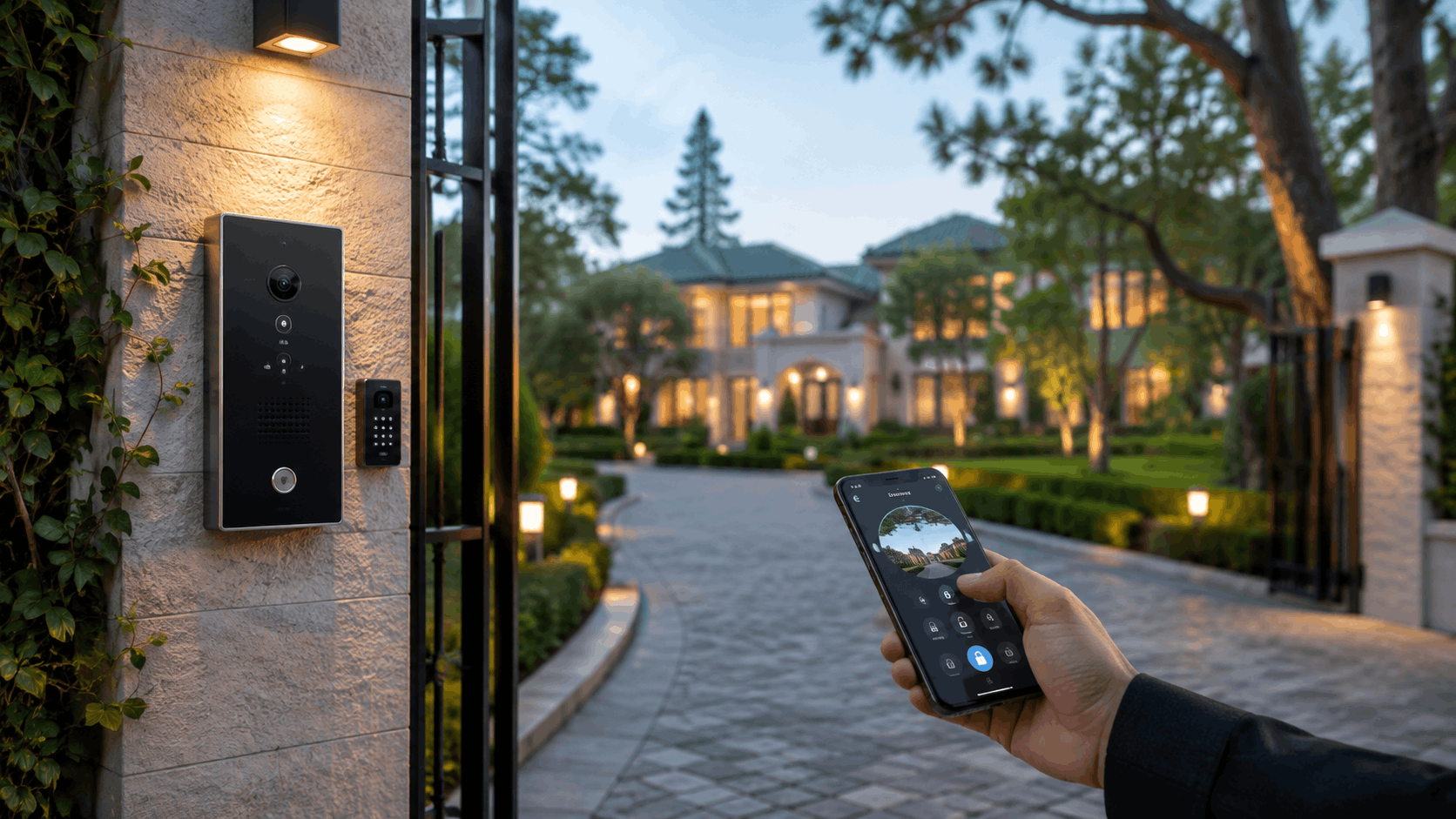
The mobile app puts that control in an owner's pocket. Whether they are at the office in San Diego or traveling overseas, they can check cameras, lock a door, or open the gate for a guest. Remote access is what makes a large estate manageable.
A good panel also handles alerts. If a sensor trips or a door opens at an odd hour, the owner gets a notification with a live view. They can decide in seconds whether it is a family member or a real concern.
We set up the app so it is simple to use, even for owners who are not into gadgets. One screen shows the whole estate, and controls stay clear and quick. The technology should serve the owner, not confuse them.
Need Help in San Diego?
Smart Shield Systems serves San Diego and all of San Diego County.
Get Your Free Quote
Tell us about your property and we'll get back to you fast.
How System Design Works for a Bridges Estate
Good estate security starts long before any equipment gets mounted. The design phase is where a system either fits the property or falls short. Here is what the process looks like from the first visit to a finished custom install.
The On-Site Property Walkthrough
Every project starts with our team walking the grounds in person. Photos and satellite images never tell the whole story on acreage. We need to stand at the gate, follow the driveway, and see where the tree line blocks a view.
During the site walkthrough we note every structure, from the main house to the smallest garden shed. We look at how the family uses the space, where they park, and which doors get the most traffic. All of it shapes the plan.
Property mapping also means spotting the weak points an owner might not think about. A back gate hidden behind hedges, a pool house with a sliding door, a low fence along one edge - these are the openings that matter.
By the end of the walkthrough we have a full assessment of the property's strengths and gaps. That firsthand knowledge is why local work beats a remote quote from a company that never set foot on the lot.
Mapping Entry Points and Blind Spots
Once we know the property, we catalog every entry point. That means each exterior door, ground-floor window, gate, and access path across the estate. Nothing gets left off the list.
Blind spots get the same treatment. We mark the corners cameras cannot reach, the shadowed stretches of lawn, and the areas where landscaping blocks a clear line of sight. Those spots need sensors or repositioned cameras.
On a multi-acre lot, this catalog can run long. A main house alone might have a dozen entry points, and adding a casita and pool house doubles the work. Being thorough here prevents surprises later.
The result is a full coverage plan that shows exactly what protects each part of the estate. The owner sees where every camera and sensor goes and why. No guesswork, no gaps left to chance.
Choosing Wired vs Wireless Setups
Distance and structure count decide a lot about how a system connects. A wired system runs cable between devices and the panel, which gives a steady, reliable signal. It works well when new construction or remodels let us route cable cleanly.
A wireless system skips the trenching and drilling, which matters on established estates where digging up a driveway is not welcome. Wireless devices connect over the network and battery power, making them faster to install across separate buildings.
On many Bridges properties we use a mix. Core cameras at the gate and main house might be wired for reliability, while sensors in a distant casita go wireless to avoid running cable across the grounds.
Connectivity is the deciding factor. Long distances between structures, thick walls, and mature landscaping all affect signal. We choose the setup that keeps every device talking without dropouts, based on what the specific property allows.
Building a Plan Around the Owner's Routine
A system that ignores how a family lives becomes a nuisance. So we build the custom plan around the owner's routine. Travel schedules, work hours, and daily habits all shape the final design.
Owners who travel often need strong remote features and vacation modes. Those who are home most days may want easy one-touch arming and quick guest access instead. The lifestyle drives the setup.
Staff access is part of the routine too. Housekeepers, landscapers, and property managers each need entry on their own schedule. We build an access schedule that lets the right people in at the right times and no one else.
The final plan reflects the way the estate actually runs. It protects the property without getting in the family's way. That balance between security and daily ease is what makes a custom system worth the investment.
Professional Monitoring and Rapid Response
A system that only records footage is missing the point. Real protection comes from someone watching and acting when an alarm fires. Here is how 24/7 monitoring works and why response time matters so much for estates in Rancho Santa Fe.
How 24/7 Monitoring Centers Operate
A monitored alarm does more than sound a siren. When a sensor trips, the signal travels to a monitoring center where trained operators are watching around the clock. They see the alert the moment it happens.
Operators then follow a set process. They check the alarm signal, often review camera footage, and try to reach the homeowner to confirm whether it is real. All of this happens in under a minute in most cases.
Self-monitoring puts that job on the owner. If a phone is on silent or the owner is on a flight, an alert can sit unseen for hours. Professional monitoring removes that risk by keeping human eyes on the system at all times.
For a large estate where the owner may be far from the property, that constant watch is worth a great deal. Our 24/7 alarm monitoring keeps someone ready to act no matter the hour.
Response Coordination With San Diego County Sheriff
When an alarm is confirmed, the monitoring center coordinates emergency dispatch. In Rancho Santa Fe, that means routing the alert to the San Diego County Sheriff serving the area, with the Encinitas station covering much of this region.
Fast, accurate dispatch depends on good information. The monitoring center gives responders the address, the type of alarm, and often a live description of what triggered it. That helps law enforcement arrive prepared.
On gated community properties, we make sure the system notes gate access details so responders are not stuck at the entrance. Getting deputies to the actual house quickly matters on these large lots.
This coordination between the monitoring center and local law enforcement is what turns an alarm into an actual response. A siren alone does little if no one is coming. A monitored system closes that loop.
Cutting Down on False Alarms
False alarms are a real headache on large estates, and Rancho Santa Fe has plenty of triggers. Wildlife, wind, and swaying landscaping can all set off a poorly tuned sensor. Too many false trips lead to slow responses and fines.
Verification is how we cut that down. When a sensor fires, the system pulls up nearby camera footage so operators can see whether it is a coyote, a branch, or a real intruder before calling in a response.
We also tune sensors to the property. Adjusting range, sensitivity, and placement keeps a motion detector from firing every time a deer crosses the lawn or a gust rattles the patio furniture.
The result is fewer false alarms and faster response to the ones that count. Operators trust the alerts, deputies take them seriously, and the owner is not woken at 3 a.m. by a raccoon. Good tuning makes the whole system more reliable.
Backup Power and Cellular Failover
Rural parts of Rancho Santa Fe deal with power outages and internet drops more than most areas. SDG&E outages during storms or public safety shutoffs can cut power for hours. A security system has to keep running through all of it.
Battery backup keeps the panel, cameras, and sensors alive when the power goes out. A good backup carries the system through the typical outage without missing a beat, so protection never lapses when the lights do.
Cellular failover handles the internet side. If the home network goes down, the system switches to a cellular signal to keep sending alerts to the monitoring center. An intruder cannot disable it by cutting the internet.
Together, backup power and cellular backup mean the system stays online during the exact moments a home is most exposed. On rural estates where outages are common, that resilience is not optional. It is the baseline.
Local Conditions That Shape Estate Security Here
Rancho Santa Fe has its own climate, wildlife, and terrain, and all of it affects how a security system is built. What works in a dense suburb can fail out here. Here are the local conditions that shape estate protection in this area.
Coastal Fog and Weather-Rated Equipment
The marine layer rolls in from the coast most mornings, blanketing the area in damp fog. That moisture is hard on outdoor electronics. Cheap gear corrodes, fogs up, and fails within a season or two.
Weatherproof cameras with proper sealing ratings hold up to that coastal fog. We look for housings rated to keep out moisture and dust, so a camera on an exposed eave keeps working through years of marine layer.
Lenses matter too. A camera without proper coating will fog over on humid mornings, leaving useless footage during the hours it is needed most. Weather-rated optics stay clear when the fog is thick.
We choose equipment built for this coastal climate from the start. Spending a little more on weatherproof gear saves the cost and hassle of replacing failed cameras every couple of years. In Rancho Santa Fe, that choice pays off.
Wildfire Season and Property Access
Fire risk is real in the San Dieguito area, especially during dry, windy stretches. Wildfire season shapes how we place cameras and plan for emergencies. Owners need to see their property even when they are evacuated miles away.
Remote monitoring becomes hugely useful during red flag days. An owner who has left the estate can still check cameras to see if the property is safe or if crews are on-site. That view brings real reassurance during a stressful time.
Camera placement accounts for fire access too. We position gear so it captures the driveway and gates that fire crews would use, and we make sure automated gates can open for emergency vehicles when they need in.
Evacuation planning ties into the system as well. Automated gates, remote access, and clear notifications help an owner secure the estate quickly when a fire warning comes. In this area, that readiness is part of the plan.
Wildlife and Landscaping Interference
The open grounds around The Bridges attract wildlife. Coyotes, deer, rabbits, and birds cross these lots constantly, and each one can trip a poorly placed motion sensor. Wildlife triggers are one of the top causes of false alarms out here.
Mature landscaping is the other. Tall trees, thick hedges, and swaying branches can block a camera's view or set off a sensor when the wind picks up. Estates at The Bridges are full of established plantings that do exactly this.
Careful sensor placement solves most of it. We mount detectors at heights and angles that ignore ground-level animals and screen out moving foliage. Cameras go where branches will not grow into the frame over a season.
We also revisit placement as landscaping matures. A camera view that was clear at install can get blocked by a growing hedge two years later. Periodic checks keep the coverage plan working as the grounds change.
Remote Lots and Cellular Signal Strength
Some properties near the edges of the community sit far from strong cellular towers. Weaker signal on these remote lots can affect cellular failover and app connectivity. We plan around it rather than hope it works.
During the walkthrough we test signal strength across the property. If the far reaches of a lot have poor coverage, we know before install and can choose equipment and carriers that hold up in that spot.
Signal boosters and antenna placement help pull in a usable connection where the raw signal is thin. On a large estate, positioning the cellular antenna in the right spot can be the difference between reliable failover and dead air.
Connectivity planning is part of every remote-property design. We do not assume a strong signal is there. We confirm it and build the system to stay connected even at the property's furthest corners.
Need Help in San Diego?
Smart Shield Systems serves San Diego and all of San Diego County.
Integrating Security With Smart Home Features
Security does not have to stand alone. On a modern estate it can tie into lighting, climate, and daily automation for a connected home that is both easier to run and better protected. Here is how smart home integration adds convenience and safety at once.
- Automated lighting makes the estate look lived-in while owners travel
- Video doorbells and gate intercoms let owners screen visitors from anywhere
- Temporary access codes handle staff and contractors without handing out keys
- One app or voice assistant controls the whole property
Automated Lighting and Vacation Modes
An empty-looking estate invites trouble, so we use automated lighting to fight that. Lights turn on and off on realistic patterns, making it look like someone is home even when the owner is across the country.
Vacation mode ties lighting, blinds, and other features together. Instead of a single porch light burning all night, the system varies which rooms light up and when, mimicking normal family activity.
That deterrence works because most opportunists avoid homes that seem occupied. A property that shows life at random hours is a far less appealing target than a dark, silent one.
Owners can set these modes from the app before a trip or leave them running on a schedule. Our smart home automation ties lighting and security into one system that works while the family is away.
Video Doorbells and Intercom at the Gate
The gate is the first point of contact for any visitor, so it makes sense to put eyes and ears there. A gate intercom lets owners speak with whoever pulls up, whether it is a guest, a delivery, or a stranger.
Video doorbells at the main entrance do the same at the house. An owner can see and talk to someone at the door from a phone, whether they are upstairs or overseas. Visitor screening becomes simple and remote.
For deliveries, this is a real convenience. An owner can direct a driver where to leave a package or open the gate for a known service and close it right after. No missed deliveries, no open gate left behind.
These features also feed the security system. Every visitor is recorded, so there is always a record of who came to the gate or door. On a large private estate, that log is worth having.
Managing Staff and Contractor Access
Large estates run on staff and contractors. Housekeepers, landscapers, pool crews, and service techs all come and go. Handing each of them a key or gate remote is a security problem waiting to happen.
Temporary access codes solve it. Each worker gets a code that works only during their scheduled hours, and it can be turned off the moment a job ends or a crew changes. No lingering keys floating around.
The system logs who entered and when, so an owner always knows which crew was on-site. If something goes wrong, there is a clear record instead of finger-pointing. That accountability matters on a busy estate.
Our guest and temporary access codes make managing staff access simple. Owners grant and revoke entry from the app without ever cutting a new key.
Voice and App Control Across the Property
Running an entire estate from a phone or a spoken command is where integration pays off daily. Voice control lets an owner lock up, adjust lights, or check a camera without lifting a finger to a panel.
App control brings the whole property onto one screen. Cameras, locks, gates, lights, and alarms all live in the same place. There is no juggling separate apps for each piece of the system.
This matters most on a big property. Instead of walking the grounds to check that everything is secure, an owner glances at the app and sees the full estate at once. It saves time and gives a clear picture.
We set up voice and app control so the system fits how the family already lives. The automation should feel natural, not like one more thing to learn.
Costs, Timelines, and Ongoing Service
Owners want real numbers before they commit, and that is fair. Custom estate systems vary widely in price and timeline based on the property. Here is a straight look at what an estate system costs, how long it takes, and what service looks like after install.
| Factor | Typical Range | What Affects It |
|---|---|---|
| Full estate system cost | $15,000 - $60,000+ | Property size, camera count, structures |
| Installation timeline | 2 - 6 weeks | Wiring needs, number of buildings |
| Monthly monitoring | $50 - $150 | Coverage level, number of zones |
| Annual maintenance | $300 - $1,000 | System size, service plan chosen |
What Drives the Price of an Estate System
Property size is the biggest pricing factor. A three-acre lot needs more cameras, more sensors, and more cable than a small home. The more ground to cover, the higher the system cost.
Camera count follows from that. An estate with a gate, a long driveway, a main house, and outbuildings might need a dozen or more cameras. Each 4K camera and its mounting adds to the total.
Structure count matters too. Every casita, pool house, and detached garage is another building to wire and protect. An estate with three buildings costs more than one with a single home of the same square footage.
Add-ons like automated gates, smart locks, and full smart home integration push the range higher. The figures in the table are starting points. A walkthrough is the only way to get an accurate number for a specific estate.
Typical Installation Timeframes
Most estate installs run two to six weeks from design to finish. The design phase and the walkthrough come first, followed by ordering equipment and scheduling the work. A larger property naturally takes longer.
Wiring drives much of the timeline. A wired system across multiple buildings involves running cable, which takes time and care on established grounds. Wireless setups move faster but still need careful placement and testing.
The number of structures stretches the schedule. Connecting a main house, casita, and pool house into one system is more work than wiring a single building. Each structure adds its own setup and testing.
We give a clear project schedule up front so owners know what to expect. Rushing an estate install leads to gaps, so we plan the setup to be thorough rather than fast. Doing it right the first time saves headaches later.
Maintenance and System Health Checks
A security system is not a set-and-forget purchase, especially in a coastal climate. Regular maintenance keeps gear working through the marine layer moisture that wears on outdoor equipment. Skipping it leads to failures at the worst times.
System health checks catch small problems early. A camera lens fogging, a sensor drifting out of alignment, a battery near the end of its life - these show up during a routine inspection before they cause a real gap.
Firmware updates keep the system current and secure. Manufacturers push updates that fix bugs and close security holes, and staying current protects against new threats. We handle those updates as part of ongoing service.
Our system maintenance service keeps everything running in Rancho Santa Fe conditions. Periodic checks are how an estate system stays reliable year after year.
Warranty and Local Support From Smart Shield Systems
When something needs attention, a local team can be at the property fast. A San Diego based company knows the roads, the community, and the way to the gate. A distant national provider cannot match that.
Warranty coverage protects the equipment, but the value is in who backs it. We stand behind the systems we install and handle service ourselves rather than routing calls through a call center hundreds of miles away.
Local support means a real person answers when an owner calls. If a camera goes down or a gate acts up, our team responds quickly because we work across San Diego County every day.
That closeness is the whole point of choosing a local partner. Smart Shield Systems serves The Bridges and the surrounding area with hands-on service that a remote provider simply cannot offer. When it matters, we are nearby.
Choosing the Right Security Partner for Your Estate
The company an owner hires matters as much as the equipment. A great system installed poorly protects nothing. Here is how to evaluate a security company and know what to look for on an estate project.
Questions to Ask Before Hiring
Start with licensing. Ask whether the company holds a valid California alarm license and whether its installers are trained and background-checked. On a private estate, you want vetted people on the property.
Ask about response times too. How fast can they reach the property for service, and how does their monitoring center handle alarms? Slow response defeats the purpose of the whole system.
Experience with estates is another must-ask. A company that mostly does small homes may not grasp the demands of multi-acre, multi-structure properties. Ask directly whether they have worked on estates like yours.
Finally, ask how they design a system. A good answer involves a walkthrough and a custom plan, not a fixed package. If they quote a price without seeing the property, that tells you something.
Why Local Knowledge of Rancho Santa Fe Matters
A company familiar with The Bridges works faster and smarter. They know the layout of the community, the way the roads run off Del Dios Highway and San Dieguito Road, and how the guard gate operates.
That community familiarity smooths out the whole project. There is no learning curve on how to get equipment through the gate or how the HOA expects work to be handled. The team already knows.
Local knowledge also covers conditions. A Rancho Santa Fe company understands the marine layer, the wildfire risk, and the wildlife that shape a good system here. They design around problems a distant provider would never see coming.
We serve estates across the region, from Rancho Santa Fe to nearby communities in San Diego and the coastal north county. That daily presence in the area is what builds real local expertise.
Red Flags to Watch For
Long, locked-in contracts are a warning sign. Some companies tie owners into multi-year agreements with steep cancellation fees. A confident provider does not need to trap customers to keep them.
Hidden fees are another red flag. Watch for vague quotes that balloon with add-on charges after the contract is signed. A trustworthy company gives a clear, itemized estimate up front.
One-size-fits-all packages do not belong on an estate. If a company pushes the same kit it sells to every home regardless of size, it is not designing for the property. Custom estates need custom plans.
High-pressure sales tactics should also give an owner pause. A good partner explains options and answers questions rather than rushing a signature. Take the time to find a company that respects that.
How Smart Shield Systems Serves The Bridges
Our approach to estate work starts with the property, not a price sheet. We walk the grounds, map the gaps, and build a custom install around how the family lives and how the estate is laid out.
We handle everything from cameras and smart lock installation to monitoring and ongoing service. One team designs, installs, and supports the system, so there is no finger-pointing when a question comes up.
Responsive service across San Diego County is a core part of what we offer. Being local means we reach The Bridges quickly for service calls, upgrades, and check-ins. Our owners are neighbors, not account numbers.
From guest houses to automated gates, we build systems that fit the private character of The Bridges. Custom estate work is what we do, and we do it with the community knowledge these properties deserve.
Need Help in San Diego?
Smart Shield Systems serves San Diego and all of San Diego County.
Final Thoughts
Estate homes at The Bridges Rancho Santa Fe carry protection needs that standard packages cannot meet. Large lots, multiple structures, coastal weather, and a strong expectation of privacy all call for a system built for the property, not pulled off a shelf.
A well-designed estate system covers the perimeter, ties every structure into one hub, and pairs with 24/7 monitoring that responds fast when it counts. Add smart home features and local service, and an owner gets protection that fits the way they live.
If you own an estate at The Bridges and want a system built around your property, our team is ready to help. Contact Smart Shield Systems to schedule a walkthrough and get a custom plan and exact pricing for your estate. Call us today for a consultation.
Frequently Asked Questions
How much does a custom estate security system cost at The Bridges?
Most full estate systems run from around $15,000 to $60,000 or more. The price depends on property size, the number of cameras, and how many structures need coverage. A three-acre lot with a main house, casita, and pool house sits at the higher end. The only way to get exact pricing is a walkthrough, where our team maps the property and builds a plan around it.
How long does installation take on a large estate?
Most estate installs take two to six weeks from design to finish. The timeline depends on wiring needs and the number of buildings involved. It starts with a walkthrough and design, followed by ordering equipment and scheduling the work. Wired systems across multiple structures take longer than wireless setups. We plan the schedule to be thorough rather than rushed, since gaps from a hurried install cause problems later.
Will the system work with the community guard gate?
Yes, the home system and the guard gate work as two layers. The Bridges front gate screens who enters the community, while the home system controls who reaches the actual house. Visitors and service crews still check in at the gate, then the home system takes over with its own access control. Together they give defense in depth, with the gate stopping obvious traffic and the home system catching anything that slips past.
Can one system cover the main house, guest house, and pool area?
Yes. We connect multiple structures into a single system with separate zones for each. That means an owner can arm the main house at night while a guest stays in the casita, without triggering false alarms. The pool house, detached garage, and any outbuildings all report to the same hub. An owner controls the entire estate from one app, with a clear picture of every building at once.
What happens during a power or internet outage?
The system keeps running. Battery backup carries the panel, cameras, and sensors through the typical SDG&E outage without a lapse in protection. If the internet drops, cellular failover switches the system to a cellular signal so alerts still reach the monitoring center. This matters in rural Rancho Santa Fe, where outages during storms and public safety shutoffs are common. An intruder cannot disable the system by cutting the power or internet.
How are false alarms handled on large properties?
We reduce false alarms through verification and sensor tuning. When a sensor fires, the system pulls up nearby camera footage so operators can see whether it is wildlife, wind, or a real threat before dispatching help. We also calibrate sensor range, sensitivity, and placement so coyotes, deer, and swaying branches do not trip them. This keeps alerts trustworthy and prevents an owner from being woken at night by a raccoon crossing the lawn.
Can I control the system while traveling?
Yes. The mobile app gives full remote access from anywhere. Owners can view live cameras, lock and unlock doors, open the gate for a guest, and manage alerts from a phone, whether they are at the office in San Diego or overseas. The app puts the whole estate on one screen. Notifications with live views let an owner decide in seconds whether an alert is a family member or a real concern.
How do I give access to staff or contractors?
Temporary access codes handle staff and contractors. Each housekeeper, landscaper, or service crew gets a code that works only during their scheduled hours, and it can be turned off the moment a job ends. The system logs who entered and when, so an owner always knows which crew was on-site. Owners grant and revoke access from the app without ever cutting a physical key or handing out a gate remote.
Does the system need regular maintenance?
Yes, periodic checks keep the system reliable, especially in the coastal climate. The marine layer moisture wears on outdoor equipment, so regular inspections catch fogging lenses, drifting sensors, and aging batteries before they cause gaps. We also handle firmware updates that keep the system current and secure. Our maintenance service keeps everything working in Rancho Santa Fe conditions, so the estate stays protected year after year without surprise failures.
Why choose a local San Diego company over a national provider?
A local team responds faster and knows the area. We can reach The Bridges quickly for service calls because we work across San Diego County every day. We understand the community layout, the roads, the guard gate, and the local conditions like coastal fog and wildfire risk. National providers route calls through distant call centers and cannot match that responsiveness or custom design. With a local partner, owners get hands-on service from neighbors, not account numbers.
Frequently Asked Questions
- How much does a custom estate security system cost at The Bridges?
- Most full estate systems run from around $15,000 to $60,000 or more. The price depends on property size, the number of cameras, and how many structures need coverage. A three-acre lot with a main house, casita, and pool house sits at the higher end. The only way to get exact pricing is a walkthrough, where our team maps the property and builds a plan around it.
- How long does installation take on a large estate?
- Most estate installs take two to six weeks from design to finish. The timeline depends on wiring needs and the number of buildings involved. It starts with a walkthrough and design, followed by ordering equipment and scheduling the work. Wired systems across multiple structures take longer than wireless setups. We plan the schedule to be thorough rather than rushed, since gaps from a hurried install cause problems later.
- Will the system work with the community guard gate?
- Yes, the home system and the guard gate work as two layers. The Bridges front gate screens who enters the community, while the home system controls who reaches the actual house. Visitors and service crews still check in at the gate, then the home system takes over with its own access control. Together they give defense in depth, with the gate stopping obvious traffic and the home system catching anything that slips past.
- Can one system cover the main house, guest house, and pool area?
- Yes. We connect multiple structures into a single system with separate zones for each. That means an owner can arm the main house at night while a guest stays in the casita, without triggering false alarms. The pool house, detached garage, and any outbuildings all report to the same hub. An owner controls the entire estate from one app, with a clear picture of every building at once.
- What happens during a power or internet outage?
- The system keeps running. Battery backup carries the panel, cameras, and sensors through the typical SDG&E outage without a lapse in protection. If the internet drops, cellular failover switches the system to a cellular signal so alerts still reach the monitoring center. This matters in rural Rancho Santa Fe, where outages during storms and public safety shutoffs are common. An intruder cannot disable the system by cutting the power or internet.
- How are false alarms handled on large properties?
- We reduce false alarms through verification and sensor tuning. When a sensor fires, the system pulls up nearby camera footage so operators can see whether it is wildlife, wind, or a real threat before dispatching help. We also calibrate sensor range, sensitivity, and placement so coyotes, deer, and swaying branches do not trip them. This keeps alerts trustworthy and prevents an owner from being woken at night by a raccoon crossing the lawn.
- Can I control the system while traveling?
- Yes. The mobile app gives full remote access from anywhere. Owners can view live cameras, lock and unlock doors, open the gate for a guest, and manage alerts from a phone, whether they are at the office in San Diego or overseas. The app puts the whole estate on one screen. Notifications with live views let an owner decide in seconds whether an alert is a family member or a real concern.
- How do I give access to staff or contractors?
- Temporary access codes handle staff and contractors. Each housekeeper, landscaper, or service crew gets a code that works only during their scheduled hours, and it can be turned off the moment a job ends. The system logs who entered and when, so an owner always knows which crew was on-site. Owners grant and revoke access from the app without ever cutting a physical key or handing out a gate remote.
- Does the system need regular maintenance?
- Yes, periodic checks keep the system reliable, especially in the coastal climate. The marine layer moisture wears on outdoor equipment, so regular inspections catch fogging lenses, drifting sensors, and aging batteries before they cause gaps. We also handle firmware updates that keep the system current and secure. Our maintenance service keeps everything working in Rancho Santa Fe conditions, so the estate stays protected year after year without surprise failures.
- Why choose a local San Diego company over a national provider?
- A local team responds faster and knows the area. We can reach The Bridges quickly for service calls because we work across San Diego County every day. We understand the community layout, the roads, the guard gate, and the local conditions like coastal fog and wildfire risk. National providers route calls through distant call centers and cannot match that responsiveness or custom design. With a local partner, owners get hands-on service from neighbors, not account numbers.
S
Smart Shield Systems Team Team
Licensed security systems professionals serving San Diego and San Diego County.
Licensed in California · License #7623
Why trust Smart Shield Systems?
Founded in 2016, Smart Shield Systems is a licensed and insured security systems serving San Diego and San Diego County. All content is reviewed by our licensed technicians.

Need Help in San Diego?
Smart Shield Systems serves San Diego and all of San Diego County.
Related Articles
Tips & Advice
La Jolla Home Security: Estate-Grade Systems for Muirlands and La Jolla Farms
Estate-grade home security for La Jolla's Muirlands and La Jolla Farms: camera placement on coastal lots, gated access, monitoring, and wildfire readiness.
Tips & Advice
Solana Beach Security Systems: Coastal Affluent Property Service
A local guide to Solana Beach security systems for coastal affluent homes, covering salt air wear, discreet installs, smart integration, monitoring, and real cost ranges.
Safety & Prevention
Rancho Santa Fe Covenant Security: Estate Property and Private Community Specialist
A local expert guide to Rancho Santa Fe Covenant security, covering estate perimeter protection, gate systems, cameras, access control, and RSF Association rules.